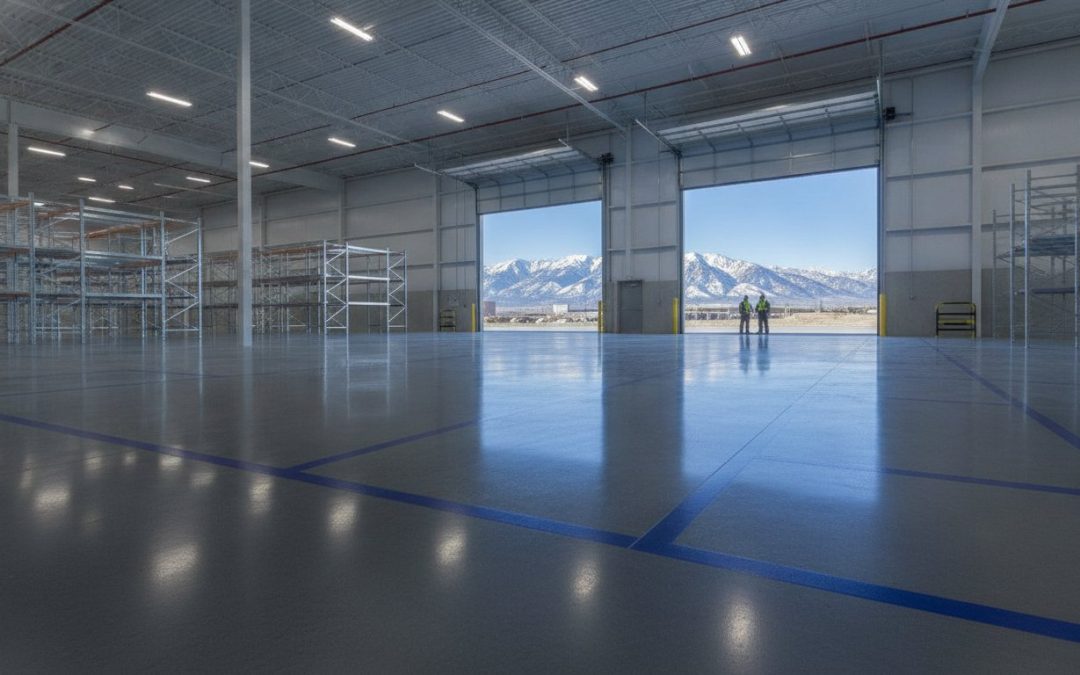
Did you know that a single safety violation on a poorly maintained industrial floor can now result in significant OSHA penalties that threaten your facility’s profitability? With 2 million square feet of industrial space currently under construction in Salt Lake City, the demand for efficient and compliant operations is reaching a fever pitch. You likely already feel the frustration of concrete dust settling on your expensive inventory or the constant worry that a slippery surface will lead to a preventable workplace injury. Your floor shouldn’t be a liability that disrupts your daily workflow. Selecting the high-performance warehouse floor coatings Utah professionals trust is the most effective way to turn a high-maintenance slab into a durable, strategic asset.
We’re here to help you navigate the latest industrial flooring standards and climate-resilient technologies. This guide will show you how to protect your facility from moisture vapor issues and heavy equipment wear while lowering your long-term maintenance costs. We’ll explore the shift toward rapid-cure polyaspartic systems and specialized coatings designed specifically for our unique Utah environment. From improving safety to creating a professional aesthetic for client walk-throughs, you’ll learn exactly how to optimize your warehouse for the years ahead.
Key Takeaways
- Learn why Utah’s extreme temperature swings and winter road salts require specialized protection to prevent permanent concrete degradation.
- Compare the high-impact durability of industrial epoxy with the rapid return-to-service benefits of polyaspartic systems to minimize your facility’s downtime.
- Discover tailored warehouse floor coatings Utah businesses use to meet specific sector needs, including ESD protection for tech facilities and high-traffic solutions for logistics hubs.
- Understand why professional surface preparation, including mechanical diamond grinding and moisture vapor testing, is the only way to ensure a lifelong industrial bond.
- See how investing in a seamless, non-porous floor increases your property’s lease value while slashing long-term cleaning and maintenance costs.
Why Utah Warehouses Demand Specialized Floor Coatings
Utah’s industrial landscape is growing at a rapid pace, but your concrete slab is under constant attack from the elements. Between the scorching summers and the brutal winters along the Wasatch Front, standard concrete simply cannot hold up without professional protection. High-performance warehouse floor coatings Utah owners rely on act as a specialized barrier system, shielding the porous concrete from chemical penetration, abrasion, and environmental stress. These systems are not just aesthetic upgrades; they are essential engineering solutions that preserve the structural integrity of your facility.
The Impact of the Utah Climate on Industrial Slabs
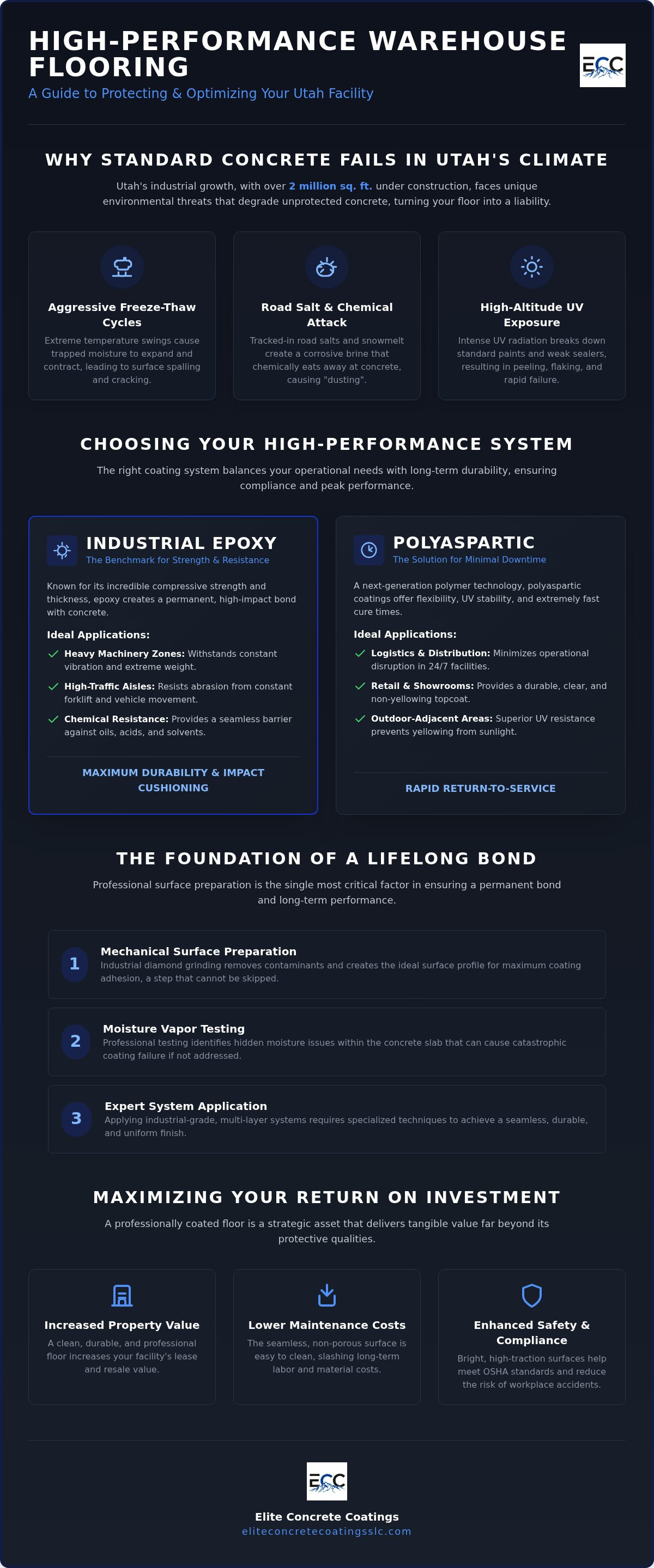
The Wasatch Front experiences some of the most aggressive freeze-thaw cycles in the country. As temperatures swing from freezing nights to sunny afternoons, moisture trapped inside unprotected concrete expands and contracts, leading to internal pressure and eventual surface spalling. Our high-altitude UV exposure also plays a role; it quickly breaks down the chemical bonds in standard floor paints, causing them to flake and peel. Unlike thin paints, a professional seamless polymer flooring system bonds deep into the substrate, providing the durability needed to withstand these thermal shifts. Standard retail products often fail in our low-humidity environment because they lack the industrial-grade adhesion required for high-stress applications.
Beyond the weather, operational hazards like road salt and snowmelt tracked into Salt Lake City facilities create a corrosive brine that eats away at the concrete. This leads to “concrete dusting,” where the top layer of the slab breaks down into a fine, abrasive powder. This dust doesn’t just make the floor look dirty. It settles on your inventory, clogs machinery filters, and creates a respiratory nuisance for your team. Investing in warehouse floor coatings Utah specialists install ensures that your inventory remains clean and your equipment stays functional.
Operational Benefits: Safety, Durability, and Light Reflectivity
A coated floor does more than just protect; it optimizes your entire workflow. Light reflectivity refers to the percentage of light that bounces off the floor surface rather than being absorbed, which significantly brightens the workspace and improves visibility for forklift operators. This increased brightness can help lower energy costs in large SLC facilities by reducing the need for high-output overhead lighting. Additionally, these systems are engineered to improve forklift traction and reduce tire wear, ensuring your fleet stays moving safely. Choose a solution that stands up to the heavy loads and high-traffic demands of the modern logistics sector.
Comparing Warehouse Coating Systems: Epoxy vs. Polyaspartic
Choosing the right material for your facility is a balance between operational needs and long-term durability. While we’ve already discussed why our local climate is so demanding, your daily operations dictate which resinous system will perform best under pressure. Compliance with OSHA Regulation 1910.22 requires walking-working surfaces to be maintained in a clean, safe, and dry condition. Professional warehouse floor coatings Utah facility managers choose are designed to meet these safety standards while handling the specific stresses of your industry.
When to Choose Industrial Epoxy
Epoxy remains the classic choice for heavy manufacturing. It’s famous for its high-impact resistance and incredible compressive strength, making it the backbone of many industrial floors. When we apply epoxy, it creates a permanent chemical bond with the concrete substrate. This makes it ideal for:
- Heavy machinery zones where vibration and weight are constant.
- High-traffic aisles that see constant forklift movement.
- Areas requiring extreme chemical resistance against oils, acids, and solvents.
Maintenance is straightforward; a seamless epoxy floor prevents liquids from seeping into the slab, meaning simple mopping keeps the surface looking professional for years. It’s a reliable, heavy-duty solution for those who prioritize maximum thickness and impact cushioning. If you’re weighing your surface options, our detailed comparison of epoxy vs polished concrete warehouse floors breaks down the long-term durability and maintenance differences to help you make the most informed decision.
The Polyaspartic Advantage for Fast Return-to-Service
For high-volume logistics hubs along the Wasatch Front, downtime is the enemy. Polyaspartic coatings are the modern solution for businesses that can’t afford to shut down for a week. These systems allow you to resume full operations, including heavy forklift traffic, in as little as 24 hours. They also offer superior UV stability, which is vital for loading docks where sunlight often causes traditional epoxy to yellow or chalk over time. While epoxy relies on a slower exothermic reaction that can take days to fully harden, polyaspartics utilize a unique aliphatic chemistry that triggers a rapid cross-linking process, reaching full strength in a fraction of the time.
For facilities dealing with extreme temperature changes, such as food and beverage cold storage, urethane cement is often the best choice. It handles “thermal shock” when floors are steam-cleaned or when freezer doors are opened frequently. All these modern warehouse floor coatings Utah experts install feature low VOC levels, ensuring your air quality remains safe during and after the application. If you aren’t sure which system fits your specific workflow, we can help you design a custom warehouse coating system that balances speed and strength. For a deeper look at how to engineer surfaces that handle forklift loads and meet current OSHA friction standards, explore our comprehensive guide to heavy duty warehouse flooring.
Industry-Specific Solutions for Utah’s Business Sectors
Utah’s industrial landscape is diverse, ranging from heavy manufacturing in Ogden to high-speed logistics in Salt Lake City. Each sector faces unique operational pressures that a standard concrete floor simply can’t handle. High-quality warehouse floor coatings Utah professionals recommend are tailored to these specific environments, ensuring your facility meets industry-standard performance metrics. Whether you’re managing a food distribution center requiring thermal shock resistance or a shipping hub that sees thousands of forklift cycles daily, the right coating system is a strategic operational choice. We understand that a one-size-fits-all approach doesn’t work for the Wasatch Front’s complex business needs.
ESD Coatings for Electronics and Cleanrooms
Silicon Slopes has turned Lehi and Provo into a global tech powerhouse. For electronics manufacturing and cleanrooms, static electricity is a silent killer of delicate components. Our ESD coatings provide a controlled path for static discharge to travel safely to the ground. This isn’t just about floor protection; it’s about protecting your high-value tech assets and maintaining strict quality control standards. Grounding industrial ESD systems requires meticulous precision. The process involves conductive primers and specialized grounding points to ensure the entire surface remains dissipative, meeting the rigorous demands of modern tech facilities.
Non-Slip and Safety Line Striping
Safety and efficiency go hand-in-hand in a modern warehouse. Integrating permanent safety line striping directly into your non-slip coatings creates a safer environment that never needs the constant repainting of standard floor tape. Per OSHA guidelines, using yellow for traffic lanes and red for fire hazards is a standard practice that reduces workplace accidents. We’ve seen local facilities drastically improve their workflow by clearly defining pedestrian walkways and forklift zones. Adding slip resistant concrete coatings with specialized additives to these warehouse floor coatings Utah businesses use ensures that even in our snowy winters, your team stays upright and productive. This proactive approach to safety minimizes liability and keeps your operations running without the disruption of preventable slips or collisions.
For those in the food and beverage sector, specialized systems handle the growth of Utah’s distribution network. These environments require non-porous surfaces that resist bacterial growth and stand up to aggressive cleaning protocols. Utah food service facilities face similar slip hazards to industrial warehouses, and our non-slip coatings for commercial kitchens address the unique ANSI DCOF requirements and FDA Food Code compliance standards that high-volume food preparation areas demand. By choosing a system designed for your specific industry, you’re investing in a long-term solution that supports your business’s growth and safety goals.
The Professional Installation Process in Utah
The longevity of industrial flooring isn’t determined by the topcoat alone. It’s won or lost in the preparation phase. For high-performance warehouse floor coatings Utah facilities require, the installation must be treated as a precise engineering project rather than a simple surfacing job. We’ve seen too many slabs fail because of shortcuts taken during the initial stages. A professional installation ensures the polymer system becomes a permanent part of the concrete structure, capable of withstanding the rigors of heavy logistics and manufacturing.
Surface Preparation: The Secret to Long-Term Adhesion
Mechanical diamond grinding is the gold standard for industrial surface preparation. While some may suggest acid etching, that method often fails to remove laitance, which is the weak, milky layer of cement dust on the surface of new or old concrete. We use industrial HEPA-filtered grinders to strip away this layer and open the concrete pores, creating a rough profile that allows the resin to “bite” into the slab. This mechanical bond is far superior to any chemical alternative. Before the first drop of resin touches the floor, we meticulously repair existing cracks and spalls. For facilities with slabs that have settled or become uneven, you can discover RiseLock Concrete Lifting to restore the surface height before the coating is applied. This ensures a level, seamless finish that won’t telegraph imperfections through the new coating. Using vacuum-shrouded equipment keeps your facility clean and protects your inventory from airborne silica dust during the process.
Utah’s unique geography, especially along the Wasatch Front, means groundwater levels can fluctuate significantly. Moisture vapor transmission (MVT) is a leading cause of coating delamination. If moisture is trapped under the coating, it creates hydrostatic pressure that can literally blow the floor off the slab. We perform rigorous testing to identify these risks before they become problems. The Calcium Chloride test measures the amount of moisture vapor emitting from a concrete slab over a 72-hour period to determine if a specialized moisture vapor barrier is required. By addressing high-moisture slabs with a dedicated primer, we ensure the system remains stable even during our wettest spring seasons.
The final “weak links” in any warehouse floor are the control joints. We use high-grade joint sealants to fill these gaps, allowing for natural concrete movement while preventing debris from collecting in the cracks. Once the joints are stabilized, we apply a multi-layer system: a deep-penetrating primer, a high-build base coat, optional texture or flake for slip resistance, and a durable topcoat. This layered approach creates a thick, resilient shield that handles everything from pallet jack traffic to chemical spills. If you’re ready to secure your facility with a system built to last, schedule a professional site evaluation to see how our installation process sets us apart.
Maximizing the ROI of Your Warehouse Floor Coating
High-performance warehouse floor coatings Utah facility owners invest in are more than just a surface treatment; they are a strategic financial asset. In a market where 2 million square feet of industrial space is currently under construction in Salt Lake City, having a pristine, professional floor significantly boosts the resale or lease value of your real estate. Potential tenants and buyers look for move-in-ready spaces that won’t require immediate, costly repairs. A seamless floor proves that the property has been meticulously maintained, often commanding higher lease rates than buildings with cracked, dusty concrete.
Beyond the property value, the daily operational savings are substantial. Because the surface is non-porous, dirt and spills stay on top rather than soaking into the slab, which slashes cleaning labor costs. You’ll also notice a difference in your fleet maintenance. Smoother flooring reduces the constant vibration that wears down forklift tires and drains batteries prematurely. It’s a long-term solution that pays for itself through reduced overhead and improved equipment longevity. By protecting the slab now, you avoid the heavy costs of concrete replacement in the future. Facility managers looking to benchmark their investment can reference our 2026 industrial guide to heavy duty warehouse flooring for a detailed breakdown of system longevity and cost comparisons.
Maintenance Best Practices for Industrial Coatings
Keeping your floor in peak condition is simple if you follow a consistent schedule. We recommend a daily sweep to remove abrasive grit and a weekly damp mop with a pH-neutral cleaner. Avoid aggressive solvents or acidic agents that can dull the resinous finish over time. Watch for high-traffic “wear paths” in your loading zones. If the shine begins to fade, a simple “refresh” topcoat can be applied. This proactive step prevents the base layers from being exposed and saves you from the cost of a full re-installation down the road.
The Strategic Advantage of Choosing a Local Expert
Choosing a partner who understands the local landscape makes all the difference. Elite Concrete Coatings is a family-owned business with a deep commitment to the Wasatch Front. We aren’t a national franchise; we’re your neighbors who understand Utah’s 2024 International Building Code requirements that went into effect in July 2026. From Salt Lake City to Ogden and Provo, we bring the technical prowess of a large contractor with the personalized care of a local shop. We take pride in transforming high-stakes industrial spaces into efficient, safe, and beautiful environments. Schedule your warehouse floor consultation with Elite Concrete Coatings today to see how we can protect your industrial assets and optimize your operations with the most durable warehouse floor coatings Utah has to offer.
Secure the Future of Your Industrial Facility
Your warehouse floor is the foundation of your entire operation; it shouldn’t be a source of constant maintenance or safety concerns. We’ve explored how Utah’s extreme climate demands more than a standard finish. By prioritizing professional mechanical preparation and choosing climate-resilient materials like polyaspartic or ESD systems, you ensure your facility remains compliant and efficient. Investing in the right warehouse floor coatings Utah experts provide is a strategic move that protects your equipment, your inventory, and your people for years to come.
As a family-owned business, we take immense pride in serving our neighbors across Salt Lake City, Ogden, and Provo. We specialize in high-performance resinous systems that stand up to the unique stressors of the Wasatch Front. Our team is ready to help you transform your workspace into a durable, professional asset that reflects the quality of your brand. Get a Free Quote for Your Utah Warehouse Flooring Project today. Let’s build a floor that works as hard as you do.
Frequently Asked Questions
How long does a warehouse floor coating typically last in Utah?
A professionally installed warehouse floor coating typically lasts between 15 and 20 years in a Utah industrial environment. This lifespan depends on your daily traffic volume and commitment to regular maintenance. Our local climate introduces unique stressors like road salt and extreme temperature shifts, so we use high-performance resinous materials designed for these conditions. Regular topcoat refreshes can extend the system’s life even further, preventing the need for a full replacement.
Can you apply floor coatings over old or cracked concrete?
Yes, professional coatings are an excellent way to restore and protect aging concrete surfaces. We begin by using industrial diamond grinding to remove the compromised top layer and expose fresh concrete for a stronger bond. Our team then uses high-performance fillers to bridge existing cracks and smooth out spalled areas before the resin is applied. This process transforms a deteriorating slab into a seamless, high-strength surface that performs like new concrete.
How much does industrial warehouse floor coating cost per square foot in Salt Lake City?
The total investment for warehouse floor coatings Utah businesses choose depends on several variables, including the total square footage, the current condition of the concrete, and the specific system required for your operations. While we don’t provide flat per-square-foot rates without a site visit, we focus on delivering long-term value through durability. Factors like moisture mitigation needs and specialized ESD requirements will also influence the final project scope for your Wasatch Front facility.
What is the difference between industrial-grade coatings and standard floor paints?
Industrial-grade coatings are significantly more durable than standard floor paints due to their high solids content and chemical composition. While common paints sit on the surface and are prone to flaking, professional resinous systems create a deep mechanical bond with the concrete. This results in a much thicker, impact-resistant shield that doesn’t peel under the weight of heavy machinery. These specialized warehouse floor coatings Utah experts install provide the necessary longevity that standard finishes cannot match.
How long is the downtime for a professional warehouse floor installation?
Operational downtime varies based on the coating chemistry selected for your project. Polyaspartic systems are specifically designed for rapid return-to-service, often allowing for full forklift traffic in as little as 24 hours. Traditional epoxy systems typically require a longer curing window, often three to seven days, to reach their maximum chemical resistance. We coordinate closely with your team to schedule applications during low-activity periods to ensure your Salt Lake City facility remains productive.
Are warehouse floor coatings slippery, and how can we improve safety?
While smooth resinous floors can be slippery when wet, we incorporate specialized non-slip additives to ensure a safe working environment. These slip-resistant textures are customized based on your specific needs, such as loading docks exposed to Utah snow or areas prone to oil spills. Using these additives helps your facility meet safety standards while maintaining an easy-to-clean surface. We also integrate permanent safety line striping to clearly define pedestrian walkways and forklift zones. Facilities in the food service industry face even greater slip hazards from grease and water; our guide to non-slip coatings for commercial kitchens covers the specialized ANSI DCOF standards and seamless resinous systems required for those high-risk environments.
What is the best coating for a warehouse with heavy forklift traffic?
High-build industrial epoxy is often the best choice for areas with heavy forklift traffic due to its incredible compressive strength and impact resistance. For facilities along the Wasatch Front that require faster turnaround times and superior abrasion resistance, polyaspartic coatings are an excellent alternative. Both systems are designed to protect the underlying concrete from the constant grinding of wheels and heavy pallet loads. We often recommend a hybrid system to provide the best balance of strength and longevity.
Does Utah’s climate affect the curing process of industrial coatings?
Utah’s low humidity and drastic temperature shifts play a significant role in how resinous materials cure. Our local installers adjust the chemical catalysts in our warehouse floor coatings Utah systems to account for current atmospheric conditions. Whether it’s the intense summer heat in Lehi or the freezing winter nights in Layton, we use specialized formulations that ensure a perfect cure every time. This expertise prevents common failures like bubbling or improper hardening that occur when using generic products. For a comprehensive breakdown of how traction ratings and DCOF standards apply to your facility, our ultimate guide to slip resistant concrete coatings covers the latest 2026 safety benchmarks and engineered solutions for Utah’s demanding climate conditions.