
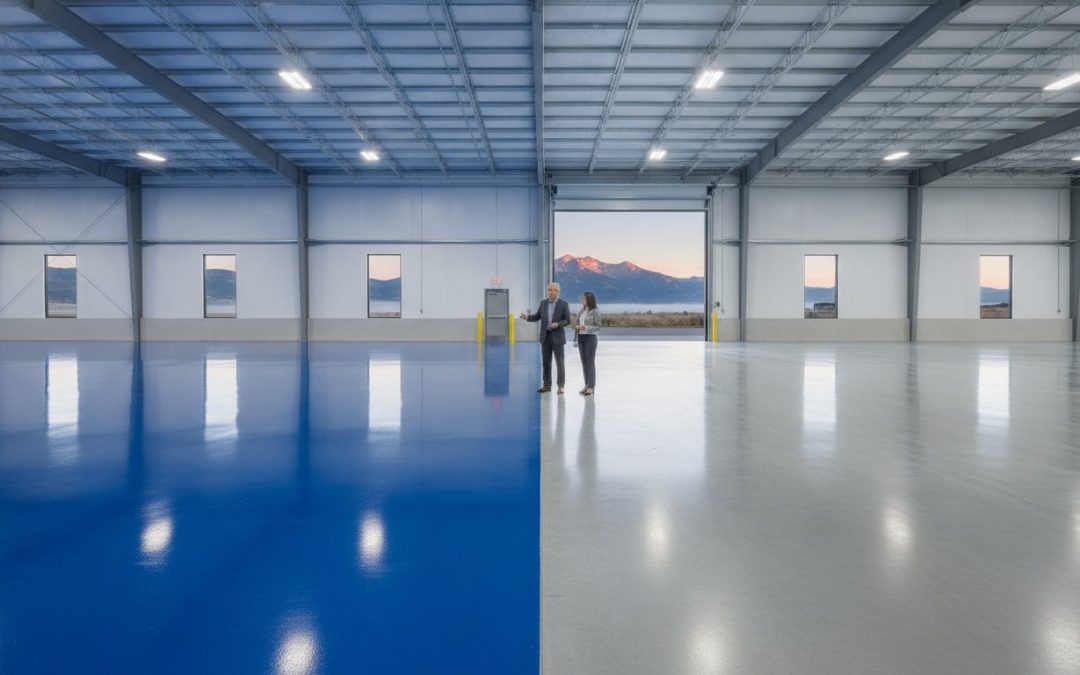
The most expensive warehouse floor isn’t the one with the highest installation cost; it’s the one that forces your operations to stop for repairs every few years. As Utah’s logistics sector faces tighter OSHA inspections through July 2026, the choice between an epoxy vs polished concrete warehouse floor has never been more critical for your bottom line. You need a surface that stands up to heavy loads without delaminating and keeps your team safe from slip hazards.
It’s frustrating to watch untreated concrete turn into a source of constant dust and staining, especially when you’re trying to maintain a professional, high-performance facility in the Salt Lake Valley. We understand that you want a floor that lasts well over a decade while reflecting enough light to keep your space bright and safe. This article compares the durability, maintenance, and long-term performance of industrial coatings and mechanical polishing. You’ll discover which solution offers the best resistance to chemical spills and which provides the 30% boost in light reflectivity your facility needs to stay compliant and efficient.
Key Takeaways
- Define the fundamental difference between mechanical diamond grinding and resinous wear layers to choose the right foundation for your Utah facility.
- Learn how professional polished concrete eliminates the headache of concrete dusting while boosting your facility’s ambient light reflectivity by up to 30 percent.
- Identify the specific chemical and acid resistances provided by industrial epoxy coatings to protect your slab from permanent oil staining and heavy load damage.
- Navigate the epoxy vs polished concrete warehouse decision using a professional framework that weighs daily forklift traffic against your specific maintenance goals.
- Discover how to maximize your floor’s 20 year lifespan by integrating critical additions like joint sealants and high quality professional surface preparation.
The Warehouse Flooring Dilemma: Epoxy or Polished Concrete?
Choosing the right surface for your facility isn’t just about aesthetics; it’s a strategic operational decision. In the debate of epoxy vs polished concrete warehouse solutions, the winner depends entirely on your daily workflow. Polished concrete is a mechanical refinement process. It uses heavy-duty grinders and diamond abrasives to hone the existing slab, closing the pores and creating a dense, reflective finish. This strengthens the concrete from within rather than adding a layer on top.
Epoxy systems take a different approach. These are resinous warehouse coatings that create a completely new, non-porous wear layer over the slab. While polishing relies on the strength of the existing concrete, epoxy acts as a topical shield. This distinction is the core of your dilemma: do you need to harden what you already have, or do you need a protective barrier to block out chemicals and oils?
Why Your Choice Matters for Utah Logistics
Utah’s climate presents unique challenges for industrial floors. Along the Wasatch Front, massive temperature swings cause concrete slabs to expand and contract. If a floor system doesn’t account for this movement, you’ll see cracks or delamination. Beyond durability, your choice impacts your utility bills. Polished concrete can improve ambient light reflectivity by up to 30 percent, which aligns perfectly with the decarbonization goals of LEED v5 standards active in 2026. Higher reflectivity means you can achieve OSHA-compliant brightness with fewer overhead fixtures, directly lowering your energy consumption.
The Role of Slab Condition in Your Decision
You can’t always polish your way out of a “bad” slab. If your concrete is soft, porous, or has significant structural damage, mechanical polishing may not produce the results you expect. At Elite Concrete Coatings, we start by assessing the integrity of your local Utah slab. We look for specific red flags, such as high Moisture Vapor Transmission (MVT). If moisture levels are too high, a standard epoxy might fail, requiring specialized moisture-mitigation primers instead. We help you determine if your floor is a candidate for the diamond-grinding process or if a high-build resinous system is necessary to level and protect the surface. Professional testing ensures you don’t invest in a system that your concrete can’t support.
Polished Concrete: The Mechanical Strength Solution
When you choose professional polished concrete, you aren’t just cleaning the floor; you’re changing the concrete’s molecular structure. The process begins with aggressive grinding to remove the soft “cream” layer of the slab. We then apply a chemical densifier that penetrates deep into the pores. This densifier reacts with the calcium hydroxide in the concrete to create calcium silicate hydrate, the same substance that gives concrete its primary strength. By filling these microscopic voids, the process permanently eliminates concrete dusting, which is a major source of inventory damage and respiratory issues in Utah facilities.
This mechanical refinement creates a permanent surface change. Unlike coatings that eventually wear away, a polished surface is the slab itself, only harder and more dense. It’s a sustainable choice that utilizes your existing materials, significantly reducing the carbon footprint of your facility renovation. This alignment with LEED v5 standards makes it a forward-thinking choice for 2026 logistics hubs.
Performance Under Heavy Forklift Traffic
Forklifts are the ultimate test for any industrial floor. Because polished concrete is a mechanical refinement of the slab rather than a topical film, there is no material to delaminate or peel under the shearing force of heavy loads. It’s incredibly resilient against tire marks and the “burnishing” effect that often occurs when heavy equipment maneuvers on softer, untreated concrete. To maximize this durability, we focus on the details that matter:
- Edge Protection: Using specialized grinders to ensure consistency near walls and columns.
- Joint Integrity: Applying industrial-grade joint sealants to prevent edge spalling under forklift impact.
- Hardness Testing: Verifying the slab’s Mohs hardness to ensure the polish will hold up to your specific traffic volume.
Maintenance Requirements for Polished Floors
Maintenance is where this system delivers its greatest value to facility managers. Your daily routine is refreshingly simple. You only need a dust mop and a pH-neutral cleaner to keep the surface clear of debris. You don’t need to worry about the expensive cycles of stripping and waxing associated with older flooring tech. Over a 20 year lifespan, this simplicity leads to the lowest Total Cost of Ownership (TCO) in the epoxy vs polished concrete warehouse debate. While the shine is durable, we recommend an occasional high-speed burnish with specialized pads to restore the original luster after years of heavy use. This proactive care keeps your facility looking sharp and professional with minimal effort.
Epoxy and Resinous Coatings: The Ultimate Shield
While polished concrete strengthens the slab from within, warehouse coatings create an impenetrable topical barrier. An industrial-grade epoxy system is built in layers to provide maximum durability. It starts with a penetrating primer that bites into the concrete, followed by a thick base coat for structural build, and finishes with a high-performance topcoat. This multi-layered anatomy provides a level of impact resistance that mechanical polishing can’t match. If a heavy tool or part drops, the thick-build coating absorbs the shock, protecting the underlying slab from chips and cracks. Understanding the full industrial epoxy floor cost — including material grades, surface preparation, and resin selection — is essential before committing to a multi-layer system for your Utah facility.
This system excels in customization and operational organization. Per OSHA regulation 29 CFR 1910.176(a), permanent aisles and passageways must be appropriately marked. Resinous systems allow us to integrate safety colors and permanent striping directly into the floor. You can designate high-traffic forklift zones and pedestrian walkways with vibrant, durable pigments that won’t peel or fade like floor tape. In the epoxy vs polished concrete warehouse comparison, epoxy is the clear winner for facilities requiring strict organizational layouts and visual safety cues.
Chemical Resistance and Hygiene
For food-grade or pharmaceutical warehouses, epoxy isn’t just an option; it’s often a requirement. These chemical resinous coatings create a seamless, non-porous finish. There are no grout lines or open pores where bacteria, oils, or harsh acids can hide. If your operations involve frequent spills, a seamless surface prevents hazardous materials from seeping into the concrete and contaminating the soil below. For those requiring the highest standards of protection, Deluxe Resin Services provides premium resin flooring solutions that ensure long-term hygiene and durability. While standard epoxy is a workhorse, we often recommend polyaspartic topcoats for Utah businesses that need a faster return-to-service. Polyaspartic systems cure rapidly, allowing you to get your forklifts back on the floor in hours instead of days.
Addressing the “Peeling” Myth
Many facility managers worry about resinous systems peeling or delaminating over time. This concern usually stems from observing failures caused by improper surface preparation or the use of inferior, low-solids materials that aren’t designed for industrial stress. The secret to a permanent, high-performance bond is professional diamond grinding. We use specialized heavy machinery to open the concrete’s pores, creating a specific profile that the resin can grip. Professional preparation ensures a mechanical bond that is actually stronger than the tensile strength of the concrete itself.
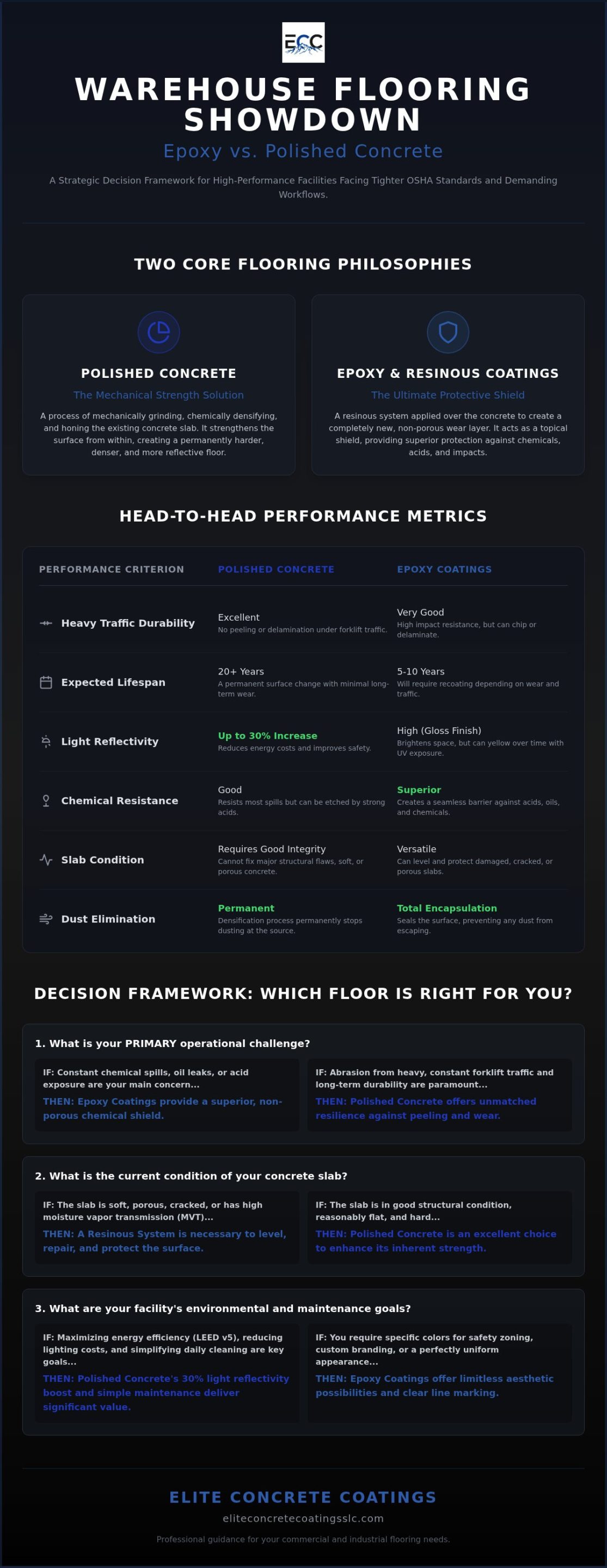
Head-to-Head: Comparing Performance Metrics
When you stack these two systems against each other, the right choice depends on your specific operational metrics. Installation downtime is often the first hurdle. Polished concrete allows for a staged approach, which is helpful if you can’t clear your entire floor at once. However, resinous systems like polyaspartic coatings offer a lightning-fast return-to-service, often allowing forklift traffic back on the floor within 24 hours. If your facility operates 24/7, that speed is a massive advantage.
Safety is another critical metric. The industry is shifting toward Dynamic Coefficient of Friction (DCOF) as the primary measure of slip resistance. Current ANSI A137.1 standards require a minimum DCOF of 0.42 for level interior floors. While polished concrete is naturally slip-resistant when dry, it can become slick when wet. In contrast, non-slip coatings allow us to broadcast specialized aggregates into the epoxy, ensuring your team stays safe even in the presence of spills or moisture.
Utah Climate Factor: Salt and Freeze-Thaw
Utah’s winters introduce a specific threat: road salt. Whether your facility is in Ogden or Provo, trucks and forklifts will track in magnesium chloride and other de-icing agents. These salts are highly corrosive to bare concrete. Because epoxy is a non-porous barrier, it completely blocks salt from reaching the slab. Polished concrete is “breathable,” which is excellent for slabs with high moisture content, but it requires a high-quality sealer to prevent salt from penetrating and causing long-term spalling. In high-moisture environments, this breathability prevents the hydrostatic pressure that can sometimes cause coatings to bubble. Facilities across the broader Intermountain West face similar challenges; the same freeze-thaw cycles that threaten Utah slabs make warehouse floor sealing Wyoming logistics operators depend on equally critical for long-term slab protection.
Zone-Based Selection: Mixing Both Systems
You don’t have to choose just one system for your entire epoxy vs polished concrete warehouse project. Many of our local clients find the best ROI by using a hybrid approach. We often design floor plans where high-abuse zones, such as loading docks and battery charging stations, receive a heavy-duty epoxy shield. Meanwhile, the main storage aisles, where light reflectivity and low maintenance are the priorities, utilize polished concrete. This strategy maximizes your budget while putting the most durable materials exactly where they’re needed most.
Ready to find the right balance for your facility? Explore our professional warehouse coatings and see how we can customize a multi-surface solution for your space.
Making the Choice: A Decision Framework for Facility Managers
Selecting the right surface for your facility requires more than a quick look at a spec sheet. It’s a strategic move that affects your operational speed for the next decade. To settle the epoxy vs polished concrete warehouse debate for your specific site, follow this professional decision framework. This logical progression ensures you don’t over-engineer a simple storage space or under-protect a high-intensity production zone.
- Step 1: Audit your chemical exposure. Identify every liquid that touches your floor. If your team handles acids, solvents, or heavy oils, you need the topical protection of an epoxy barrier. If you only deal with water or dry pallet debris, polished concrete is a strong contender.
- Step 2: Measure your traffic volume. Count your forklift rotations per hour. High-tonnage equipment moving in tight circles can eventually wear down a coating, making the internal densification of polished concrete more attractive for high-traffic aisles.
- Step 3: Evaluate your lighting and aesthetic goals. Determine if you need the 30 percent boost in light reflectivity that polishing provides. Alternatively, if your facility requires color-coded safety zones or specific branding, resinous coatings are the superior choice.
- Step 4: Determine your maximum allowable downtime. Be realistic about your schedule. Polished concrete can often be done in sections without high-odor interference. If you need a total surface transformation in a single weekend, a polyaspartic coating system is your fastest route back to full capacity.
- Step 5: Consult with a local specialist. Utah slabs have unique mineral profiles and moisture levels. A local expert like Elite Concrete Coatings can perform a hardness test and moisture probe to see which system your concrete will actually support.
When to Choose Polished Concrete
Polished concrete is the gold standard for high-volume logistics hubs, retail-warehouses, and dry storage facilities. It’s the most efficient path for managers who want to slash their long-term maintenance costs and eliminate concrete dusting forever. This system thrives in environments where “breathability” is a priority, especially for slabs with slightly higher moisture levels. Before you start, ensure your slab has the necessary hardness; soft or crumbling concrete won’t take a high-gloss finish effectively. For these durable, low-maintenance spaces, commercial polished concrete is often the smartest long-term investment.
When to Choose Epoxy Coatings
Resinous systems are essential for manufacturing plants, chemical storage areas, and any facility requiring strict sanitation. If your slab has significant surface damage, pitting, or old stains, an epoxy system acts as a high-build filler that restores a uniform, level surface. It’s the ultimate shield against the corrosive road salts tracked in during Utah winters. Don’t settle for a floor that can’t handle your specific chemical profile. Schedule a professional floor audit with Elite Concrete Coatings to get an expert recommendation tailored to your facility’s unique demands.
Future-Proof Your Utah Facility Floor
The decision between an epoxy vs polished concrete warehouse floor ultimately comes down to your facility’s specific daily demands. If you need a seamless barrier against harsh chemicals and road salt, resinous coatings are your best bet. For those prioritizing light reflectivity and the lowest possible maintenance over a 20 year lifespan, mechanical polishing is the clear winner. Your floor is the foundation of your entire operation; it affects everything from OSHA compliance to energy efficiency.
We bring specialized industrial equipment and deep local Utah expertise to every project, ensuring your slab is prepped to perfection. As a family-owned business, we take immense pride in our reliability and the lasting results we deliver for our neighbors across the Salt Lake Valley. Don’t leave your facility’s performance to chance. It’s time to invest in a surface that works as hard as you do.
Get a Free Warehouse Floor Evaluation & Quote today to ensure your space is ready for the challenges of 2026 and beyond. We look forward to helping you transform your warehouse into a safer, more efficient environment.
Frequently Asked Questions
Is polished concrete cheaper than epoxy for a large warehouse?
Polished concrete often provides a lower Total Cost of Ownership (TCO) because it utilizes your existing slab and requires less frequent replacement. While the initial investment varies based on the number of grinding steps required, the typical 20 year lifespan of polished concrete makes it the more budget-friendly choice over time. It eliminates the need for the recurring material reapplications that topical coatings eventually require.
How long does a warehouse epoxy floor last under heavy forklift traffic?
Commercial-grade warehouse coatings are generally rated for 10 to 20 years. The exact lifespan depends on your daily traffic volume and the quality of the initial professional grinding. In high-intensity Salt Lake City distribution hubs, using a thick-build system with a polyaspartic topcoat can significantly extend durability. Regular maintenance and the use of joint sealants to protect slab edges also play a massive role in longevity.
Can you turn old, damaged warehouse concrete into polished concrete?
It depends entirely on the depth of the damage and the slab’s structural integrity. While mechanical polishing can remove surface staining and minor pitting, deeply spalled or soft concrete may not take a high-gloss finish effectively. In these cases, we often recommend a grind and seal or a high-build epoxy system to level the surface. We perform hardness testing on local Utah slabs to determine if polishing is a viable solution.
Is polished concrete too slippery for a warehouse environment?
Polished concrete is generally safe when kept dry, but it can become slick when wet. The industry now prioritizes the Dynamic Coefficient of Friction (DCOF) over older static measurements. For level interior floors, a minimum DCOF of 0.42 is required per ANSI standards. If your facility in Provo or Ogden experiences frequent spills, we can apply specialized anti-slip treatments or suggest a textured epoxy system to ensure team safety.
What is the curing time for industrial epoxy before we can resume operations?
Curing times vary based on the specific resin type used. Standard epoxy systems often require 24 to 72 hours before they can handle heavy forklift traffic. However, polyaspartic coatings offer a much faster return-to-service, sometimes allowing operations to resume in as little as 24 hours. This speed is a major factor when weighing the epoxy vs polished concrete warehouse decision for facilities that cannot afford long periods of downtime.
Does polished concrete require waxing or sealing periodically?
No, true polished concrete does not require waxing or topical acrylic sealers. The process uses a chemical densifier to harden the slab from within, followed by mechanical honing to achieve the desired shine. This eliminates the expensive strip and wax cycles common with older flooring technology. You only need to perform occasional high-speed burnishing with specialized pads to maintain the floor’s luster after years of heavy industrial use.
Which flooring option is better for LEED certification in Utah?
Polished concrete is typically the superior choice for LEED v5 certification, which became the standard for all new registrations after June 30, 2026. This system emphasizes decarbonization by utilizing the existing slab and reducing the need for new raw materials. Additionally, it can improve ambient light reflectivity by up to 30 percent. This helps Utah warehouses reduce energy consumption by lowering the requirement for artificial overhead lighting.
How does road salt affect warehouse floors in Salt Lake City?
Magnesium chloride and other de-icing salts tracked in during Utah winters are highly corrosive to bare concrete. These salts can penetrate the pores of polished concrete if a high-quality penetrating sealer isn’t maintained; this often leads to surface spalling. Epoxy coatings provide a non-porous barrier that completely shields the slab from salt damage. This makes resinous systems a popular choice for loading docks in Salt Lake City and Layton where winter moisture is constant. Regional logistics operators managing multiple facilities should also review the warehouse floor sealing Wyoming industrial protection standards for 2026 to understand how neighboring states address the same freeze-thaw and salt-corrosion challenges.