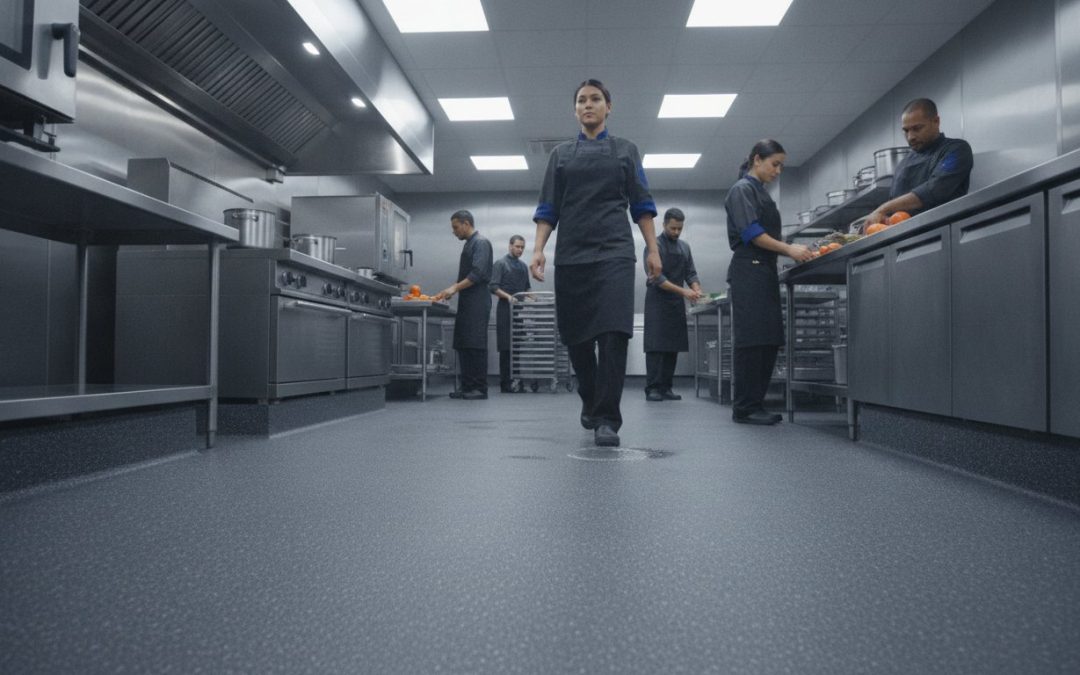
Did you know that restaurants average four workers’ compensation claims every single year due to slip-and-fall incidents? In a fast-paced Utah kitchen, a single patch of grease or a splash of soapy water can quickly turn into a liability that threatens your team and your bottom line. You already know that keeping your floors safe is a non-negotiable part of the job; however, finding a solution that actually lasts under heavy foot traffic and constant cleaning is the real challenge.
This guide shows you how professional non-slip coatings for commercial kitchens protect your staff, ensure strict health code compliance, and withstand the daily rigors of a high-volume facility. We’ll look at the technical standards for slip resistance, including the latest ANSI DCOF requirements, and explain why seamless resinous systems are the gold standard for hygiene. From managing thermal shock to meeting 2022 FDA Food Code coving regulations, you’ll discover how a professional installation creates a durable, high-performance environment without causing long periods of facility downtime.
Key Takeaways
- Discover how specialized non-slip coatings for commercial kitchens create a safer environment that exceeds OSHA standards and protects your team from costly accidents.
- Compare urethane cement and epoxy systems to determine which material provides the best thermal shock resistance for your specific cooking line and temperature shifts.
- Learn how seamless flooring and integrated coving eliminate grout lines and bacteria traps to ensure your kitchen remains fully health code compliant.
- Identify why professional-grade subfloor preparation is essential for a bond that survives heavy equipment, hot water washdowns, and high-volume traffic.
- Explore why local Utah expertise is vital for selecting a durable floor system that handles the unique demands of our regional food service industry.
The Critical Role of Slip-Resistant Flooring in Commercial Kitchens
High-performance non-slip coatings for commercial kitchens are engineered resinous systems designed to handle the most demanding environments on earth. These aren’t simple paints; they’re multi-layered solutions that bond chemically to your concrete slab. In Utah, our unique climate adds an extra layer of complexity. Our significant temperature swings and naturally dry air can cause indoor concrete slabs to expand and contract. When you add the intense heat of a commercial range and the cold of a walk-in freezer, standard flooring often fails. A professional coating acts as a resilient shield that moves with your building while providing a rock-solid grip for your staff.
The High Stakes of Kitchen Safety
Liability is a constant concern for any restaurant owner or facility manager. Data from the National Safety Council shows that over 25,000 slip-and-fall accidents happen every single day in the United States. In a kitchen, the combination of water, oils, and animal fats creates a dangerous “hydroplaning” effect. This occurs when a thin layer of liquid prevents a shoe from making contact with the floor. To prevent this, your flooring must maintain a high Dynamic Coefficient of Friction (DCOF). While many level interior floors only require a DCOF of 0.42, a greasy cooking line often needs a rating of 0.55 or higher to remain safe during a busy dinner rush.
Why Resinous Coatings Outperform Traditional Tile
Many local kitchens rely on traditional quarry tile, but this choice often leads to long-term headaches. The primary culprit is the grout. Over time, acidic grease and heavy-duty degreasers erode grout lines, causing tiles to loosen, crack, or pop out entirely. These damaged areas aren’t just trip hazards; they’re also unhygienic pockets where bacteria and moisture thrive. Choosing Commercial Non-Slip Coatings eliminates these weak points by creating a completely seamless surface from wall to wall.
Durability is the true test of any safety system. It isn’t enough for a floor to be slip-resistant on the day it’s installed; it has to stay that way after thousands of footsteps and nightly washdowns. This is why we advocate for Sustainable Slip Resistance testing to ensure the surface texture remains effective throughout its lifecycle. By opting for a professional resinous system, you’re investing in a floor that stays grit-tough and easy to clean, even under the most punishing high-volume conditions.
Urethane Cement vs. Epoxy: Which Coating Wins in a Kitchen?
Choosing the right material for your floor isn’t just about the finish; it’s about chemistry. While many people use the term “epoxy” as a catch-all, there’s a significant difference between a standard resin and a heavy-duty urethane cement. In a high-volume kitchen, the material you choose determines whether your floor lasts a decade or starts peeling within months. Selecting the best non-slip coatings for commercial kitchens requires understanding how these materials react to heat, chemicals, and the concrete slab itself.
Thermal shock is the primary reason why many kitchen floors fail. Imagine a scenario where a staff member drains a large pot of boiling pasta water directly onto a floor that’s sitting at sixty degrees. If the coating doesn’t expand and contract at the same rate as the concrete underneath, it will crack or delaminate. This creates a safety hazard that might violate OSHA safety standards regarding floor maintenance. Additionally, moisture vapor transmission from the ground can build up pressure under a non-breathable floor, leading to bubbles and bond failure.
The Power of Urethane Cement
Urethane cement is a specialized hybrid material that combines polymer resin with portland cement and aggregate. It’s the gold standard for high-output environments because it is virtually immune to thermal shock. It also provides incredible resistance to organic acids, animal fats, and heavy grease that can eat through lesser coatings. For 24/7 operations, this material offers the best longevity because it handles moisture vapor transmission from the subfloor better than almost any other option. It’s a proactive choice for owners who want a “set it and forget it” solution that stays tough under pressure.
When to Consider High-Build Epoxy
Standard epoxy still has a vital place in your facility. For dry storage areas, employee breakrooms, or light-duty prep stations where thermal shock isn’t a factor, Resinous Commercial Flooring using high-build epoxy is an excellent choice. These systems are highly customizable. We can broadcast quartz or sand aggregates into the resin to achieve the exact level of texture your team needs. It results in a beautiful, durable finish that is easy to sanitize and maintains its grip over time. The same high-build epoxy technology used in commercial kitchens also forms the foundation of professional airport hangar floor finishes, where chemical resistance and slip prevention are equally critical in Utah’s demanding aviation environments.
If you aren’t sure which system fits your specific layout, you can explore our specialized non-slip coatings to see how we tailor each project to the unique needs of Utah businesses. Making the right choice now prevents business interruption later.
Beyond Safety: Hygiene and Health Code Compliance
Safety keeps your staff on their feet, but hygiene keeps your doors open. In Utah, health inspectors follow the 2022 FDA Food Code, which sets strict requirements for surface characteristics in food preparation areas. Specifically, Section 6-101.11 mandates that floors must be smooth, durable, and easily cleanable. While traditional tile might seem compliant at first, those porous grout lines quickly become breeding grounds for bacteria, mold, and even pests. High-performance non-slip coatings for commercial kitchens solve this by creating a non-porous, monolithic shield that prevents contaminants from soaking into the concrete slab. Following the CDC-NIOSH slip prevention guidelines helps ensure your facility remains a safe and productive environment for your culinary team while exceeding local sanitation standards.
Seamless Integration and Cove Basing
The transition where the floor meets the wall is a critical inspection point. Standard baseboards often leave small gaps where moisture and organic matter collect, leading to hidden rot and odor. To eliminate this, we utilize “cove basing” to create a continuous, curved transition from the floor up the wall. Most local health codes require this coving to have at least a 3/8-inch radius and extend 4 inches up the wall. This design eliminates hard-to-clean 90-degree corners, making it easy to power wash the entire room. For areas requiring a streamlined aesthetic without sacrificing performance, our Neat Flooring systems provide a smooth yet slip-resistant finish that inspectors love to see.
Chemical Resistance and Sanitation
Commercial kitchens are harsh chemical environments. Every night, your floors are subjected to aggressive degreasers, heavy-duty sanitizers, and industrial cleaning agents. If your coating isn’t chemically resistant, these substances will eventually soften the resin, leading to staining or peeling. Our chemical resinous coatings are specifically formulated to withstand these daily chemical assaults without losing their structural integrity. We can also incorporate antimicrobial additives directly into the resin to provide an extra layer of protection against food-borne pathogens. This ensures your floor stays compliant for years, even in high-volume facilities that require constant washdowns. Proper drainage is also key; your floor must be sloped toward drains at a rate of 1/4 inch per foot to prevent standing water, a common red flag during health inspections.

The Professional Installation Process: Durability Without the DIY Risk
Professional grade non-slip coatings for commercial kitchens require much more than a simple roller and a bucket. In environments defined by high heat and constant moisture, the bond between the coating and the concrete is the single most common point of failure. While retail-grade kits often promise a quick fix, they lack the chemical density and adhesion properties needed to survive industrial dishwashers or hot oil spills. A professional installation ensures that the system becomes an integrated part of your building structure. This prevents the peeling and delamination that plague inferior products and can lead to dangerous trip hazards.
Mechanical Surface Preparation
Success starts with the subfloor. We use heavy-duty diamond grinding equipment to open the pores of the concrete, creating a specific Concrete Surface Profile (CSP). This mechanical bond is far superior to acid etching, which often fails to penetrate deep enough for industrial-strength resins. Before any material is applied, we identify and repair every hairline crack or spall to prevent future moisture intrusion. This meticulous attention to detail ensures your floor remains a seamless, stable platform for your entire culinary team for years to come. Facility managers who want to explore additional concrete surface options for adjacent spaces often consult with experienced polished concrete contractors to determine whether a light-reflective, low-maintenance polish is appropriate for dining rooms or dry storage areas connected to the kitchen.
Layering for Performance
A high-performance floor is a multi-layered system designed for maximum resilience. We apply a moisture-tolerant base coat followed by a precise broadcast of non-slip aggregates like quartz or sand. This texture provides the essential grip your staff needs in greasy or wet conditions. To finish, we seal the system with a high-durability, polyaspartic topcoat. This layer is UV-stable and incredibly resistant to abrasions from heavy equipment and foot traffic. We then verify the surface for consistent texture to ensure it meets safety standards across every square foot of your kitchen.
Minimizing downtime is a top priority for any busy Utah restaurant. Using fast-curing polyaspartic technology allows us to get your kitchen back in operation much faster than traditional resins. This means you can have a world-class, hygienic floor installed during a short closure without sacrificing the quality of the bond. If you want to ensure your facility remains safe and compliant, schedule a professional consultation for slip resistant concrete coatings to see how our team can transform your space with minimal business interruption.
Elite Concrete Coatings: Local Expertise for Utah’s Food Industry
Elite Concrete Coatings isn’t just another contractor. We’re a family-owned and operated Utah business with deep roots in the communities we serve. When we install non-slip coatings for commercial kitchens, we aren’t just finishing a job; we’re helping a local neighbor protect their staff and their reputation. From the bustling restaurant rows in Salt Lake City to the growing tech hubs of the Silicon Slopes and down into Provo, we understand the high-stakes pressure of the Utah food industry. We take pride in our craftsmanship because we know that a safe, hygienic floor is the foundation of every successful culinary operation along the Wasatch Front.
Serving the Wasatch Front
Our local experience extends across a wide variety of industrial environments. We’ve mastered the art of high-performance flooring through years of installing warehouse concrete coatings and heavy-duty industrial systems. This background gives us a unique advantage in the kitchen. We understand the logistical hurdles restaurant owners face, such as tight operating windows and the need for immediate results. Our team works with your schedule to ensure that your safety upgrade happens with as little business interruption as possible. You can explore our full range of commercial services to see how we tailor our solutions to meet the specific demands of Utah’s hospitality sector. Utah’s dry climate also creates unique static electricity challenges in adjacent tech and manufacturing spaces, which is why facility managers in the Silicon Slopes often pair kitchen safety upgrades with static dissipative floor coatings engineered to protect sensitive electronic components.
Ready for a Safety Upgrade?
The journey to a safer, more compliant facility begins with a professional site evaluation. Every concrete slab has its own history; every kitchen has unique traffic patterns and thermal challenges. We don’t believe in one-size-fits-all solutions. Our experts visit your facility to assess the condition of your substrate and recommend the specific non-slip coatings for commercial kitchens that will provide the best long-term value. This personalized approach ensures your investment yields a floor that is durable, easy to clean, and fully compliant with Utah health standards.
Protecting your staff is about more than just checking a box on a safety list. It’s about creating an environment where your team can perform at their best without the fear of a slip or fall. Investing in a professional-grade floor system is a proactive step that safeguards your business against liability and ensures years of reliable service. Reach out to Elite Concrete Coatings today to start your transformation. Let’s build a safer foundation for your kitchen together.
Build a Safer Foundation for Your Utah Kitchen
A high-performance floor is more than just a surface; it’s a critical safety tool for your entire team. By choosing specialized non-slip coatings for commercial kitchens, you’re investing in a system that survives thermal shock, resists aggressive chemicals, and exceeds health department hygiene standards. We’ve explored why professional-grade urethane cement outperforms standard tile and how meticulous mechanical preparation ensures your floor won’t peel or crack under pressure. These technical choices directly impact your facility’s safety and long-term durability.
At Elite Concrete Coatings, we’re proud to be a family-owned and operated Utah business with deep expertise in high-traffic industrial environments. Whether you’re running a busy line in Salt Lake City or a high-volume prep facility in Provo, we understand the unique demands of the Wasatch Front’s culinary scene. Our team is ready to help you transform your space into a seamless, hygienic, and slip-resistant environment that protects your staff and your bottom line. Don’t wait for a slip-and-fall accident to happen before taking action.
Upgrade your kitchen safety-Contact Elite Concrete Coatings today! We look forward to helping your business thrive with a professional floor that stands the test of time.
Frequently Asked Questions
What is the best non-slip floor coating for a greasy kitchen?
Urethane cement is the superior choice for greasy environments because it resists animal fats and organic acids that degrade standard resins. It provides a dense, durable surface that maintains its grip even when saturated with oil. In high-volume facilities from Salt Lake City to Provo, this material is the gold standard for long-term safety. It ensures your team remains stable during the most demanding dinner rushes without the risk of delamination.
How long does a professional kitchen floor coating installation take?
A professional installation typically requires two to three days, depending on the size of the kitchen and the level of floor preparation needed. We prioritize efficiency to minimize your operational downtime in the Wasatch Front. By using fast-curing polyaspartic topcoats, we can often return the floor to service much faster than traditional epoxy systems. This allows your business to reopen quickly with a fully cured, high-performance safety surface.
Are non-slip kitchen floors harder to clean and sanitize?
Non-slip floors are actually easier to sanitize because they eliminate the porous grout lines found in traditional tile. While the surface has a textured grit for safety, the resin itself is non-porous and resistant to bacteria growth. You can easily power wash or use industrial degreasers without worrying about moisture seeping into the substrate. This creates a more hygienic environment that meets the high standards of local health inspectors in Lehi and Layton.
Can you apply non-slip coatings over existing kitchen tile?
We strongly recommend removing existing tile rather than coating over it. For a non-slip system to perform correctly, it must bond directly to a mechanically prepared concrete slab. Coating over tile introduces a significant risk of failure if the underlying thin-set or grout begins to crack or loosen. Our team in West Jordan and South Jordan specializes in full surface restoration to ensure your new floor has a permanent, industrial-strength bond.
What is thermal shock, and why does it cause floor failure?
Thermal shock occurs when a floor experiences rapid temperature changes, such as draining boiling water or blast-chilling a room. If the coating doesn’t expand and contract at the same rate as the concrete, it will lose its bond and begin to peel. This is why we recommend urethane cement for kitchens in Syracuse and Spanish Fork. It shares a similar thermal expansion coefficient with concrete, preventing failure during intense temperature fluctuations.
How often do commercial kitchen floors need to be recoated?
Most high-quality non-slip coatings for commercial kitchens last between five and ten years before requiring a professional topcoat refresh. The exact lifespan depends on your facility’s daily traffic volume and cleaning protocols. Regular maintenance and using the correct industrial cleaners will extend the life of the system. We provide site evaluations across the Wasatch Front to help you determine the optimal time for a maintenance coat to preserve your floor’s safety properties.
Does the Utah Health Department require specific kitchen flooring?
The Utah Health Department requires flooring that is non-porous, durable, and easily cleanable. Current 2026 standards emphasize the need for integrated coving, which creates a seamless transition between the floor and the wall to prevent bacteria accumulation. Our systems are specifically designed to exceed these local regulations in Salt Lake City and surrounding areas. We ensure your facility stays compliant with the latest FDA Food Code requirements for food preparation surfaces.