
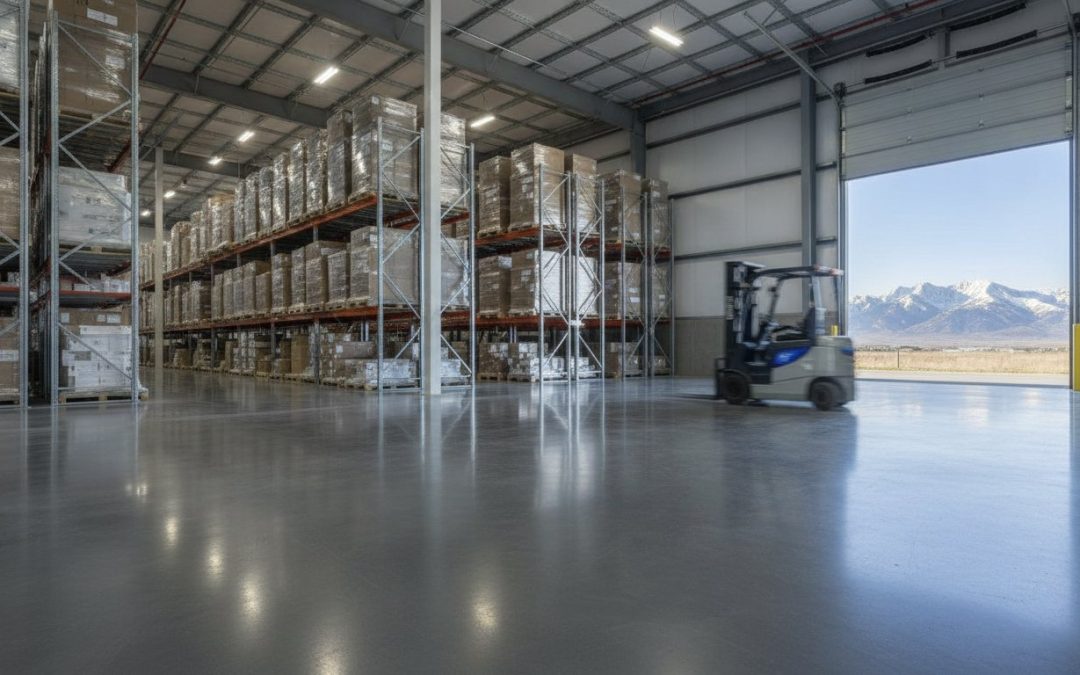
Could your warehouse floor be the most expensive piece of machinery you’re currently ignoring? It’s a common realization for facility managers who watch their operations slow down due to peeling coatings or hazardous cracks. Most industrial leaders agree that constant floor repairs and concrete dusting are more than just an eyesore; they’re a direct drain on your bottom line. Choosing the right heavy duty warehouse flooring is about more than just thickness. It’s about engineering a system that balances compressive strength with the flexibility to handle Utah’s unique seismic shifts and thermal swings.
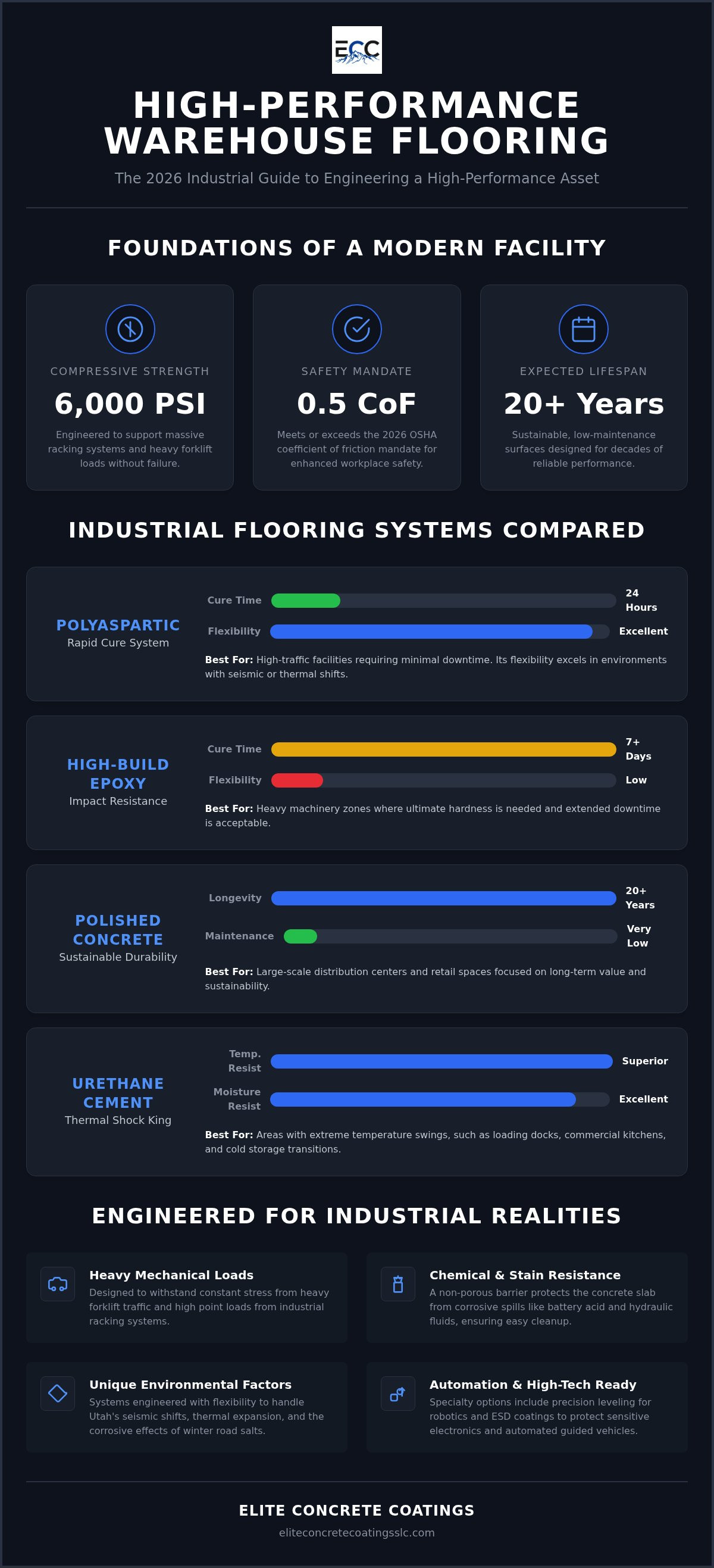
You deserve a facility that works as hard as you do, which is why we’ve built this 2026 industrial guide. You’ll discover how to select, install, and maintain surfaces that withstand heavy forklift loads and meet the current OSHA mandate of a 0.5 coefficient of friction. We’ll preview the shift toward automation-ready floors, compare the longevity of polished concrete against high-performance coatings, and show you how to achieve a maintenance-free finish that lasts over ten years. From loading docks requiring 6,000 PSI strength to precision-leveled zones for robots, we’ll help you turn your floor into a high-performance asset.
Key Takeaways
- Learn how compressive strength and structural engineering turn a simple slab into a high-performance asset capable of supporting massive racking systems and heavy forklift loads.
- Compare high-build epoxy and rapid-curing polyaspartic systems to find the best heavy duty warehouse flooring solution for your specific traffic patterns and downtime requirements.
- Explore why polished concrete is the 2026 gold standard for sustainable, maintenance-free distribution centers that need to last up to 20 years.
- Understand how to protect your facility from Utah’s extreme thermal expansion and the corrosive winter road salts tracked in by heavy truck traffic.
- Discover the essential professional assessment and preparation steps required to ensure your facility meets the 0.5 coefficient of friction mandated by 2026 OSHA safety standards.
What Defines Heavy Duty Warehouse Flooring in 2026?
In the industrial world, your floor is the foundation of your entire supply chain. True heavy duty warehouse flooring isn’t just a thick layer of paint; it’s an engineered system designed to survive relentless mechanical stress, corrosive chemical exposure, and high-impact loads without failing. Standard concrete slabs are naturally porous and, left untreated, will eventually succumb to “dusting.” This process releases fine particles that damage sensitive inventory and irritate employees. While residential-grade epoxy kits might look okay in a home garage, they lack the high-build resinous structure needed for a million-square-foot facility.
The Mechanical Load Factor
Success in a modern warehouse depends on how your floor handles pressure. Point loads from heavy-duty racking systems can exert thousands of pounds on a tiny footprint. If the slab isn’t properly reinforced or coated, you’ll see spider-webbing and cracks. Even the choice of forklift tires matters. Polyurethane wheels are harder on the surface than pneumatic tires because they distribute weight over a smaller area. Compressive strength is the measure of how much pressure a material can withstand before it deforms or breaks. For heavy-duty applications, we often look for slabs reaching 5,000 to 6,000 PSI to ensure the structural integrity of the facility stays intact under 2026’s increased automation demands.
Chemical and Abrasion Resistance
Durability isn’t just about weight; it’s about chemistry. Hydraulic fluids and battery acid leaks from charging stations can eat through standard concrete in weeks. When engineering heavy duty warehouse flooring for high-traffic zones, high-performance warehouse concrete coatings provide a non-porous shield that keeps these liquids on the surface for easy cleanup. We also look at “Shore D Hardness,” a metric that determines how well a floor resists scratches from dragged pallets or metal equipment. Polished concrete flooring and resinous systems are tested against ASTM standards to ensure they meet commercial liability requirements. These tests aren’t just for show. They’re your guarantee that the floor won’t peel when a forklift makes a sharp turn at high speed. For long-term success, we recommend choosing a commercial polished concrete or resinous system that meets the 2026 OSHA mandate of a 0.5 coefficient of friction.
Industrial Coating Systems: Beyond Standard Epoxy
While many facilities still rely on standard epoxy, the demands of 2026 logistics require more specialized chemistry. High-build epoxy remains the traditional workhorse for impact resistance, providing a thick, protective barrier against heavy machinery. However, it can be brittle. For environments facing extreme temperature swings or constant moisture, urethane cement is the superior choice. It handles thermal shock, like moving from a cold storage zone to a warm loading dock, without delaminating. Choosing the right heavy duty warehouse flooring system means looking beyond surface-level aesthetics to the chemical bond beneath.
Polyaspartic vs. Epoxy: The Speed and Durability Debate
The biggest differentiator in modern industrial flooring is return-to-service time. Standard epoxy systems often require seven days to reach full chemical resistance, which is a lifetime in a busy distribution center. Polyaspartic coatings cure in as little as 24 hours. At Elite Concrete Coatings, we specialize in these rapid systems because they don’t just save time; they offer better elongation. This flexibility allows the coating to move with the concrete during Utah’s frequent seismic micro-adjustments, preventing the hairline fractures common in more rigid systems. Standard epoxy is incredibly hard, but hardness without flexibility leads to failure. Polyaspartic systems provide a superior balance, combining scratch resistance with the ability to absorb the vibration of thousands of forklift movements every day. If you’re weighing your options, our detailed breakdown of epoxy vs polished concrete warehouse performance can help you make the most informed decision for your facility.
Specialty Coatings for High-Tech Warehousing
As automation becomes the norm, ESD coatings have become essential for facilities handling sensitive electronics or automated picking robots. These systems dissipate static electricity, protecting both your inventory and your expensive automated guided vehicles. Safety is equally critical. Integrating non-slip additives ensures your team stays upright while maintaining a surface that’s still easy to sweep. Compliance with federal accessibility standards ensures your facility remains safe and compliant for all workers. High-gloss resinous commercial flooring also reflects overhead lighting, which can noticeably reduce energy costs in large spaces. If you’re looking to upgrade your facility’s safety and efficiency, the team at Elite Concrete Coatings can help you select the perfect system for your specific traffic patterns.
- High-Build Epoxy: Best for areas requiring maximum thickness and impact cushioning.
- Polyaspartic Coatings: The 2026 standard for UV stability and rapid 24-hour installation.
- Urethane Cement: Essential for food processing or areas with high moisture vapor transmission.
- ESD Coatings: Necessary for electronics logistics to prevent static discharge.
Polished Concrete: The Heavy-Duty Alternative
Polished concrete has emerged as a premier contender for heavy duty warehouse flooring, particularly in massive distribution centers where scale and sustainability are top priorities. By utilizing the existing slab as the finished surface, this method reduces material waste and eliminates the need for recurring topical applications. It offers a lower total cost of ownership over time because the surface itself is hardened rather than just covered. However, it’s important to understand that polished concrete is not a universal fix. For areas prone to aggressive chemical spills or battery acid leaks, the resinous systems discussed in the previous section remain the superior choice. Understanding the full spectrum of trade-offs is essential, and our comprehensive guide on choosing between an epoxy vs polished concrete warehouse floor covers the durability, maintenance, and long-term performance differences in detail.
Mechanical Polishing vs. Grind and Seal
There is a common misconception that all shiny concrete is the same. A grind and seal involves a basic mechanical grind followed by a topical sealer, which can eventually peel or wear under heavy forklift traffic. In contrast, mechanical commercial polished concrete uses progressively finer diamond-grit pads to refine the slab to a natural luster. Elite Concrete Coatings recommends mechanical polishing for high-traffic aisles and staging areas because the finish is part of the stone itself. It won’t flake off, even under the constant friction of polyurethane wheels.
Dust-Proofing and Longevity
One of the biggest operational wins with polished concrete is the total elimination of concrete dusting. Standard concrete is essentially a hard sponge that releases fine powder as it wears, but mechanical polishing closes those pores. Chemical densifiers permanently change concrete at a molecular level by reacting with calcium hydroxide to create crystalline structures that fill the voids in the concrete matrix. This process significantly increases the surface’s Shore D Hardness and prevents particles from settling on your sensitive inventory.
Beyond dusting, the diamond-grinding process helps improve Floor Flatness (FF) and Floor Levelness (FL) numbers. These metrics are critical for 2026’s automated material-handling systems. Ensuring that robots and high-reach forklifts operate on a consistent, vibration-free plane reduces equipment maintenance and increases picking speed. When you choose a polished finish, you aren’t just cleaning up the floor; you’re precision-tuning your facility for maximum efficiency.
- Sustainability: Uses existing materials and qualifies for many green building credits.
- Reflectivity: Increases ambient light, creating a safer and more attractive environment for investors.
- Traction: When kept clean, polished concrete meets or exceeds OSHA slip-resistance standards.
- Longevity: With proper densification, these floors can last 20+ years with minimal intervention.
The Utah Factor: Engineering for the Intermountain West
Utah warehouses face environmental challenges that facilities in other regions never have to consider. Our high-desert climate means your concrete slab is constantly fighting against extreme temperature swings along the Wasatch Front. During a typical Utah summer, concrete expands; in the winter, it contracts. This cycle creates massive internal pressure. If your heavy duty warehouse flooring isn’t engineered to handle this movement, you’ll see delamination and cracking within the first few years of operation. We’ve seen many facilities struggle with these issues because they used products designed for more stable climates.
Moisture Vapor Transmission (MVT) is another silent threat in our region. Ground moisture can get trapped beneath a non-breathable coating, building up pressure until the surface bubbles and peels. We also have to account for the corrosive cocktail of road salt and magnesium chloride brine that trucks track into your loading docks. Magnesium chloride is particularly aggressive because it stays liquid at lower temperatures, allowing it to seep deeper into concrete pores than traditional rock salt. Selecting the right heavy duty warehouse flooring in Utah requires a partner who understands the specific chemistry of our local soil and weather patterns.
Joint Sealants and Structural Protection
The most vulnerable parts of your floor are the joints. Many older facilities used rigid epoxy to fill these gaps, but that’s a recipe for disaster in a seismic zone like Utah. Rigid fillers don’t move with the slab; they crack and then the concrete edges begin to spall. This creates potholes that destroy forklift tires and slow down your operations. We recommend polyurea joint fillers as the industry standard. They remain flexible enough to handle slab movement and seismic micro-adjustments while being hard enough to support heavy wheels. You can extend the life of your facility significantly by investing in professional warehouse concrete coatings and joint sealants before the damage becomes structural.
OSHA Safety and Visibility
Safety isn’t just a checkbox; it’s an operational necessity. Loading docks are high-risk areas, especially when Utah snow and ice are tracked inside. We integrate commercial non-slip coatings with specific textures to ensure your team stays upright even in wet conditions. We also use high-contrast safety yellow and pedestrian-specific colors to define forklift no-go zones. This visual management helps you stay compliant with the 2026 OSHA mandate for a 0.5 coefficient of friction on all level walking surfaces. Defined walkways and bright striping don’t just protect workers; they improve the flow of your entire facility. Ensure your facility is ready for the next winter season by scheduling a consultation for warehouse concrete coatings with our local experts.
Implementing Your Warehouse Floor Strategy
Success in warehouse management depends on precision, and your flooring strategy is no exception. A professional assessment is the first critical step because a simple visual check can’t detect deep-seated moisture vapor issues or sub-slab structural weaknesses. In a large-scale facility, guessing about moisture levels can lead to catastrophic coating failure within months. We use advanced testing equipment to ensure the slab is ready for a long-term bond. This level of technical scrutiny is what separates a high-performance heavy duty warehouse flooring system from a temporary fix that will eventually peel under pressure.
Preparation is the most important part of our process. While some contractors still rely on acid etching, we utilize industrial diamond grinding to open the concrete pores and create a “profile” for the coating to grip. This mechanical process removes laitance and contaminants, ensuring the resinous system becomes a permanent part of the slab. We understand that your operations can’t stop for weeks. By using rapid-curing polyaspartic systems and phased installation schedules, we can often complete sections overnight, allowing you to return to service without missing a shipping deadline.
The Elite Concrete Coatings Process
We take pride in serving the industrial hubs from Salt Lake City to Ogden. As a family-owned business, we don’t just send a crew to your site; we provide personal accountability on every square foot we coat. Whether we are restoring a historic hangar or outfitting a new distribution center, our team focuses on meticulous detail. We specialize in resinous commercial flooring and commercial polished concrete tailored to the specific traffic patterns of your facility. You can easily start the process by requesting a site-specific quote that addresses your unique load requirements and safety goals.
Final Checklist for Facility Managers
Before you sign off on a major floor restoration, verify that your partner has the right credentials. Industrial environments require specialized insurance and a proven track record with similar large-scale projects. Ask for references that specifically involve heavy forklift traffic or chemical exposure to see how the floors have held up after several years. Understanding your warranty is equally vital. A true industrial warranty should clearly define what is covered under heavy mechanical use, ensuring you aren’t left with unexpected repair needs down the road.
Long-term maintenance is surprisingly simple once the right system is in place. Regular cleaning with non-corrosive solutions and keeping the surface free of abrasive debris will protect the high-gloss finish and maintain your OSHA-compliant slip resistance. If you’re ready to transform your facility into a safer, more efficient workspace, it’s time to take the next step. Schedule a professional floor assessment with Elite Concrete Coatings to ensure your foundation is ready for the years of hard work ahead.
Future-Proof Your Industrial Operations
Your warehouse floor is more than just a surface; it’s a critical tool for your facility’s efficiency and safety. By selecting the right heavy duty warehouse flooring system, you can eliminate operational downtime and ensure compliance with 2026 OSHA safety standards. Whether you choose the rapid return-to-service of polyaspartic coatings or the sustainable longevity of polished concrete, the success of your project rests on professional preparation and local expertise. We’ve seen how Utah’s unique climate can punish a poorly engineered floor, which is why we prioritize precision on every job site.
As a Utah-based family business, we take pride in restoring large-scale industrial spaces with high-performance systems. Our team specializes in everything from ESD coatings for high-tech zones to structural joint restoration. Don’t let a failing floor slow down your supply chain. Get a Free Industrial Flooring Quote from Elite Concrete Coatings and let us help you build a foundation that lasts for decades. We’re ready to bring our specialized craftsmanship and personal accountability to your next project.
Industrial Flooring Frequently Asked Questions
How long does a heavy-duty warehouse floor coating last?
A professionally installed heavy duty warehouse flooring system typically lasts between 10 and 20 years. The exact lifespan depends on the volume of forklift traffic and the specific chemistry used. Polished concrete often reaches the 20 year mark with minimal intervention, while resinous coatings may need a fresh topcoat after a decade of intense mechanical use. Regular cleaning and prompt joint maintenance are the best ways to extend the life of your facility’s foundation.
Can you apply industrial coatings over damaged or oil-stained concrete?
We can apply industrial coatings over damaged or stained slabs, provided the surface is properly prepared. Preparation is 90% of the job. We use industrial diamond grinding to remove the top layer of contaminated concrete, reaching the clean, porous stone beneath. For deep oil saturation, we utilize specialized degreasers and heat treatments. This ensures the new coating achieves a permanent mechanical bond rather than just sitting on top of the debris.
What is the difference between epoxy and polyaspartic for warehouses?
The primary differences are cure speed and flexibility. Epoxy is a traditional workhorse that offers incredible hardness but can take up to seven days to fully cure. Polyaspartic systems are the 2026 standard because they cure in as little as 24 hours. They also offer better elongation, which helps the floor handle Utah’s thermal expansion and seismic shifts without cracking. For most busy warehouses in Salt Lake City, polyaspartic is the superior choice for minimizing operational downtime.
How do I know if my warehouse floor needs a moisture barrier?
You’ll know your floor needs a moisture barrier if professional testing reveals a high Moisture Vapor Transmission (MVT) rate. Signs like bubbling, peeling, or white efflorescence powder on the surface often indicate ground moisture is pushing through the slab. In Utah’s high-desert soil, we frequently see these issues. We use specialized meters to measure the pounds of moisture per 1,000 square feet to determine if a dedicated moisture-mitigating primer is required before the main coating.
How much downtime should I expect during a professional floor installation?
Most professional installations require between 24 and 72 hours of downtime depending on the square footage and the system chosen. We often use a phased approach to keep your facility operational. For example, we can coat one half of a warehouse while you move inventory to the other side. Because we specialize in rapid-curing polyaspartic systems, your team can often return to full forklift traffic just 24 hours after the final topcoat is applied.
Is polished concrete or epoxy better for heavy forklift traffic?
Both systems handle heavy forklift traffic well, but they solve different problems. Polished concrete is excellent for massive distribution centers because it won’t peel or flake under constant tire friction. However, if your facility handles chemicals, battery acid, or frequent spills, a high-build resinous coating is better. The coating provides a non-porous shield that protects the underlying slab from corrosive liquids that could eventually penetrate and damage unsealed polished concrete over time.
Do warehouse floor coatings meet OSHA slip-resistance requirements?
Yes, our warehouse coatings are engineered to meet or exceed the 2026 OSHA mandate of a 0.5 coefficient of friction. We achieve this by integrating specialized non-slip additives directly into the topcoat. This creates a predictable texture that provides traction even when the floor is wet from tracked-in snow or minor spills. Maintaining these standards is a critical part of facility safety and commercial liability management for any industrial operation in the Intermountain West.
What maintenance is required for industrial polished concrete?
Industrial polished concrete is remarkably low-maintenance but it isn’t “no-maintenance.” You should perform daily dust mopping to remove abrasive grit that can dull the shine over time. Use an automatic scrubber with a neutral pH cleaner once or twice a week to keep the surface pristine. Avoid using aggressive acidic or alkaline cleaners, as these can chemically attack the densified surface. Periodically using a high-speed burnisher will help maintain the floor’s high-performance luster and slip resistance.