
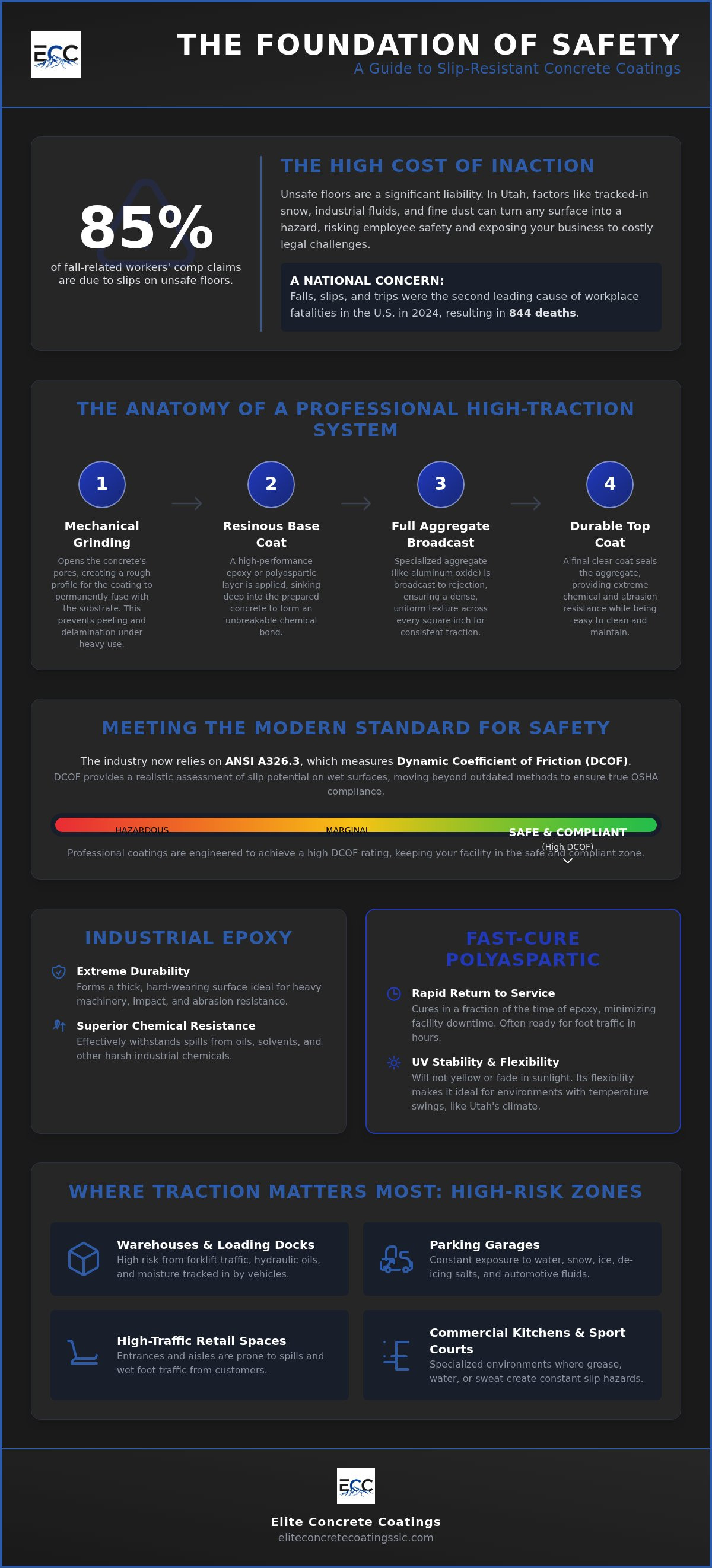
Did you know that an estimated 85% of fall-related workers’ compensation claims are the direct result of slips? If you manage a high-traffic facility here in Utah, you’ve likely felt that flash of anxiety when a spill hits the floor or a rainy day turns your entrance into a skating rink. You shouldn’t have to choose between a floor that’s easy to clean and one that keeps your team on their feet. It’s a common frustration, but the right solution involves more than just a simple textured additive.
Professional slip resistant concrete coatings are engineered systems designed to provide reliable traction without sacrificing the sleek, professional look of your facility. This guide will show you how advanced polyaspartic and epoxy systems transform hazardous zones into safe, OSHA-compliant environments. We’ll break down the latest 2026 safety standards, explain why Dynamic Coefficient of Friction (DCOF) is the new industry benchmark, and help you select a finish that stands up to heavy machinery and daily wear. It’s time to build a foundation of safety that protects your business and your people.
Key Takeaways
- Learn how modern safety standards like ANSI A326.3 utilize Dynamic Coefficient of Friction (DCOF) to provide a more accurate measure of workplace safety and compliance.
- Discover the engineering behind traction additives like aluminum oxide and quartz that create a reliable mechanical grip without making the floor difficult to clean.
- Compare the benefits of industrial epoxy and fast-curing polyaspartic systems to determine which high-performance coating best suits Utah’s unique temperature swings.
- Understand why professional mechanical grinding is the critical foundation for slip resistant concrete coatings to prevent delamination and ensure long-term durability.
- Identify high-risk zones in your facility, such as loading docks and parking garages, where targeted traction upgrades are essential for reducing liability.
Understanding Slip Resistant Concrete Coatings and Workplace Safety
Slip resistant concrete coatings are not just “paint with sand.” They are high-performance resinous systems, usually based on epoxy or polyaspartic chemistry, specifically engineered to provide a consistent mechanical grip. Unlike a standard Concrete sealer that might actually increase slipperiness when wet, these professional systems integrate specialized aggregates like aluminum oxide or quartz into the resin itself. This creates “engineered traction” that won’t wear off after a few months of foot traffic. It’s a permanent safety upgrade that directly reduces slip-and-fall liability in demanding commercial and industrial environments.
Beyond legal protection, a high-traction floor significantly improves employee morale. When your team doesn’t have to worry about their footing, they work faster and more confidently. A stable floor is the foundation of a productive workplace. Additionally, many insurance providers view these professional upgrades favorably during risk assessments. Investing in a certified system often helps businesses maintain more manageable operational premiums by demonstrating a commitment to proactive risk management.
The Real Cost of Floor Safety Hazards
Workplace accidents are more than just a paperwork headache. In 2024, falls, slips, and trips were the second leading cause of workplace fatalities in the U.S., accounting for 844 deaths. For Utah business owners, the risks are amplified by our local climate. In Salt Lake City warehouses, moisture tracked in from snow, hydraulic oils, and fine dust can turn a smooth floor into a hazard in seconds. Proactive safety is especially critical in high-traffic retail spaces where the public’s safety is just as important as your staff’s. One poorly timed spill on an untreated surface can lead to a lifetime of liability concerns.
Regulatory Standards and Compliance
Staying compliant with safety regulations is a top priority for any responsible facility manager. OSHA Regulation 1910.22 requires all walking-working surfaces to be kept in a clean and, as far as possible, dry condition. While OSHA uses a performance-based approach rather than mandating a specific number, the industry has moved toward the ANSI A326.3 standard. This test method measures the Dynamic Coefficient of Friction (DCOF), providing a realistic assessment of slip potential for hard surfaces under various conditions.
Utilizing professional slip resistant concrete coatings ensures your facility meets these rigorous performance-based standards. These systems are designed to provide the necessary traction even in wet conditions, helping you pass safety audits and maintain a secure environment. It’s a strategic investment that moves your facility from “at-risk” to “industry-leading,” ensuring your floors are as hard-working as the people who walk on them.
The Engineering Behind High-Traction Concrete Surfaces
Engineering slip resistant concrete coatings involves a deep understanding of how materials interact at a microscopic level. It’s not enough to simply have a rough surface; the coating must be chemically fused to the concrete to withstand industrial pressure. Professional installers use mechanical grinding to open the concrete’s pores, allowing the resin to “root” into the substrate. This creates a permanent bond that prevents the safety layer from peeling when heavy machinery turns or brakes. Within these systems, the Coefficient of Friction is the ratio of the force of friction between two bodies. By precisely controlling this ratio, we transform a slick slab into a predictable, high-performance work surface.
How Texture Additives Work
The secret to lasting grip lies in the type of aggregate used. While some hardware store kits suggest simple sand, professional systems rely on specialized materials like quartz or aluminum oxide. Aluminum oxide is the heavy hitter of the industry; it’s nearly as hard as diamond and incredibly resistant to crushing. We typically use a “broadcast” method, where the aggregate is showered over a wet base coat until the surface is saturated. This creates a uniform “mountain range” of traction. Unlike mixed-in additives that can settle to the bottom of a bucket, a full broadcast ensures that every square inch of your floor provides the same level of safety.
Finding the right balance is a technical art. If a floor is too aggressive, it will shred mops and trap dirt, making sanitation impossible. If it’s too smooth, it fails the moment a spill occurs. We help you dial in the perfect profile for your specific environment, ensuring your floor is safe enough to prevent falls but smooth enough for easy daily maintenance.
Measuring Traction: DCOF vs. SCOF
In the past, the industry relied on the Static Coefficient of Friction (SCOF), which measured the force needed to start a person moving from a dead stop. However, most workplace accidents happen while someone is already in motion. This is why Dynamic Coefficient of Friction (DCOF) is now the modern gold standard. The ANSI A326.3 standard provides a rigorous test method for DCOF, offering a realistic assessment of how a floor performs under active foot traffic. Following OSHA guidelines on slip-resistant surfaces helps facility managers recognize that safety is a performance-based result, not just a marketing claim.
The most effective slip resistant concrete coatings are tested after installation to verify they meet these specific DCOF requirements. This data-driven approach removes the guesswork from workplace safety. If you’re evaluating the needs of your own facility, exploring our non-slip commercial floor finishes can help you identify which texture profile matches your operational risks.
Comparing Non-Slip Coating Systems: Epoxy, Polyaspartic, and Beyond
Selecting the right chemistry for your facility is a decision that impacts safety and maintenance for years. While the texture provides the grip, the resin system acts as the backbone of the floor. In Utah, our floors face a unique set of challenges. We deal with heavy machinery, intense UV rays, and the corrosive nature of winter road salts. Professional slip resistant concrete coatings must be tailored to these specific stressors to ensure they don’t peel or fail prematurely. It’s about matching the material to the mission.
Epoxy Systems for Heavy Industry
Industrial epoxy remains the traditional workhorse for warehouse concrete coatings. Its primary strength lies in its high-build nature and incredible compressive strength. If your facility operates heavy forklifts or stores massive pallets, epoxy provides the impact resistance needed to keep the concrete underneath intact. However, epoxy has two main drawbacks. It takes longer to cure, often requiring several days before it can handle full traffic. It’s also sensitive to sunlight. Over time, UV exposure causes epoxy to “amber” or turn yellow, which can affect the visibility of safety markings and the overall aesthetic of your space. Facility managers comparing systems should also review our guide to epoxy garage flooring in Salt Lake City, which covers how slab preparation and material selection affect long-term performance.
Polyaspartic: The High-Performance Alternative
For businesses that can’t afford long shutdowns, polyaspartic systems are the modern answer. These coatings cure incredibly fast, often allowing for a full return to service in just 24 hours. Beyond speed, polyaspartic resins are naturally flexible. This is a game-changer for Utah’s climate. As our temperatures swing from freezing winters to scorching summers, the concrete expands and contracts. A rigid floor might crack, but polyaspartic coatings move with the slab. They are also completely UV-stable, making them ideal for loading docks or entryways with large windows where sunlight is constant.
Beyond the base resin, the system must also stand up to chemical attacks. Utah’s winter roads are treated with aggressive salts and de-icers that are easily tracked into your building on tires and boots. High-performance resinous flooring creates an impermeable barrier that prevents these chemicals from reaching and degrading the concrete. This protection is vital for meeting U.S. Access Board guidelines regarding stable and firm surfaces. Whether you’re managing a sleek retail showroom or a rugged chemical processing plant, the right combination of resin and aggregate ensures your floor remains a safe, compliant asset for the long haul.
Strategic Applications for Slip-Resistant Flooring in Utah
Utah facility managers face environmental hazards that managers in warmer climates rarely encounter. Between the Wasatch Front’s heavy snowfall and the aggressive road salt used throughout Salt Lake City, entryways and parking garage floor coatings in Utah must handle constant moisture tracking. Integrating slip resistant concrete coatings into these high-traffic areas isn’t just about safety; it’s about operational continuity. When snowmelt mixes with smooth concrete, the risk of a liability claim skyrockets. We focus on creating high-traction zones that stand up to our unique “freeze-thaw” cycles without losing their grip.
In the Silicon Slopes, high-tech facilities often require ESD coatings to protect sensitive electronics from static discharge. We ensure these specialized, conductive surfaces still offer the necessary traction to prevent technician slips in cleanrooms and labs. Similarly, community centers and schools across Provo and Ogden rely on high-traction sport court concrete surfacing. These areas require a specific balance of grip for rapid lateral movements and a smooth enough finish to prevent “turf burn” during falls.
Warehouses and Distribution Centers
Safety in a modern logistics hub depends on clearly defined paths. Forklift operators and pedestrians often share tight spaces, and a single slick patch can lead to a catastrophic collision. By applying specialized finishes to forklift lanes and loading docks, we provide the mechanical grip necessary for heavy machinery to stop on a dime. For a deeper dive into the specific needs of local industrial spaces, check out The Ultimate Guide to Warehouse Floor Coatings in Utah.
Commercial Kitchens and Retail
Retail spaces and food service environments deal with a different set of contaminants. Organic fats, vegetable oils, and constant cleaning cycles create a permanent “slip zone” if the floor isn’t properly textured. You don’t have to sacrifice your brand’s look for safety; decorative flake or quartz finishes provide elite traction while looking professional. Learn more about these specific requirements in our sibling article, Non-Slip Coatings for Commercial Kitchens.
Every facility has unique “hot spots” where falls are most likely to occur. If you’re ready to secure your high-risk areas, our team is here to help you select the perfect non-slip commercial floor finishes for your specific industry needs.
Why Professional Application is Essential for Certified Slip Resistance
Surface preparation is the heartbeat of any safety system. While some might suggest acid etching as a shortcut, this chemical process often fails to create the deep mechanical profile required for heavy industrial traffic. Professional slip resistant concrete coatings require a foundation built through industrial diamond grinding. This process opens the pores of the concrete slab, allowing the resin to “root” deeply into the surface. Without this mechanical bond, even the highest quality coating is at risk of delamination, where the safety layer simply peels away under the stress of forklift tires or temperature changes.
In Utah, professional application also involves critical moisture vapor testing. Our local slabs in Salt Lake City and the surrounding valleys often contend with high ground moisture. If a coating is applied without checking the moisture emission rate, hydrostatic pressure can build up and literally blow the coating off the floor. We use specialized equipment to ensure the slab is ready for a permanent bond, protecting your investment from the ground up.
The Pitfalls of Non-Professional Solutions
One of the most common issues with non-professional applications is inconsistent aggregate distribution. This leads to “bald spots” where the floor looks finished but lacks the necessary traction to prevent a fall. Achieving a uniform broadcast of quartz or aluminum oxide takes precision and experience. If the resin is applied too thin, it won’t hold the aggregate in place; if it’s too thick, it “buries” the texture, leaving the floor as slick as it was before. Additionally, professional work provides a level of liability protection and warranty coverage that simple kits can’t match. When safety is the goal, you need a system that is certified to perform.
The Elite Concrete Coatings Difference
As a family-owned business right here in Utah, we treat every project like it’s in our own neighborhood. Our process is meticulous, moving from heavy-duty grinding and crack repair to a multi-layered resinous system tailored specifically for our high-altitude climate. We don’t believe in one-size-fits-all solutions. Instead, we match the chemistry and the texture profile to your specific operational needs, whether you’re managing a fast-paced distribution center or a high-end retail showroom. For facilities evaluating a broader range of surface treatments, working with experienced polished concrete contractors can help you understand the full spectrum of options available for your Utah facility.
We take immense pride in transforming hazardous floors into durable, high-performance assets. If you’re ready to upgrade your facility’s safety and performance, we invite you to explore our commercial non-slip coatings. Let’s work together to build a safer environment for your team and your customers.
Secure Your Foundation for a Safer Workplace
Your floor is the most frequently used tool in your facility. Investing in professional slip resistant concrete coatings is a direct commitment to your team’s safety and your business’s long-term operational success. By focusing on the Dynamic Coefficient of Friction (DCOF) and selecting a resilient system like polyaspartic that handles Utah’s temperature swings, you eliminate the dangerous guesswork of workplace hazards. Professional diamond grinding and moisture testing ensure these surfaces remain durable through years of heavy forklift traffic and winter road salt exposure.
As a local, family-owned team, we take immense pride in serving businesses across Salt Lake City, Provo, Ogden, and Layton. We are specialists in high-performance industrial systems that turn hazardous slabs into durable, high-traction assets. Don’t leave your facility’s liability to chance or an uncertified fix. Request a Professional Safety Floor Evaluation today and let our expert team help you build a more secure, productive environment for your business. We look forward to helping you transform your space and protect your people.
Frequently Asked Questions
Are slip-resistant coatings hard to clean?
Slip resistant concrete coatings are designed to be low-maintenance and easy to sanitize. While the added texture provides essential grip, it doesn’t trap debris like unfinished or porous concrete. Using a standard industrial floor scrubber or a simple degreaser and mop will keep the surface clean. We carefully calibrate the aggregate size to ensure your facility stays sanitary while effectively reducing the risk of slips in moisture-prone areas.
How long do non-slip concrete coatings last in high-traffic areas?
In high-traffic environments like Salt Lake City distribution centers, these coatings typically last over a decade. Their longevity comes from the professional diamond grinding process that ensures a deep mechanical bond with the substrate. Unlike topical treatments that wear away, our high-performance systems are built to withstand the constant friction of heavy machinery and pallet jacks without losing their traction or peeling under pressure.
Can I apply a slip-resistant coating over existing epoxy?
Yes, it is often possible to apply a new traction layer over existing epoxy if the current floor is well-bonded. In cities like Lehi, we frequently see facilities looking to upgrade their safety profile. We perform a thorough adhesion test and scuff the existing surface to ensure the new layer fuses perfectly. This provides a cost-effective way to enhance safety and compliance without requiring a full floor demolition.
Is there a difference between non-slip and non-skid coatings?
In the industry, “non-slip” usually refers to pedestrian safety, while “non-skid” is often used for vehicular traffic on ramps or docks. Both terms describe the same goal: increasing the Dynamic Coefficient of Friction (DCOF). Whether you’re protecting employees in a commercial kitchen or forklifts in a warehouse, the objective is to create a reliable mechanical grip that prevents uncontrolled sliding on wet or oily surfaces.
What is the best slip-resistant coating for Utah weather?
Polyaspartic is the superior choice for Utah’s climate. From Ogden down to Spanish Fork, our concrete experiences massive expansion and contraction due to rapid temperature swings. Polyaspartic resins are flexible enough to move with the slab, which prevents the cracking seen in more rigid materials. They also remain UV-stable, ensuring they won’t yellow or degrade under our intense high-altitude sunlight in loading docks or entryways.
How do I know if my current floor meets OSHA safety standards?
The best way to verify compliance is through a professional DCOF test using a digital tribometer. While OSHA focuses on the performance-based requirement of keeping surfaces “clean and dry,” the ANSI A326.3 standard provides the technical benchmark for safety. If your floor feels slick or has visible “bald spots” in the texture, it likely fails to meet the modern standards required for a safe, compliant workplace.
Do slip-resistant coatings change the look of my floor?
These systems offer a wide variety of aesthetic finishes that can actually improve your facility’s appearance. You can choose from solid colors, decorative flakes, or quartz blends that complement your brand. The traction additive is integrated into the final topcoat, meaning you get the safety benefits without sacrificing a high-end, professional look. It’s a great way to modernize a space while simultaneously meeting strict safety requirements.
Can these coatings be used in outdoor commercial areas?
Yes, specialized slip resistant concrete coatings are highly effective for outdoor commercial zones like entry ramps in Syracuse or South Jordan. We utilize UV-resistant polyaspartic topcoats that won’t chalk or peel when exposed to the elements. These systems are specifically designed to provide essential traction during our snowy winters, creating a safer path for employees and customers even when moisture is tracked across the surface.