

A discharge as low as 3 volts can damage modern high-speed components, so ESD flooring for electronics labs must help control static before it reaches sensitive equipment. It works as part of a grounded floor, footwear and person system, guiding charge away instead of allowing it to build up and discharge unpredictably. The right resistance range and installation details matter as much as the flooring material itself.
Anti-static flooring is not a standalone safeguard. It is one part of a broader electrostatic discharge control approach, and its performance depends on how the floor works with footwear, grounding, and the lab’s operating requirements.
This guide explains how flooring dissipates static, how conductive and static-dissipative systems differ, and why the substrate affects performance. It also outlines the standards used to define resistance testing and system requirements, helping you plan reliable protection for an electronics lab.
Key Takeaways
- Understand how anti-static, static-dissipative, and conductive flooring differ, and why the right resistance range matters.
- Learn why flooring alone isn’t a complete safeguard and how resistance and body-voltage testing help assess system performance.
- See how substrate condition and flooring-system choice affect the foundation for reliable static control.
- Follow the path charge takes through the floor, footwear, and person toward ground, and how that connection helps limit buildup.
- Recognize how relevant standards and test methods guide flooring specifications without treating every standard as a universal requirement.
What Is Anti-Static Lab Flooring?
ESD flooring for electronics labs helps control static by giving charge a managed route to ground. Performance depends on electrical resistance, grounding, and how people use the space, not simply on an “anti-static” label.
Static Buildup in Electronics Workspaces
Static builds when materials touch and separate, transferring electrical charge to a person or surface. In an electronics workspace, walking across the floor in ordinary shoes can generate charge that someone carries toward a workstation. The charge may go unnoticed, so consider how people move between benches, equipment, and room entrances.
The human body can carry thousands of volts without a person feeling the charge. People may feel an electrical charge at 3.5 kV, but that sensation threshold is well above levels that can threaten some electronic components. The relevant goal is to prevent charge from accumulating and discharging unpredictably near exposed equipment.
Static Discharge and Equipment Damage
Electrostatic discharge is a sudden transfer of built-up charge between objects with different electrical potentials. For example, a technician may touch a circuit board and release charge through a tiny spark that is difficult to see. Depending on the component’s sensitivity, the discharge can disrupt operation or cause permanent damage.
A discharge of 100 volts can permanently damage sensitive electronic components. Some electronic equipment can be damaged by discharges as low as 5 to 10 volts, while modern high-speed components can be harmed at 3 volts. Since personnel may not feel charge until much higher levels, lack of sensation doesn’t show that a workspace is protected.
Anti-Static, Dissipative, and Conductive Floors
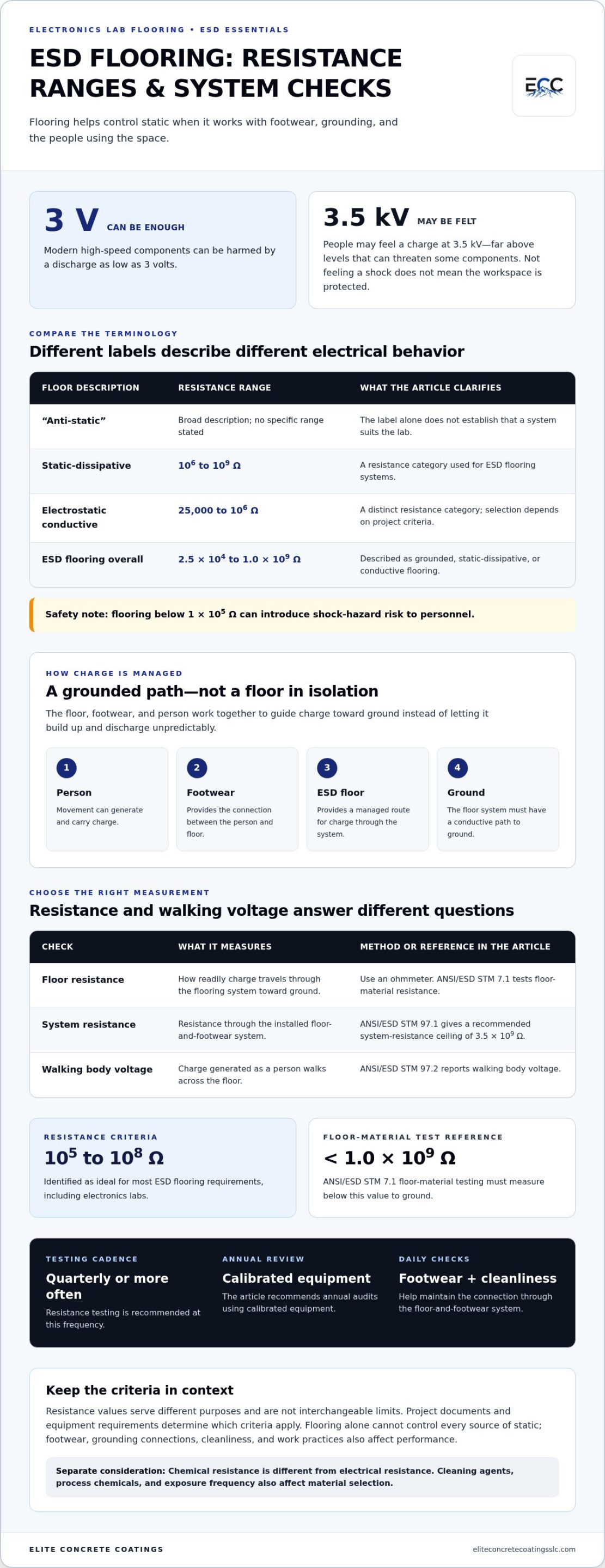
“Anti-static” is a broad description, while static-dissipative and conductive identify different electrical behaviors. ESD flooring for electronics labs is intended to help control charge through a grounded floor system. Static-dissipative flooring has a resistance range of 106 to 109 ohms; electrostatic conductive flooring ranges from 25,000 to 106 ohms.
ESD flooring is described as grounded, static-dissipative, or conductive, with resistance from 2.5 × 10⁴ to 1.0 × 10⁹ ohms. Floors below 1 × 10⁵ ohms can introduce shock-hazard risk to personnel. So an “anti-static” label alone doesn’t establish suitability. The selected system must match the lab’s electrical criteria; resinous systems are one category of commercial flooring used in project planning.
Can ESD flooring alone protect sensitive electronics?
No single resistance value guarantees protection. Project criteria should guide the floor, footwear, and person system. Test resistance and walking body voltage, connect the floor to ground, and include footwear and cleanliness checks alongside scheduled testing.
Electrical Resistance and Body-Voltage Testing
Resistance testing measures how readily charge travels through the flooring system toward ground; body-voltage testing measures charge generated as a person walks. Both matter because a suitable floor material can perform differently as part of an installed floor-and-footwear system. ANSI/ESD STM 7.1 tests floor-material resistance, while ANSI/ESD STM 97.2 reports walking body voltage.
Use an ohmmeter to test flooring resistance. The system also needs a conductive path to ground, with footwear that connects people to the floor. Daily footwear and cleanliness checks help maintain that path. Resistance testing is recommended quarterly or more often, with annual audits using calibrated equipment.
Resistance Ranges and Criteria
Resistance criteria describe the electrical path through flooring, but the applicable target depends on project documents and equipment needs. A range of 105 to 108 ohms is identified as ideal for most ESD flooring requirements, including electronics labs. ANSI/ESD STM 7.1 floor-material testing must measure below 1.0 × 10⁹ ohms to ground.
These values serve different purposes, so don’t treat them as interchangeable limits. ANSI/ESD STM 97.1 gives a recommended system-resistance ceiling of 3.5 × 10⁹ ohms. A project’s governing documents and equipment requirements determine which criteria apply. Installation details matter because the finished system includes more than the flooring material alone.
Charge-Generation Limits
Charge-generation testing evaluates the body voltage produced while a person walks across the floor. Walking body-voltage testing assesses the charge generated as a person moves across the floor. This measurement helps show whether the floor-and-footwear combination limits charge generation during ordinary movement through the lab.
Flooring alone cannot control every source of static or replace an ESD control program. Footwear, grounding connections, cleanliness, and work practices all affect performance. A floor may meet its resistance criterion while people still generate unwanted body voltage if their footwear or the grounding path is unsuitable.
Chemical resistance is separate from electrical resistance. Cleaning agents, process chemicals, and exposure frequency affect which flooring material suits a lab. Evaluate chemical compatibility alongside ESD criteria: an electrical test result does not show how a material will tolerate chemical contact.
Comparing flooring systems and substrate condition
Electronics labs commonly use resilient tile or sheet flooring and resinous systems designed for static control. The right option depends on the facility’s electrical, cleanroom, substrate, and handling requirements.
Flooring Materials and System Comparisons
Resilient tile or sheet systems and resinous systems differ in how they meet the room’s layout and substrate conditions. Tile introduces seams, while a resinous surface can form a continuous floor; either system still needs appropriate electrical resistance and a grounding path. UFGS-09 62 38 details specifications for a variety of flooring materials, making the project specification central to comparison.
Start by identifying the work performed in each area. A lab handling exposed components may prioritize electrical performance, while a room with frequent equipment movement also needs a surface suited to that traffic. Compare the complete installed assembly, not just its visible top layer. The substrate, conductive elements, adhesives, and underlayment can all affect the electrical path.
Assess the substrate before installation. Cracks, uneven areas, contamination, or moisture can interfere with adhesion and create inconsistencies beneath the finished surface. For example, a coating over a poorly prepared concrete slab may not bond uniformly. Assessment and preparation should account for the existing slab and the flooring system’s requirements.
Adhesives and underlayments must be compatible with the selected ESD flooring assembly. A layer that interrupts electrical continuity can undermine the intended route to ground, even if the surface material has suitable properties. Specify and evaluate the floor, adhesive, grounding components, and substrate together: changing one component can affect the complete system’s performance.
Cleanroom Compatibility
Cleanroom-compatible flooring supports static dissipation while limiting particles shed from the surface. ISO Cleanroom Standards provide a benchmark for cleanroom laboratories, where both properties matter. Choose a system based on the room’s cleanliness needs and the movement of people, carts, and equipment across the floor.
In cleanroom facilities, consider surface continuity, seams, joints, and edges. A system that sheds particles or creates hard-to-clean transitions can conflict with cleanliness goals, even if its electrical resistance is appropriate. Consider how personnel handle components and move equipment through doorways, work zones, and adjoining rooms.
Make the comparison in context: the lab’s electrical criteria, substrate condition, cleaning demands, and cleanroom expectations all shape the system choice. UFGS-09 62 38 can inform material specifications, while ISO Cleanroom Standards offer a cleanliness reference. Aligning those project documents helps keep flooring, adhesive, underlayment, and surface requirements consistent across the installation.
How ESD flooring directs charges to ground
An ESD floor works as part of a connected path from personnel through footwear and flooring to ground. The floor-footwear-person system must prevent charge buildup that could cause a discharge of 100 volts or more from a person.
Grounding Design and Electrical Continuity
Electrical continuity means charge can travel through connected components without a break in the intended path. In an ESD floor system, conductive elements connect the surface to grounding points, allowing charge to move away from people rather than build up near sensitive equipment.
Think of the route as a chain: footwear contacts the static-control floor, the floor connects to its grounding point, and charge dissipates along that path. If an isolating layer, damaged connection, or unsuitable footwear breaks the chain, a person may remain electrically isolated even while standing on the floor.
Footwear and grounding straps connect a person to a grounding system in different ways. ESD footwear works through contact with the floor; a grounding strap connects the person through its designated lead. Either connection must match the room’s grounding design. An improperly connected strap cannot complete the route.
Layout matters, too. A technician moving between an ESD work area and an adjacent carpeted space, for example, encounters different surface conditions. Treat transitions, doorways, workstations, and equipment locations as part of the grounding plan, not as separate flooring details.
Grounding Faults, Moisture, and Cleaning Products
A grounding fault is a break or poor connection that stops charge from following its intended path. Moisture and cleaning products can also affect surface conditions: water or residue may change contact between footwear and floor, while an incompatible cleaner can leave a film. These issues can disrupt reliable charge control around sensitive equipment.
Consider a spill near a grounding point or cleaning residue along a frequently used route. Either can make floor performance less consistent across the room. Carpet is another consideration: walking friction can generate static, and carpet does not provide the same designed path as an ESD floor.
Keep the complete route in view when planning the facility. Map how people move between the floor, benches, and equipment; account for footwear and grounding straps; and include floor connections in the inspection and testing program. A reliable design depends on continuity from the person’s contact point through the floor to ground, not on the surface alone.
Cleaning should preserve the floor’s intended electrical behavior. Products and methods must suit the flooring system, because residue that changes surface contact may affect how charge travels. Moisture near a grounding connection also needs attention before the area returns to normal use. These details help maintain an effective grounding path where people handle sensitive components.
Electronics lab flooring standards
Standards help define how an electronics lab specifies and evaluates flooring, but each serves a different purpose. The practical step is to identify the project’s governing documents, then match each flooring test to the requirement it addresses.
For electronics manufacturing and research environments, the IEC 61340 Series addresses electrostatics. IEC 61340-5-1 is a standard to assess for relevance to an ESD flooring project, not an automatic requirement for every lab. The distinction matters: a standard’s existence alone doesn’t establish that it governs a particular room or project.
ANSI/ESD S20.20-2021 is the identified standard for electronics manufacturing ESD control programs. It addresses the broader program context, while flooring test methods assess specific floor-system performance. Use the governing project documents to connect the program requirements with flooring materials, footwear, grounding, and verification criteria.
Testing methods answer different questions. ANSI/ESD STM 7.1 is used to specify and test ESD flooring electrical resistance. ANSI/ESD STM 97.1 addresses system resistance, while ANSI/ESD STM 97.2 reports body-voltage generation from ESD flooring. For example, resistance results describe an electrical path; walking body-voltage results show charge generated as personnel move across the floor.
The reported criteria also differ by test. ANSI/ESD STM 97.1 has a recommended system-resistance ceiling of 3.5 × 10⁹ Ω. Walking body-voltage testing evaluates voltage generated as people move across flooring. These figures shouldn’t be swapped or treated as one universal flooring limit; each belongs to its named method and measured property.
For a facility specification, record the applicable standard and test method, which part of the floor system is being evaluated, and the acceptance criteria. Include the test setup and results in project documentation. This clarifies whether a value describes the flooring material, the installed floor-and-footwear system, or body voltage while walking across the surface.
Cleanroom projects may also use ISO Cleanroom Standards as a benchmark. Flooring in these settings needs to dissipate static and resist particulate shedding. This cleanliness requirement complements, rather than replaces, electrical testing: a floor’s cleanroom role alone does not establish its suitability for sensitive electronics.
For a practical specification, connect the applicable ESD program standard to the relevant flooring test methods, then state the criteria for each test. This separates electronics manufacturing program requirements from floor resistance, system resistance, and walking body-voltage measurements, giving the project team a clear basis for evaluating flooring performance.
Elite Concrete Coatings: Warehouse Coatings
Elite Concrete Coatings installs ESD Coatings for commercial and industrial spaces where static control is part of the flooring plan. For an electronics lab, discuss the intended use, substrate condition, and performance criteria to shape the flooring project around its ESD requirements.
For facilities with warehouse operations, Warehouse Coatings address a different flooring context. Non-Slip Coatings and Parking Decks & Garages serve other commercial applications. Matching the coating to the space and its demands keeps the project focused on practical requirements.
Contact Elite Concrete Coatings to discuss ESD flooring for your facility.
Plan the next step for your lab
Turn your flooring requirements into a clear project scope. Bring together the lab’s operating needs, substrate condition, electrical criteria, and applicable standards so the proposed system can be assessed against the work it must support. That preparation makes conversations about ESD flooring for electronics labs more focused and useful.
Elite Concrete Coatings also installs Warehouse Coatings, Non-Slip Coatings, and Parking Decks & Garages for other commercial flooring needs. For an electronics lab project, keep the discussion focused on the space’s ESD goals and the flooring system that fits them.
When you’re ready to discuss your flooring project, contact Elite Concrete Coatings. A clear set of project requirements is a practical place to begin, and the right next step can help you move forward with confidence.
Frequently Asked Questions
Can existing concrete be used beneath ESD flooring?
Yes, an existing concrete slab can serve as the substrate beneath an ESD flooring system. Its condition affects how the assembly bonds and performs, so assess cracks, uneven areas, contamination, and moisture before installation. For example, residue from an earlier adhesive may interfere with a new system. The slab and any repairs must suit the selected flooring, adhesive, and grounding design.
Do employees need special footwear with ESD flooring?
Usually, personnel need footwear designed to work with the ESD floor system. It provides electrical contact between the person and the floor, allowing charge to move along the intended path. Ordinary shoes may not provide that connection. For example, a lab’s footwear requirements should account for the flooring system and how employees move between work areas, benches, and equipment.
How do I maintain an ESD floor?
Maintain an ESD floor by keeping its surface clean and following the installed system’s cleaning guidance. Residue from an unsuitable cleaner can affect contact between footwear and flooring. Check for damage, contamination, or changes around seams and grounding points. For example, spills or repair work near a connection need attention before the area returns to normal lab use.
How does ESD flooring work?
ESD flooring helps charge travel from a person through compatible footwear and the floor toward ground. This controlled path helps reduce static buildup and the risk of a sudden discharge near a circuit board or other sensitive component. The floor is one part of the system, so performance also depends on suitable footwear, grounding continuity, and the lab’s handling practices.
How often should ESD flooring be tested?
Resistance testing is recommended quarterly or more often, with annual audits using calibrated equipment. The applicable ESD program and project documents guide the schedule and criteria. Testing after floor repairs or changes to the grounding path can help assess the affected area. Organize results by test method and location, so a reading from a lab entrance is not confused with one from a work zone.
What does ESD flooring stand for?
ESD stands for electrostatic discharge, the transfer of electrical charge between objects at different electrical potentials. “ESD flooring” describes flooring used within a system intended to control static in places such as electronics labs. For instance, someone walking toward a workstation can carry charge, so the floor must work with grounding and footwear to manage it.
What is antistatic flooring?
Antistatic flooring is a broad term for flooring intended to help limit static buildup or its effects. The label alone does not describe the floor’s resistance or prove it meets a particular electronics lab requirement. For example, when comparing flooring options, distinguish a general antistatic claim from documented resistance and body-voltage test results tied to the project criteria.
What is ESD flooring and how does it protect electronics labs?
ESD flooring is a grounded, static-dissipative, or conductive floor system used to help control electrostatic discharge around sensitive electronics. It provides a managed route for charge rather than letting it build up and release near exposed components. In a lab, protection also depends on compatible footwear, grounding connections, and the room’s ESD control program, not just the floor surface.