That “anti-static” paint you found online isn’t just a budget-friendly alternative; it’s a gamble that could cost your facility thousands in fried circuit boards. Many facility managers across the Silicon Slopes worry that their flooring won’t hold up against the rigorous demands of high-tech manufacturing. You’re right to be concerned. In Utah’s uniquely dry climate, static electricity isn’t just a nuisance; it’s a constant threat to your sensitive electronic components and your bottom line. Professional static dissipative floor coatings are engineered to manage this risk by providing a controlled path to ground, ensuring your workspace remains safe and compliant.
We understand the confusion surrounding technical terms like conductive versus dissipative. You need a floor that meets ANSI/ESD S20.20-2021 standards without guessing which system actually works. This article explores the critical differences between these static control systems and explains why a professional application is essential for long-term durability in high-traffic industrial sectors. You’ll gain total clarity on which protection level fits your specific facility, helping you move forward with confidence and precision.
Key Takeaways
- Stop relying on vague “anti-static” labels and learn why the specific 10^6 to 10^9 ohm range is the gold standard for electronics safety.
- Master the technical differences between conductive and static dissipative floor coatings to ensure you invest in the right level of protection.
- Discover why Utah’s dry climate makes proper grounding a non-negotiable requirement for facilities along the Wasatch Front.
- Learn how the ANSI/ESD S20.20-2021 standards provide a blueprint for safeguarding your high-tech equipment against expensive failures.
- Understand why professional substrate preparation is the secret to a coating system that withstands heavy industrial traffic without losing its protective properties.
Debunking the ‘Anti-Static’ Myth: What Static Dissipative Really Means
Walking through a high-tech facility in Lehi or Draper, you’ll often hear the term “anti-static” tossed around like it’s a specific product specification. It isn’t. In the flooring industry, “anti-static” is a broad marketing term that describes anything from a temporary spray to a heavy-duty industrial system. Relying on this vague label for electronics manufacturing is a high-risk gamble. While a floor might technically be “anti-static” because it doesn’t generate its own charge, it may still fail to protect your sensitive equipment from an outside Electrostatic discharge (ESD) event.
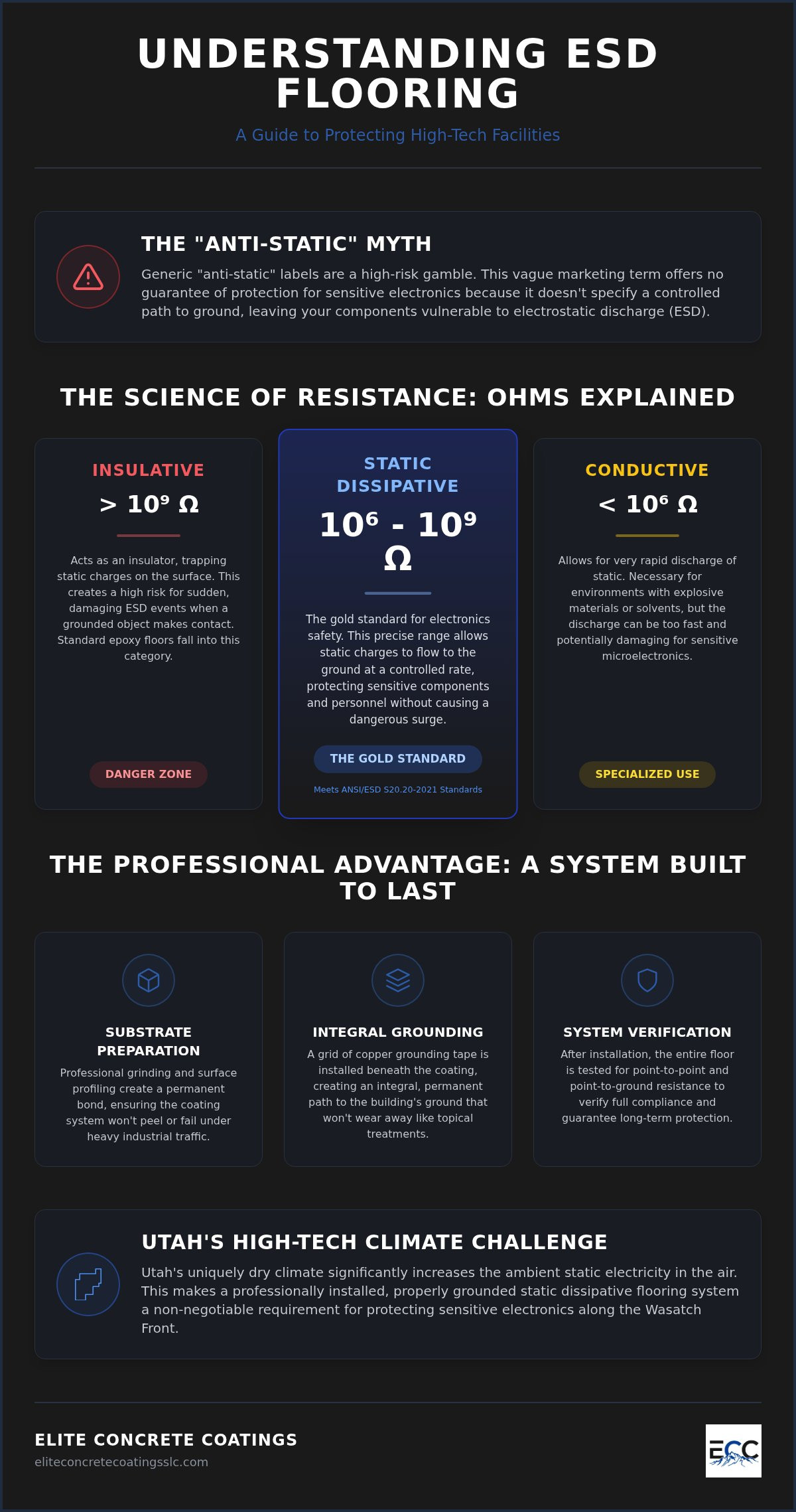
The reality is that professional static dissipative floor coatings are precision-engineered systems. Unlike generic paints, these coatings are designed to maintain a specific electrical resistance range between 10^6 and 10^9 ohms. This exact window is critical. It’s fast enough to bleed off static before it damages a circuit board, yet slow enough to prevent a sudden, dangerous surge. Settling for a standard epoxy in a tech room might save time upfront, but because standard epoxy acts as a powerful insulator, it actually traps static charges on the surface, waiting for a grounded person or piece of equipment to trigger a discharge.
The Difference Between Topical and Integral Protection
Topical treatments like anti-static waxes or sprays are temporary fixes at best. In a busy warehouse or lab, foot traffic and equipment wheels quickly strip away these thin layers, leaving “dead zones” where static can build up unnoticed. Our ESD coatings utilize specialized resins that create a permanent, integral path to ground. This isn’t just a surface film; it’s a structural feature of the floor that won’t wear off, ensuring your facility remains compliant with safety standards for years, not weeks.
Common Misconceptions in Industrial Flooring
A common mistake we see is the “more is better” approach to conductivity. While conductive flooring (less than 10^6 ohms) is necessary for environments with volatile explosives or munitions, it can actually be less safe for human operators working with high-voltage equipment. A floor that is too conductive increases the risk of an electrical shock to a person if they touch a live wire. Static dissipative floor coatings serve as the controlled middle ground between highly conductive materials and dangerous insulators, providing the perfect balance of equipment protection and personnel safety.
The Science of Resistance: Understanding Ohms and ESD Safety Standards
Resistance isn’t just a technical specification; it’s the barrier between a safe facility and a catastrophic equipment failure. When we talk about static dissipative floor coatings, we measure their performance in Ohms. A Megohm is one million Ohms, and for a floor to be classified as dissipative, it must fall within the specific window of 1 million (10^6) to 1 billion (10^9) Ohms. This range is designed to allow static to drain away at a controlled speed. If the resistance is too high, the floor acts as an insulator. If it’s too low, the discharge happens too fast, which can be just as damaging to sensitive micro-electronics.
One of the biggest threats in any cleanroom or lab is “walking body voltage.” This is the electrical charge your body naturally builds up through simple friction between your shoes and the floor. Without a proper path to ground, that charge stays on you until you touch a sensitive component. Our systems are engineered to bleed that voltage off instantly. Following the current ESD safety standards, specifically the ANSI/ESD S20.20-2021 update, ensures that your facility is equipped to prevent discharges of 100 volts or more. This is the critical threshold for protecting modern semiconductors from invisible but terminal damage.
Point-to-Point vs. Point-to-Ground Resistance
Understanding how electricity moves across your floor is vital for long-term safety. Point-to-point resistance measures how well the surface prevents static from building up in one spot. However, point-to-ground resistance is the most critical metric for your facility. This measures the path from the floor surface all the way to the building’s electrical ground. During installation, we integrate copper grounding tape beneath the coating layers to create this permanent highway for electrons. If you’re looking to protect a high-stakes environment, our specialized ESD coatings provide the reliable grounding path your equipment requires.
Industry Standards for Utah Tech Hubs
Utah’s diverse tech landscape has different requirements depending on the sector. Medical device manufacturers in Salt Lake City need absolute precision to ensure life-saving equipment isn’t compromised during assembly. Meanwhile, aerospace facilities in Ogden and Layton must adhere to strict military and aviation protocols that demand verified resistance levels. Meeting these standards isn’t just about safety; it’s a requirement for insurance coverage and liability protection. Professional installation ensures every square inch of your floor is tested and verified to meet these rigorous benchmarks.
Dissipative vs. Conductive: Choosing the Right Protection Level
Deciding between conductive and dissipative systems often comes down to the specific sensitivity of your equipment and the materials you handle. Conductive flooring, which has a resistance of less than 10^6 ohms, provides an ultra-fast path to ground. This rapid discharge is mandatory in high-risk environments like munitions plants or facilities handling flammable chemical powders where even a tiny spark could lead to a disaster. However, for the vast majority of Silicon Slopes tech companies, static dissipative floor coatings are the ideal choice. By falling in the 10^6 to 10^9 ohm range, these floors slow the discharge just enough to protect sensitive electronics without creating a potential safety hazard for employees.
Employee safety is a major factor that often gets overlooked. If a worker accidentally touches a live electrical circuit while standing on a highly conductive floor, the electricity can pass through them to the ground with dangerous speed. Dissipative systems offer a higher level of electrical resistance, which provides a safer environment for technicians working around high-voltage testing equipment. Adhering to ESD Association standards helps you balance these technical requirements with the safety of your team while maintaining a productive workspace.
Application Profiles: Which Floor Fits Your Facility?
Selecting the right system depends entirely on your operational goals. If you manage a server room, an electronics assembly line, or a medical laboratory, dissipative coatings are your best bet. They provide the necessary protection for microchips and sensitive sensors while remaining easy to maintain. On the other hand, if your facility handles explosive materials or highly volatile chemicals, the rapid grounding of a conductive system is non-negotiable. You can explore our ESD coatings for specialized tech environments to see which specific formulation matches your facility’s safety profile. Utah aviation facilities face similarly demanding flooring requirements, and understanding how airport hangar floor finishes address chemical resistance and heavy point loads can offer valuable perspective on selecting the right industrial coating system.
Durability and Aesthetics
There is a common myth that choosing a technical floor means sacrificing looks. Many facility managers assume they are stuck with a flat, “industrial gray” finish. That simply isn’t true anymore. Modern dissipative systems can actually mirror the high-gloss, professional look of commercial polished concrete while providing full ESD protection. These coatings are also incredibly tough. They are designed to withstand the daily abuse of heavy forklift traffic and chemical spills common in Utah warehouses. You get a floor that looks great, stays clean, and protects your high-value assets all at once.
Why Utah’s High-Tech Facilities Require Specialized Static Control
Utah’s environment presents a unique set of challenges that national coating brands often overlook. While a standard floor might perform adequately in a humid coastal city, our state’s 10-20% average humidity levels turn every unprotected surface into a potential static generator. This dry air is the primary culprit behind the increased risk of electrostatic discharge. For a facility manager in the heart of the Silicon Slopes, this isn’t just a technical detail. It’s a constant threat to the precision equipment that drives your business forward. Choosing local expertise means working with someone who understands how the Wasatch Front’s climate interacts with industrial resins.
Protecting the Silicon Slopes
The concentration of semiconductor production and data centers in Lehi and Draper requires a higher standard of protection than ever before. With over 7,000 technology companies now calling Utah home, the demand for reliable ESD control has reached a critical point. Our state’s growing biotechnology sector, which employs nearly 40,000 workers, also relies on these systems to safeguard delicate research and medical device assembly lines. Utah’s dry air makes static dissipative floor coatings a necessity, not an option, for tech reliability. From Ogden to Provo, high-altitude environments only increase the risk of rapid electrostatic buildup, making professional grounding a non-negotiable requirement for your infrastructure.
Environmental Stability and Longevity
Our state is famous for dramatic temperature swings. Whether your facility is located in Ogden or Spanish Fork, the concrete slab beneath your feet expands and contracts significantly as the seasons change. This movement can cause rigid, inferior coatings to crack or delaminate, which instantly compromises your grounding path. We frequently utilize high-performance polyaspartic systems because they offer faster cure times and superior flexibility in our variable climate. These advanced materials maintain consistent resistivity levels even when the winter air becomes bone-dry, ensuring your facility stays compliant with ANSI/ESD S20.20-2021 standards year-round. The same UV-stable polyaspartic technology that excels in ESD applications is also a top choice for demanding airport hangar floor finishes in Utah, where temperature extremes and aggressive aviation fluids put coatings to the ultimate test.
Don’t leave your facility’s safety to chance; reach out for a professional ESD assessment tailored specifically to Utah’s unique environmental conditions.
The Professional Installation Advantage: Ensuring System Integrity
Installing static dissipative floor coatings isn’t as simple as rolling on a fresh layer of paint. It’s a technical process that requires precision at every step. While some national brands suggest their products are easy to apply, they often gloss over the complex physics required to make the floor actually work. A professional installation ensures that the coating doesn’t just look good but functions as a reliable safety system for your high-value tech assets. When the stakes involve thousands of dollars in sensitive electronics, the “Expert Neighbor” approach means getting the details right the first time.
Before a single drop of resin hits the floor, the substrate must be perfectly prepared. We use mechanical diamond grinding to open the pores of the concrete, creating a superior bond that prevents delamination under heavy industrial traffic. In Utah, we also perform critical moisture vapor testing. Even in our dry climate, moisture trapped deep within the concrete can rise and cause the coating to blister. These tiny imperfections do more than look bad; they can instantly break the electrical path, rendering your static protection useless.
The Dangers of Improper Installation
Cutting corners during installation leads to “dead spots,” which are areas of the floor that don’t dissipate static correctly. If a technician walks across a dead spot and touches a sensitive semiconductor, the resulting discharge can cause immediate failure or latent damage that isn’t discovered until the product is in the customer’s hands. DIY methods are particularly prone to these inconsistencies. Without professional-grade equipment and rigorous testing, it’s impossible to verify that the resistivity is uniform across your entire facility. This lack of verification creates a massive liability for your quality control standards.
A true dissipative system must be physically connected to the building’s electrical ground. We install a precision copper grounding grid that sits securely beneath the coating layers. Once the system is cured, the job isn’t finished. We use calibrated Megohmmeters to perform post-installation testing, verifying that the resistance falls exactly within the required 10^6 to 10^9 ohm range. This certification provides the documented proof your insurance and quality control teams need to operate with total peace of mind.
Elite Concrete Coatings’ Commitment to Quality
As a family-owned Utah business, we take a personal interest in every project from Salt Lake City to Provo. We treat your tech facility like our own, ensuring every square foot is tested and verified. We don’t just leave you with a new floor; we leave you with a certified safety system built to withstand the unique environmental pressures of the Wasatch Front. Contact Elite Concrete Coatings for a professional facility evaluation in Utah and let us help you safeguard your technology and your team.
Secure Your Facility’s Future with Precision ESD Protection
Protecting your high-tech investment requires more than just a surface-level solution. You now understand that static dissipative floor coatings aren’t just generic paint; they are precision-engineered systems designed to meet rigorous industrial standards. In Utah’s dry climate, where low humidity turns every step into a potential hazard, the right resistance range is your best defense against catastrophic equipment failure. We take pride in helping local businesses along the Silicon Slopes build foundations that are as reliable as they are durable.
As a family-owned and operated team, we bring industrial-grade precision to every project across Salt Lake City, Lehi, and the entire Wasatch Front. We don’t just apply a coating and walk away. Our process includes expert Megohmmeter testing and certification to ensure your floor meets every technical specification for your specific industry. Don’t leave your facility’s safety to chance when you can have a certified path to ground that handles high-traffic demands. Protect Your Tech Facility with Professional ESD Coatings today and gain the peace of mind that comes with a perfectly grounded workspace. We are excited to help you transform your facility into a safe, high-performance environment.
Frequently Asked Questions
What is the difference between anti-static and static dissipative floor coatings?
“Anti-static” is a general marketing term for materials that don’t produce static themselves, while static dissipative floor coatings are precision-engineered to actively drain existing charges. These coatings fall within a specific resistance range of 10^6 to 10^9 ohms. This distinction is vital for tech hubs in Lehi where sensitive microchips require active protection rather than just a passive surface. We provide the technical certification to prove your floor meets these exact safety requirements.
How long do static dissipative floor coatings last in a high-traffic warehouse?
In a high-traffic warehouse in West Jordan or South Jordan, a professional-grade resinous system typically lasts 10 to 15 years with proper care. These aren’t thin paints; they are thick, durable coatings designed for heavy forklift use and constant foot traffic. Because our family-owned team uses industrial-grade polyaspartic and epoxy resins, the dissipative properties remain integral to the floor for its entire lifespan. Regular testing ensures the grounding path stays fully functional as the floor ages.
Does my facility in Utah really need an ESD floor if we have climate control?
Even with advanced climate control, Utah’s naturally dry air presents a persistent risk. Humidity levels along the Wasatch Front often drop to 10-20%, which significantly increases the speed and frequency of static buildup. While humidifiers help, they rarely maintain the consistent 40-60% levels needed to stop static generation on standard floors. Professional static dissipative floor coatings provide a permanent safety net that works regardless of how dry the Salt Lake City air becomes inside your facility.
Can static dissipative coatings be applied over existing concrete or epoxy?
Yes, we can apply these systems over existing slabs, but the preparation process is intensive. We use mechanical diamond grinding to strip away old sealers or failing epoxies in labs from Provo to Layton. This creates a porous surface that allows our grounding resins to bond deeply with the concrete. We also perform moisture vapor testing beforehand to ensure the new coating won’t bubble or peel, guaranteeing a long-term, reliable path to ground for your equipment.
How do you test a static dissipative floor to ensure it is working?
We verify every installation using specialized Megohmmeters and the ANSI/ESD STM7.1 test method. This process measures the electrical resistance from one point on the floor to another, as well as the resistance from the floor surface to the building’s electrical ground. For facilities in Syracuse and Spanish Fork, we provide documented certification that the floor meets the 10^6 to 10^9 ohm range. This testing is the only way to confirm your ESD protection is actually working.
Are static dissipative floors harder to clean than regular industrial epoxy?
These floors are remarkably easy to maintain, requiring similar effort to standard industrial epoxy. The key is using specialized, non-insulative cleaners that don’t leave behind a waxy residue. Standard floor waxes can create an insulating layer that “plugs” the path to ground, rendering the dissipative properties useless. We provide our clients in Salt Lake City with specific maintenance guidelines to ensure their high-performance coatings stay clean and fully functional without any extra labor or complex processes.
What industries in Salt Lake City typically require ESD-safe flooring?
Salt Lake City’s tech landscape is diverse, requiring ESD protection across several high-stakes sectors. Semiconductor manufacturers in Lehi, medical device assembly plants in the SLC area, and aerospace contractors in Ogden are the primary users. Additionally, data centers in Draper and pharmaceutical labs in South Jordan rely on these systems to protect sensitive servers and testing equipment. Any environment where a 100-volt discharge could cause latent damage or immediate failure needs a professional static control solution.
Do I need special shoes or equipment to work on a static dissipative floor?
To get the full benefit of the floor, employees typically need to wear ESD-rated footwear or heel straps. These items act as the bridge between the person and the floor, allowing static to flow from the body into the dissipative coating and down to the ground. Without this connection, a technician can still carry a charge even while standing on the best floor. We help facilities across the Wasatch Front understand how to integrate these safety protocols to ensure total system integrity.