
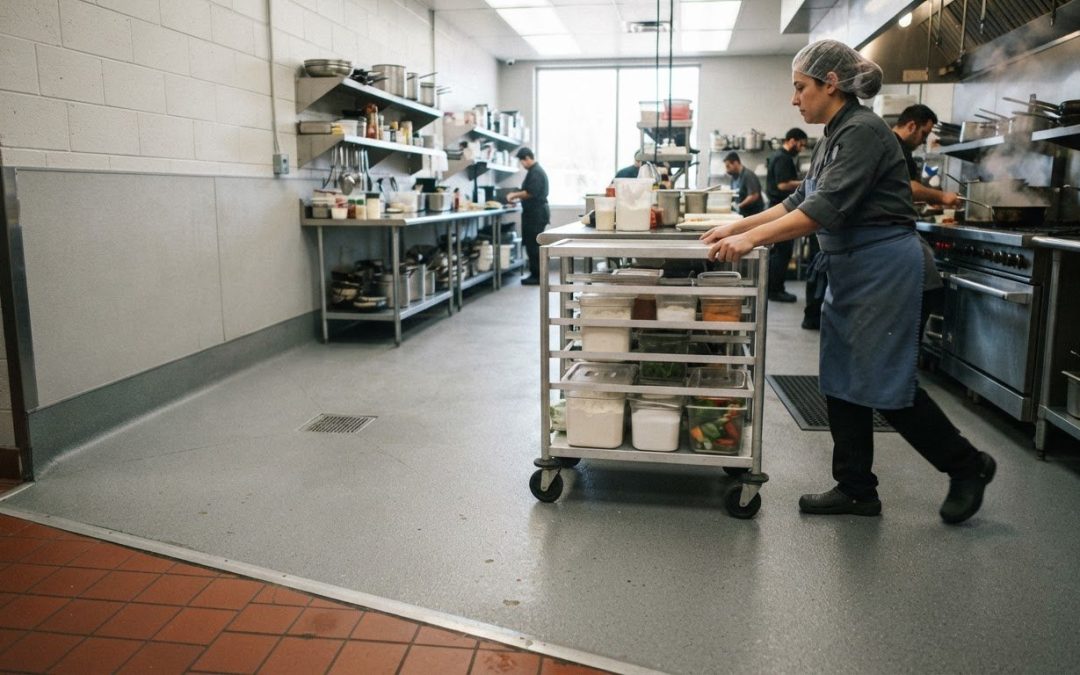
The best commercial kitchen floor isn’t one material for every operation. The FDA Food Code calls for floors to be smooth, durable, easily cleanable, and non-absorbent. For commercial kitchen flooring in Salt Lake City, compare quarry tile, epoxy, stained concrete, and vinyl against those needs, along with your kitchen’s wet areas, cleaning routine, and tolerance for installation downtime.
It makes sense to prioritize durability and easy cleaning, but the right choice also has to work with daily kitchen traffic and the realities of keeping a business running. A floor that suits one kitchen may not be the best fit for another.
This comparison looks at how flooring options perform, where their trade-offs matter, and what to plan for to reduce installation downtime. Use it to weigh surface performance, maintenance, and disruption before choosing.
Key Takeaways
- Match the floor to heavy equipment, foot traffic, spills, and cleaning routines rather than choosing by appearance alone.
- Compare quarry tile, epoxy, stained concrete, and vinyl by their maintenance needs and how they handle daily kitchen demands.
- Plan installation around cure time, work zones, and reopening needs to reduce disruption to kitchen operations.
- Use the comparison table and decision guide to narrow your options based on the conditions that matter most in your kitchen.
- Explore commercial coating solutions when your facility needs durable flooring suited to demanding work environments.
What is the Best Flooring for a Commercial Kitchen?
The right floor depends on equipment loads, foot traffic, spills, and cleaning needs. The FDA Food Code says kitchen floors need to be smooth, durable, easily cleanable, and non-absorbent. Choosing commercial kitchen flooring in Salt Lake City means matching those criteria to the demands of each work area.
Durability Under Kitchen Demands
Heavy equipment and repeated traffic can wear surfaces and stress seams, grout, or coatings. Quarry tile handles demanding use, but its grout needs regular attention; epoxy creates a seamless surface, while stained concrete depends on its protective sealer. Vinyl is softer underfoot, yet back-of-house commercial vinyl floors often fail within 3 to 7 years.
Slip-Resistant Flooring Options
Rubber flooring is described as slip-resistant, and its high-friction surface can help reduce slipping. It’s recommended for kitchen areas that get a lot of water. Vinyl is described as less slip-resistant than other kitchen flooring types, so compare surfaces based on wet-zone conditions and the tasks performed there.
Commercial Kitchen Floor Health Codes
The FDA Food Code says kitchen floors need to be smooth, durable, easily cleanable, and non-absorbent. These criteria are useful for Salt Lake City and Utah kitchens, but they do not establish a separate local code or approval process. Compare each surface against all four properties, especially in areas exposed to spills and chemicals.
Match cleaning practices to the material. Quarry tile can be cleaned with neutral cleaners, with daily maintenance and weekly scrubbing using a deck brush. Epoxy and stained concrete depend on intact, cleanable surfaces. Vinyl is easy to clean, but its shorter back-of-house lifespan may mean earlier replacement. The right commercial kitchen flooring in Salt Lake City should also fit the team’s routine for maintaining seams, grout, and sealers.
| Flooring | Heavy traffic and equipment | Spills and cleaning | Key consideration |
|---|---|---|---|
| Quarry tile | Durable | Neutral cleaners; maintain grout | Regular grout care |
| Epoxy | Seamless surface | Cleanable, non-absorbent when properly installed | Allow curing time |
| Stained concrete | Depends on sealed surface | Sealer protects porous concrete | Maintain the seal |
| Vinyl | May wear sooner in back-of-house use | Non-porous and easy to clean | Often fails within 3 to 7 years |
Choose a surface that fits your traffic, wet areas, cleaning routine, and ability to maintain seams, grout, or sealers.
Quarry tile compared with epoxy, stained concrete, and vinyl flooring
Quarry tile, epoxy, stained concrete, and vinyl each respond differently to kitchen conditions. Compare their joints, surface resistance, maintenance needs, and suitability for industrial traffic before choosing.
For restaurant floors, quarry tile is a modular ceramic surface, while epoxy forms a seamless resin floor. Urethane cement is another resin-based option, but its performance depends on the specified system and installation. Compare all three by how they handle equipment, spills, cleaning, and the existing substrate.
How the Materials Differ
Quarry tile does not need a top coating, and individual damaged ceramic tiles can be replaced without shutting down the kitchen. Grout still requires maintenance. Epoxy avoids tile joints across the coated area, but significant pressure can mean replacing epoxy or polyurethane resin flooring every five to ten years. Stained concrete leaves the existing slab visible, but concrete is porous and needs a coating to seal its openings and reinforce it.
Vinyl is non-porous, durable, and easy to clean, with a variety of colors, textures, and styles. Back-of-house commercial vinyl flooring often fails within 3 to 7 years. Vinyl comes as sheets, tiles, or planks; seams and edges are practical considerations wherever spills can reach the substrate. Linoleum and rubber are also available categories, but their suitability depends on the kitchen’s wet zones and cleaning demands. Rubber is recommended where copious amounts of water will be on the floor.
Wear, Spills, and Common Failures
Common failure points include worn grout, damaged tile, deteriorated coatings, and vinyl wear. Reduce avoidable problems by matching the surface to traffic and spill exposure, maintaining grout or protective coatings, and addressing damage promptly. Avoid unglazed ceramic in industrial kitchens because it is porous and can absorb bacteria and germs. A quality glaze can protect ceramic tile from spills, abrasion, and impact.
Substrate condition matters especially for vinyl and resin finishes. A sound, prepared base supports consistent installation; existing damage or surface irregularities can complicate the finished floor. Stained concrete also depends on its protective coating, since untreated concrete remains porous. For epoxy, plan around curing: professionally installed commercial kitchen epoxy may need 24-48 hours before reopening. That timing can shape whether the work is practical during a short closure.
Choose quarry tile for a replaceable ceramic surface, epoxy for a seamless resin floor, stained concrete for a coated slab, or vinyl where its wear profile fits the operation. Compare the resinous flooring approach with the kitchen’s load, spills, substrate, and closure plan.
Reducing kitchen downtime during flooring installation
Base reopening plans on the flooring system’s installation sequence, cure requirements, and kitchen layout. When replacing a restaurant floor, map equipment removal, surface preparation, coating work, and cleaning before scheduling the closure.
Epoxy installation can require 24-48 hours to cure before reopening. That cure period is only one part of the schedule: preparation, application, and the final cleaning also affect when staff can return. Build those stages into the closure plan, and keep kitchen equipment and supplies out of areas where they could obstruct work or collect dust.
Sequence Work Around the Kitchen
Where the layout and installation method allow, divide the floor into practical work zones. A kitchen with separate prep and service areas, for example, can schedule equipment moves by zone while preserving access to essential operations. Confirm the sequence with the installer, and coordinate staff cleaning, food storage, and equipment relocation around each completed area.
Polyaspartic coatings and epoxy systems do not share a universal installation or cure schedule. Follow the system’s stated cure instructions when setting reopening timing. Do not assume a polyaspartic coating will cure within the one-hour period associated with PMMA resin flooring; these are different materials. Account for the preparation and application steps, and when the floor can handle foot traffic, equipment, and cleaning.
Standards, Preparation, and Damage Prevention
Installation quality affects floor performance and can help prevent damage that causes further disruption. Quarry tile installation follows ANSI standards for products and installation. Before work begins, agree on the sequence for removing existing flooring, preparing the substrate, installing the new surface, and cleaning the work area. Clear instructions help kitchen staff avoid unfinished flooring and keep debris out of food-preparation areas.
Ask the installer for written warranty terms and clarify what they cover, such as materials, installation, or specific damage exclusions. Permit needs depend on project scope and applicable local requirements; establish responsibility for permits before scheduling. Include these details in the project plan, not in a last-minute reopening decision.
Commercial flooring contractors who install resinous coatings handle epoxy and polyaspartic systems, while tile contractors install quarry tile. For a Salt Lake City kitchen, choose an installer experienced with the specific system and installation sequence. Discuss substrate preparation, cure instructions, work zones, and cleaning plans together. A clear schedule helps coordinate installation with equipment moves and reopening, while limiting avoidable contact with uncured coatings.
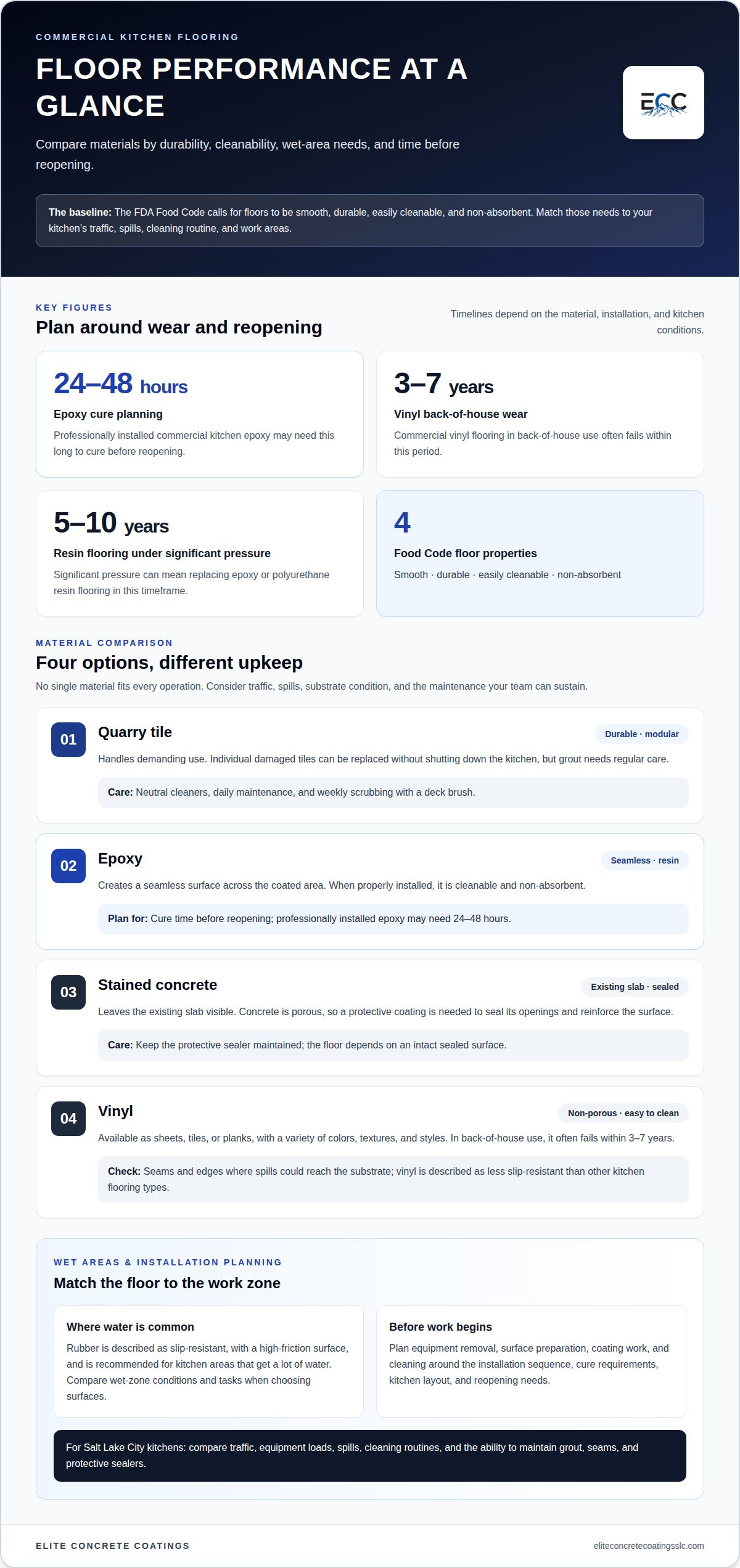
Commercial kitchen flooring options
A restaurant floor must stand up to food preparation, grease, equipment movement, and repeated cleaning. Consider the surface, seams, and maintenance routine together. A material that’s easy to clean in an open prep area may need different care near a sink or cooking line.
Tile and Resin Surfaces
Quarry tile provides a durable ceramic surface, and individual damaged tiles can be replaced. Grout creates joints that need maintenance, especially where grease and food debris collect. Glazed ceramic tile is easy to clean, while unglazed ceramic is porous and can absorb bacteria and germs. Choose based on the kitchen’s cleaning demands and exposure.
Epoxy coatings create a seamless surface that is easy to clean, without tile grout lines across the coated area. Epoxy coatings may be suitable for food-service areas, depending on the product and installation. Coved bases can also eliminate the 90-degree wall-floor corner where grease and bacteria may accumulate. These details can support hygiene, but the installation and cleaning routine still matter.
Concrete, Vinyl, and Rubber
Concrete offers a different starting point. It is porous, so it needs a coating to seal its openings and reinforce the material. Polished or properly sealed concrete can suit commercial settings, while stained concrete relies on its protective coating. Consider spills, cleaning chemicals, and stains when comparing a coated slab with tile or epoxy.
Vinyl offers a variety of colors, textures, and styles, with resources like mcgrathfloordesign.com showcasing how different wear layers and finishes perform in high-traffic settings. Its soft, flexible feel can make standing and walking more comfortable, and its non-porous surface is easy to clean. However, back-of-house commercial vinyl floors often fail within 3 to 7 years. Rubber flooring is soft and elastic while retaining strength; its high-friction surface can help reduce slipping and resist staining, moisture, and impact.
- Quarry tile: A durable ceramic option with grout joints to maintain.
- Epoxy: A seamless coating suited to easy cleaning and food-service environments.
- Coated concrete: A concrete surface sealed to close pores and reinforce the slab.
- Vinyl: A flexible, easy-to-clean choice with varied finishes and a shorter back-of-house lifespan.
- Rubber: A resilient option for wet areas and standing comfort.
Commercial kitchen anti-fatigue mats offer another targeted option: rubber mats are described as slip-resistant, grease-resistant, and comfortable underfoot. Use them to support a defined workstation, not as a substitute for flooring suited to the whole restaurant. Match each option to its location, cleaning demands, and exposure to grease or water.
Comparing commercial kitchen flooring options
A useful comparison goes beyond durability. For a restaurant, assess each floor’s slip resistance, cleanability, repair approach, substrate needs, and installation disruption. Then consider temperature exposure, cleaning chemicals, and whether the surface must accommodate different work zones. These criteria reveal trade-offs that a finish sample alone can’t show.
| Option | Surface and cleaning | Repair and practical fit |
|---|---|---|
| Quarry tile | Individual ceramic units with grout joints | Damaged tiles can be replaced individually |
| Epoxy | Seamless resin surface | Resin damage may require full replacement |
| PMMA resin | Seamless, monolithic, non-porous surface | Repairable resin flooring option |
| Vinyl | Available in varied colors, textures, and styles | Consider traffic and floor condition |
| Rubber | High-friction surface | Can help reduce breakage from dropped glassware |
| Sealed concrete | Coated concrete surface | Depends on maintaining its protective seal |
Repair strategy is another practical difference. PMMA is the only resin flooring type described as repairable; other resin types need complete replacement when damaged. Quarry tile offers a different approach: replace a damaged tile instead of the whole floor. That can matter in a busy kitchen where localized damage needs attention without obstructing the entire operation.
Porosity and cleaning also distinguish the options. PMMA creates a non-porous surface that’s easy to clean. Concrete is porous and needs a coating to seal its openings. Vinyl flooring is non-porous and comes in a range of colors, textures, and styles. Consider how seams, grout, and protective coatings fit into the kitchen’s regular cleaning plan.
Assess slip resistance in the context of the actual work area. Rubber flooring has a high-friction surface that can help reduce slipping, and it’s recommended for areas that get a lot of water. Dropped glassware is another consideration: rubber can reduce the chance of glass cracking or shattering. Match surfaces to wet zones and glass-handling stations rather than treating the whole kitchen alike.
Use this decision sequence: identify the floor’s main exposure, compare cleaning and repair needs, then check substrate condition and installation timing. Include temperature changes as a site condition to assess, not as an assumed performance rating. For a coated concrete surface, review how polished concrete systems fit the kitchen’s needs.
Cost is another consideration, but compare quotes alongside operational needs rather than letting price decide on its own. Use the same project assumptions for each proposal: clarify what surface preparation, removal, edge details, and cleanup include, and confirm that the quoted area matches the planned work zones. This makes estimates easier to compare without treating different flooring systems as interchangeable.
A price comparison is most useful when weighed against the needs identified for each space. Check that the finish suits the exposure and cleaning routine, and consider its repair approach alongside the disruption localized damage could cause. For coated concrete, include the existing surface’s condition and the protective seal in your review. These checks keep the decision grounded in the kitchen’s needs, not just appearance or a single quoted figure.
Elite Concrete Coatings: Warehouse Coatings
When your comparison points to a coated commercial floor, Elite Concrete Coatings can help. Its Warehouse Coatings and Non-Slip Coatings serve demanding work environments where surface performance and traction matter. For a kitchen project, focus the conversation on the existing concrete, work areas, and conditions the floor needs to handle.
Warehouse Coatings can suit broader commercial flooring needs, while Non-Slip Coatings are relevant when traction is a priority. These options can inform your decision, but the floor still needs to fit the kitchen’s cleaning routine, wet zones, and installation plan.
Contact Elite Concrete Coatings to discuss flooring for your commercial space.
Make Your Next Flooring Decision With Confidence
Make your final selection based on how the kitchen works, not just how a sample looks. Map high-traffic areas, surfaces exposed to water or grease, and the cleaning routine your team can maintain. This creates a practical brief for comparing commercial kitchen flooring in Salt Lake City and planning work around operations.
Bring those priorities to a conversation about your concrete floor and coating needs. Elite Concrete Coatings offers Warehouse Coatings, Non-Slip Coatings, and Parking Decks & Garages for commercial and industrial coating needs, including situations where traction or a hard-working floor surface matters.
Share the conditions your floor needs to handle and the outcome you’re aiming for. Contact Elite Concrete Coatings to discuss your commercial flooring project. A clear starting point can help you move toward a floor that fits your facility and supports the work ahead.
Frequently Asked Questions
What flooring materials are best for commercial kitchens in Salt Lake City?
Quarry tile, epoxy, coated concrete, and vinyl can each suit a commercial kitchen, depending on the work area. On a busy cookline with frequent spills, compare cleanability and the upkeep of seams or joints. For a concrete slab in a prep area, consider a coated finish. Vinyl may suit a lower-impact zone if its wear profile fits. Choose by area, not appearance alone.
What are the prices per square foot for commercial kitchen flooring installation in Salt Lake City?
There is no single price per square foot for every flooring material and kitchen. An estimate depends on the selected surface, the existing floor’s condition, preparation work, and the area being covered. A kitchen with a damaged substrate or difficult equipment access may need a different scope from one with a clear, sound floor. Elite Concrete Coatings provides a free quote; request one to discuss your project.
How should commercial kitchen flooring be installed, including floor drains, coving, and slope?
Plan drains, floor slope, and perimeter details together before installation. Map where water needs to flow, then coordinate the finished floor elevation with each drain opening and adjacent doorway. Specify coving at the wall-floor junction where it suits the space. Planning these details together helps avoid awkward transitions and supports cleaning around drains, edges, and equipment bases.
How long does commercial kitchen flooring installation take, and can a restaurant stay open?
Installation time depends on the floor area, preparation, material, and access to work zones. Epoxy may need 24-48 hours to cure before reopening, so include curing time in the closure schedule. A restaurant can keep operating only in areas physically separated from active installation and equipment movement. Plan service around the work zone, and reopen the treated area after its required cure period.
What warranties and permits should Salt Lake City businesses check before installing kitchen flooring?
Ask for written warranty terms and clarify whether they cover materials, installation, or specific damage exclusions. Permit needs depend on project scope and applicable local requirements, so establish responsibility before scheduling.
Which Salt Lake City contractors install commercial kitchen flooring?
Commercial flooring contractors install resinous coatings such as epoxy and polyaspartic systems, while tile contractors install quarry tile. Choose an installer experienced with the flooring system and installation sequence.