

Commercial warehouse floors take a beating. Even high-quality concrete coatings won’t last indefinitely.
Heavy forklift traffic, pallet jacks, large machinery, chemical spills, rolling loads, and foot traffic will all begin to wear down your warehouse floor over time. What was once a shiny seamless floor can start showing
signs of wear such as scratches, dull spots, peeling, cracks, or worn traffic lanes.
So how do you know if your warehouse floor just needs a new top coat or if it’s time to consider your flooring options and get a whole new resurfacing system?
Commercial businesses in Utah can save themselves time and money by knowing the difference. Here are some signs it may be time to replace your warehouse floor.
1. The Surface has Lost its Shine
A dull looking warehouse floor does not always require replacement. Often times the coating is still properly adhered to the concrete, it has just worn some of the shine away through abrasion and use.
This can be especially prevalent around areas of:
- Frequent forklift traffic
- Pallet jack movement
- Heavy cleaning
- Repeated foot traffic
- Rolling carts
If the coating itself is still intact, and the concrete under has not begun to deteriorate, then a simple recoat could be all that is needed to restore shine and protection.
2. Forklift Lanes are Wearing Through
Areas of heavy traffic are one of the most obvious places wear and tear will show on warehouse floors.
Forklift traffic usually travels through the same lanes each day, which can lead to noticeable wear patterns such as:
- Main aisles
- Loading zones
- Shipping areas
- Production lines
- Turning areas
If your coating is thin but hasn’t begun to peel or flake away, you may be able to get more life out of your floor by applying a new topcoat.
If the bare concrete is showing through though, more extensive surface prep and recoating will be needed.
3. The Coating is Peeling or Delaminating
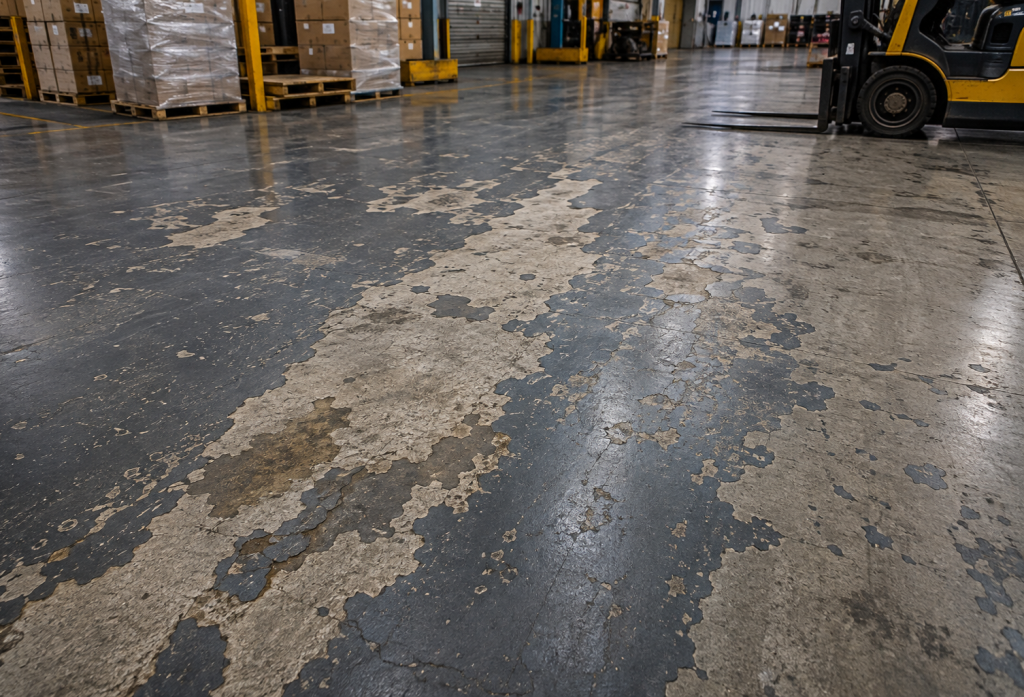
Warehouse Floor Replacement Due to Coating Damage
Peeling is a significant warning sign.
If your coating is lifting from the concrete, it could be due to:
- Poor original surface preparation
- Moisture problems
- Contamination
- Heavy impact
- Coating failure
- Age-related deterioration
Once your coating starts coming off, applying another layer on top is generally not going to fix it.
Usually, you’ll want to remove the failed coating so that you can properly prepare the concrete before applying a new coating system.
4. Bare Concrete is Showing
If you’re seeing large areas of exposed concrete, the coating is failing.
Once concrete is exposed, it’s more susceptible to:
- Staining
- Dusting
- Oil absorption
- Chemical damage
- Surface wear
- Moisture penetration
Occasionally, small worn areas can be repaired. However, if large areas are affected then your floor will need more than just a touch-up.
It’s best to have your floor inspected by a professional who can advise if your surface can be recoated or if a full system replacement is a better option.
5. Cracks are Getting Worse
Yes, concrete cracks. But does every crack mean you need to replace your coating? Not necessarily.
Hairline cracks that remain stable over time can often be repaired prior to applying a new coating system.
More troublesome are:
- Cracks that continue to widen
- Multiple connected cracks
- Uneven slab movement
- Spalling around the crack
- Moisture entering through cracks
If the substrate (concrete) is moving, shifting, or deteriorating you should try to correct the issue before applying another epoxy coating. Putting epoxy over moving concrete can only cause the coating to fail prematurely.
6. The Floor has Deep Scratches and Gouges
Surface scratches are common in warehouses that get a lot of use.
Deep gouges can cut all the way through the coating system and into the concrete substrate.
Heavy damage is typically caused by:
- Dragging equipment
- Forklift forks
- Dropped machinery
- Metal pallets
- Sharp objects
- Heavy impacts
Localized repairs may be possible if the damage is confined to a few areas. If your entire floor is heavily scratched and worn down, recoating may be a better option.
7. The Floor is Becoming Difficult to Clean
Ease of maintenance is one of the advantages of coated concrete floors.
If you find that your warehouse floor is starting to retain:
- Oil
- Grease
- Dirt
- Tire marks
- Chemicals
- Stains
…the sealant is likely wearing off.
When intact, a good coating creates a smooth surface that is easy to sweep, mop and scrub.
However, if your concrete coating is porous or worn down from use, cleaning may require more effort and lead to poorer results.
It might be time to recoat the floor.
8. The Floor has Lost Slip Resistance
Some warehouse floors are textured or treated with anti-slip additives during installation.
Heavy traffic wear and repeated cleaning will eventually diminish the texture built into the floor.
A slicker floor can pose safety risks, especially in areas that see:
- Water
- Oil
- Snow
- Cleaning chemicals
- Heavy pedestrian traffic
Recoating your floor is a chance to restore traction where necessary. You can even customize different levels of texture in different areas of the warehouse.
9. Safety Lines and Floor Markings are Fading
Floor Markings: Many warehouse floors have floor markings that indicate:
- Pedestrian walkways
- Forklift lanes
- Loading zones
- Storage areas
- Restricted spaces
- Equipment locations
When these start to fade, the whole warehouse floor can start to look dirty.
If the base coating is still intact, all you may need to do is apply a new topcoat and repaint your floor markings.
This can drastically help with appearance and organization.
10. Chemical Damage is Visible
Certain chemicals will harm some coatings more than others.
Look for:
- Discoloration
- Soft spots
- Bubbling
- Peeling
- Etching
- Surface breakdown
If oils, solvents, cleaners or industrial chemicals are common in your warehouse, take these into consideration when selecting your replacement system.
You may need to upgrade the chemical resistance versus what was originally on the floor.
When is Recoating the Better Option?
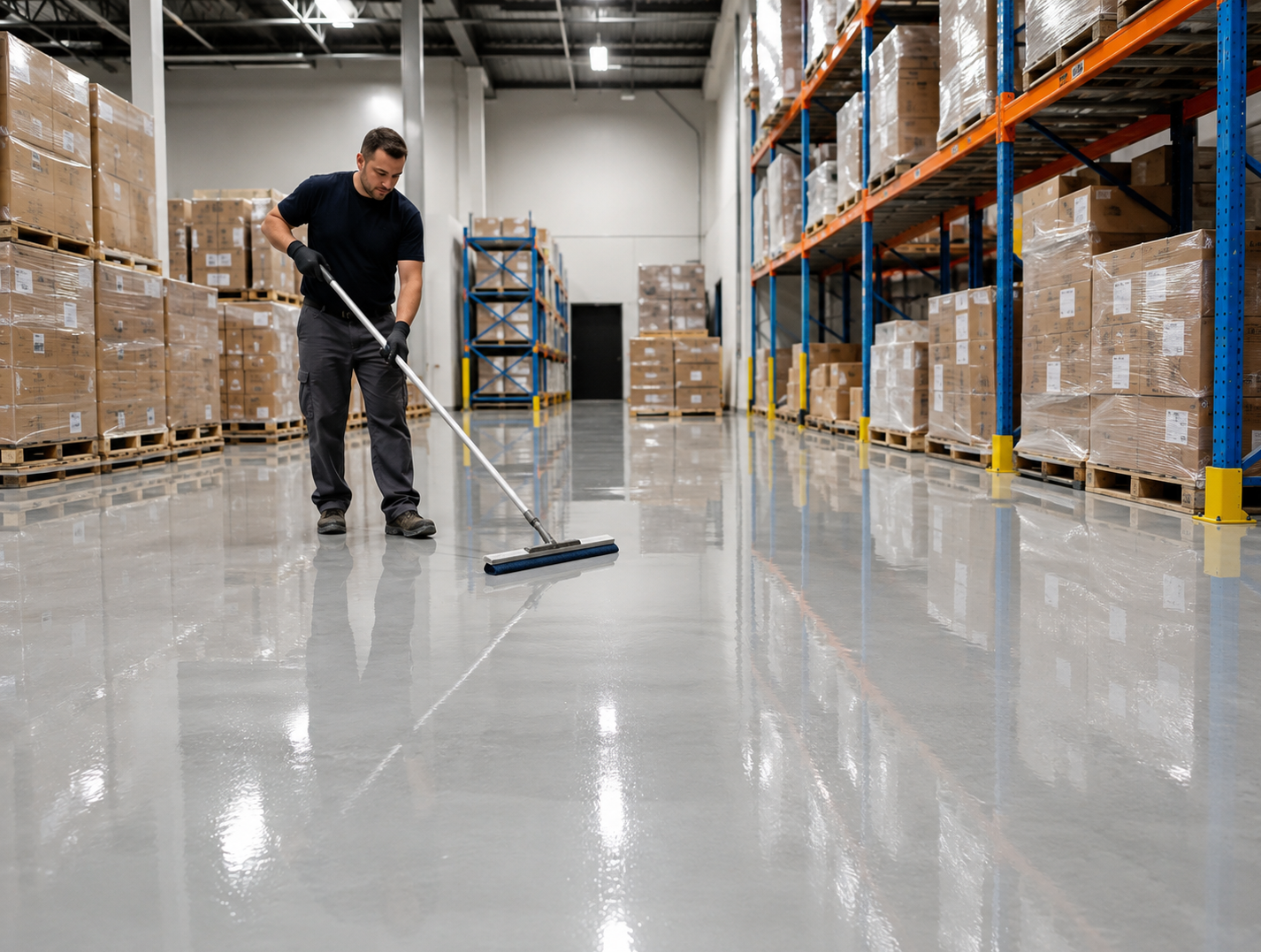
Warehouse Epoxy Floor Recoating
Scenarios in which recoating may be the optimal solution:
- The existing coating is still firmly bonded
- Damage is mostly cosmetic
- The surface is dull or scratched
- Traffic lanes are beginning to wear
- Safety markings need refreshing
- The concrete underneath remains stable
- There are no major moisture problems
By adding another layer of coating, you can renew the look of your pavement and increase its protection without having to strip away the entire existing system.
Of course, the old surface will still need to be prepared properly so the new coating can adhere.
When Should the Floor be Replaced?
When complete replacement is necessary:
- Large sections are peeling
- The coating is delaminating
- Bare concrete is exposed throughout the facility
- Moisture is causing coating failure
- The concrete is heavily damaged
- Previous coatings are failing in multiple layers
- Chemical damage is widespread
Mechanical removal of the existing coating may be necessary prior to installation of a new system.
How Long Should Warehouse Floor Coatings Last?
It really depends.
The life of a warehouse floor depends on:
- Traffic volume
- Forklift use
- Equipment weight
- Chemical exposure
- Surface preparation
- Coating thickness
- Maintenance
- Installation quality
For light traffic the wear and tear on a warehouse floor will be significantly less than a warehouse that sees continuous use of forklifts all day long.
This is why routine inspections are helpful.
Identifying surface degradation early may provide the opportunity to recoat the floor before further costly damage is realized.
Can you Recoat Epoxy Without Removing it?
Occasionally.
If your epoxy is still firmly attached and holding up well, you may be able to machine prep the surface and recoat with a compatible product.
Always inspect the floor first though. You don’t want to apply a new coating over failing or flaking epoxy as it will seal in the issue and cause it to fail again.
Floor prep should be done professionally.
Why Surface Preparation Matters During Recoating
You have to prepare a surface, even if you’re just recoating.
You may need to:
- Cleaned
- Degreased
- Mechanically abraded
- Repaired
- Profiled for adhesion
You want to provide a surface that will allow your new coating to adhere to properly.
Rolling epoxy over a glossy old coating without surface prep will peel or delaminate.
Plan Around Warehouse Downtime
Floor recoating or replacement will temporarily impact your operations. That’s why scheduling is important.
Here are some things to keep in mind:
- Cure time
- Equipment access
- Shipping schedules
- Production needs
- Temperature conditions
- Section-by-section installation
Phasing warehouses allows for completion of the job with minimal downtime.
Work with your contractor to schedule your project around business needs. .
Warehouse Floor Recoating in Utah
Scratches, dull spots, peeling paint, stains and bare concrete can be reasons to recoat your warehouse floor. Elite Concrete Coatings can help you decide if recoating your floor is better than replacement.
An onsite evaluation by the experts will reveal what condition your existing coating is in, what condition the concrete is in and how much wear there is from forklifts and equipment.
Whether your warehouse needs a simple topcoat refresh or an entirely new flooring system installed, we want to make sure we install what is best for your warehouse needs.
Call Elite Concrete Coatings today at (801) 946-0929 to learn more about warehouse floor recoating and commercial concrete coatings for your Utah facility. You can also fill out our online form and one of our helpful team members will be in touch.