
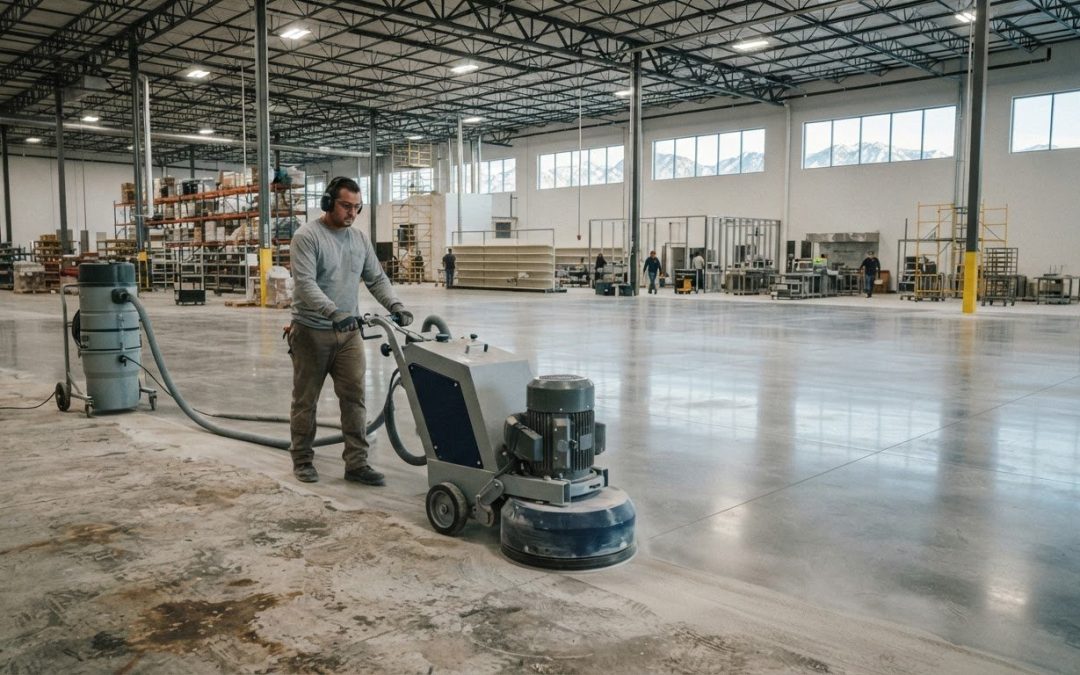
What if the floor’s biggest weakness is hiding beneath the coating you’re ready to install? Uneven slabs, old epoxy, carpet adhesive, and porous concrete can all undermine the finished surface. Professional concrete grinding services Salt Lake City businesses need can create a clean, properly prepared foundation for a flooring system.
If you’re concerned about trip hazards, residue, concrete dust, or a new coating failing to bond, start by considering the slab’s preparation. Grinding removes surface contaminants and helps create the profile needed for adhesion. Elite Concrete Coatings is a family-owned Utah company offering commercial and industrial floor coatings, polished concrete, and grind and seal services. Preparation is an important part of planning these flooring systems for facilities in Salt Lake City and across the Wasatch Front.
This guide explains how grinding can reduce some high spots, prepare concrete for coatings or polishing, and support a cleaner work area. It also covers practical factors to consider when choosing surface preparation, so you can compare options based on the slab and the floor’s intended use.
Key Takeaways
- Learn how concrete grinding can prepare warehouse and commercial floors for coatings or polished concrete.
- Understand how the concrete surface profile helps guide preparation for the flooring system you’re planning.
- See why coating preparation and polishing use different grinding approaches, and how surface texture supports coating adhesion.
- Explore how winter salt and concrete spalling can affect slabs, and why the remaining concrete must be assessed before choosing a finish.
- Find out what to consider when comparing commercial flooring options in Salt Lake City, Ogden, Provo, and other Northern Utah communities.
Professional Concrete Grinding Services in Salt Lake City: Preparing the Slab
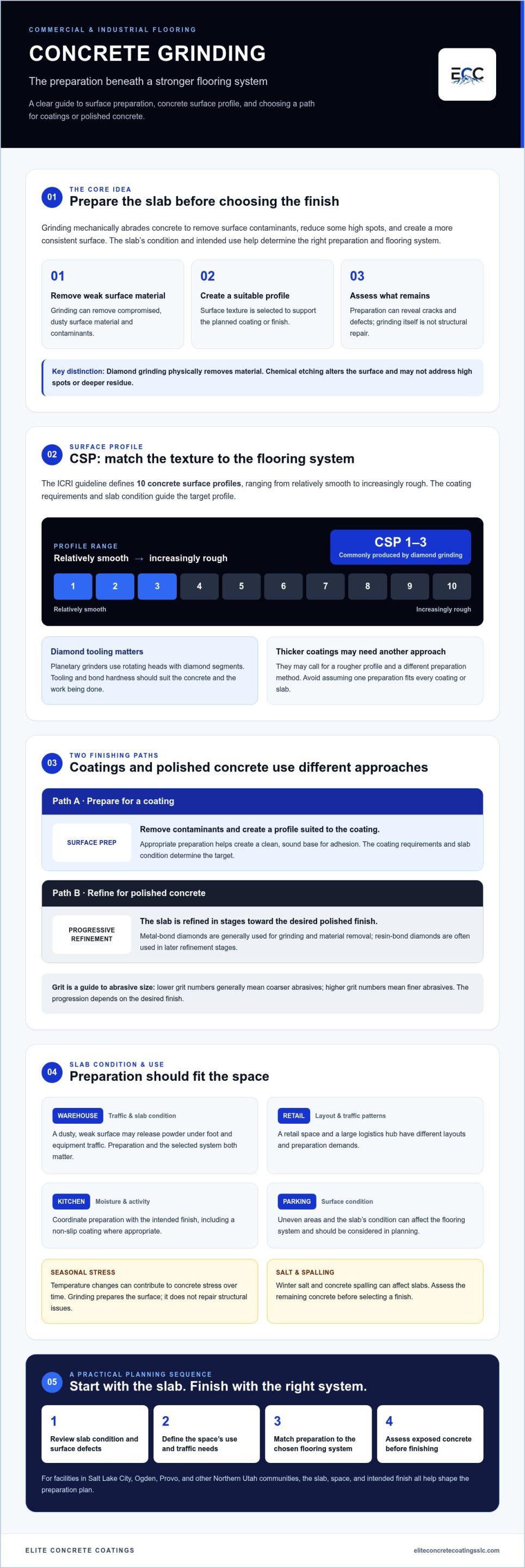
Concrete grinding is a mechanical preparation process. Specialized equipment abrades the slab to remove surface contaminants, reduce high spots, and create a more consistent surface. In a Salt Lake City warehouse, that preparation may help address a weak, dusty surface layer that releases powder under foot and equipment traffic. Grinding removes compromised surface material, but a durable result also depends on choosing a coating or polished concrete system suited to the slab.
Unlike chemical etching, which uses a solution to alter the surface, diamond grinding physically removes material. It can reduce some unevenness while preparing concrete for its next finish. Etching may not address high spots or deeper residue. The right approach depends on the slab’s condition and intended use. Elite Concrete Coatings offers warehouse coatings and other commercial flooring systems, along with polished concrete and grind and seal services. Discussing the planned finish helps clarify what preparation the project may require.
Why Northern Utah Concrete Needs Specialized Care
Seasonal temperature changes can cause concrete to expand and contract, contributing to stress over time. Grinding prepares the surface for a flooring system, but it is not a structural repair. Preparation can make cracks and surface defects easier to see. A qualified professional can then assess whether further attention is needed. For a high-performance coating, appropriate surface preparation helps create a clean, sound base for adhesion.
The finish can follow a different path, too. Polished concrete involves progressively refining the slab, and this polished concrete process differs from grinding that prepares a surface for a coating. Learn more about resinous commercial flooring and how preparation relates to the finished system.
Commercial vs. Industrial Grinding Requirements
A Salt Lake City retail space and a large logistics hub have different layouts, traffic patterns, and preparation demands. Planning should account for the work area, slab condition, and selected flooring system rather than treating every floor the same. Parking structures also need careful consideration, since uneven areas and surface condition can affect the flooring system.
Commercial kitchens have a practical concern of their own: traction in spaces exposed to moisture and frequent activity. Surface preparation should be coordinated with the intended finish, including a non-slip coating where appropriate. A contractor providing concrete grinding services Salt Lake City businesses use should consider the slab’s condition, the space’s purpose, and the desired flooring outcome together. This assessment helps establish a suitable starting point for the finished floor.
The Mechanics of Precision Grinding: Understanding CSP and Tooling
Grinding is a technical preparation step, not a one-size-fits-all pass over the slab. The target is a concrete surface profile, or CSP, suited to the floor’s next use. The ICRI guideline defines 10 profiles, from relatively smooth to increasingly rough. Diamond grinding commonly produces CSP 1–3, while thicker coatings may call for a rougher profile and a different preparation method. The coating system’s requirements and the slab’s condition should guide the target.
Planetary grinders use multiple rotating heads fitted with diamond segments to abrade concrete across a broad area. Their movement helps create a consistent profile, while the selected tooling affects how quickly material is removed and how refined the surface becomes. Bond hardness matters, too. The bond holding the diamonds must suit the concrete’s hardness so the segments wear appropriately and continue exposing abrasive. Since concrete varies from slab to slab, tooling should be selected for the material rather than assumed based on location alone.
Diamond Tooling: The Secret to a Smooth Finish
Metal-bond diamonds are generally used for grinding and material removal, while resin-bond diamonds are often used in later refinement stages for polished concrete. The sequence moves from more aggressive material removal toward finer surface refinement, depending on the desired finish. Diamond grit describes the abrasive particle size, with lower grit numbers generally indicating coarser abrasives and higher numbers finer ones. Choosing an appropriate progression helps avoid an unnecessarily rough or inconsistent result.
Dust Containment and Facility Safety
Grinding concrete can release respirable silica dust, so effective collection and work-area controls matter. In an operating warehouse, dust could affect inventory, equipment, or HVAC systems. A shrouded grinder connected to a suitable dust-collection system, including HEPA filtration where required, helps capture dust at the source. This does not guarantee a completely dust-free environment. Containment depends on the equipment, setup, and work conditions.
OSHA’s construction silica standard sets a permissible exposure limit of 50 micrograms per cubic meter as an 8-hour time-weighted average. A qualified contractor should plan grinding controls around the work and applicable requirements. The FHWA also explains chemical deicer distress on concrete, useful context when assessing slabs affected by winter conditions.
For active commercial spaces, clear work-zone planning and dust collection can help limit disruption while crews prepare the floor. Elite Concrete Coatings offers industrial and commercial flooring systems, including warehouse coatings. If you’re comparing concrete grinding services Salt Lake City facilities may need for a coating or polished finish, explore Elite Concrete Coatings’ flooring services to review available systems.
Grinding for Coatings vs. Polished Concrete: Choosing Your Path
The right grinding approach depends on the finished floor you need. Prep grinding removes unwanted material and prepares the slab to bond with a coating. It may be more aggressive when crews need to remove old finishes or adhesives. Finish grinding uses progressively finer abrasives to refine concrete for polishing. The approaches share equipment and techniques, but their goals differ: one prepares the slab for another flooring layer, while the other refines the concrete itself.
For resinous flooring, grinding creates a mechanical anchor by exposing clean concrete with a profile suited to the coating system. Appropriate preparation helps the coating bond to the slab, but the required finish depends on the product and floor conditions. Explore resinous commercial flooring as an option for commercial spaces where a coating is the intended finish.
Preparing for High-Performance Coatings
Where old epoxy, urethane, or stubborn mastic remains, preparation may involve removing those materials before a new system is applied. The concrete can then be assessed and prepared for the selected coating. Facilities with specialized needs, such as tech spaces considering ESD coatings, should ensure the preparation plan aligns with the flooring system’s requirements. A flatter slab may matter for the intended look and performance, but grinding alone does not correct every structural issue.
Architectural Polishing and Refinement
Polished concrete follows a different progression. Grinding refines the slab through successive stages, and a densifier may be used to harden the surface before further polishing. The result is a finished concrete surface rather than a separate topical coating. Grind and seal also preserves the concrete’s appearance but adds a sealer, so maintenance and finish considerations differ. The best fit depends on the facility’s appearance goals, traffic, and care needs.
For a Salt Lake City facility manager, there is no universal winner for return on investment. Compare expected upkeep, traffic demands, desired appearance, and the disruption involved in installing and maintaining each system. A polished finish may suit a space that wants concrete’s natural character; a coating may better fit operational needs that call for a distinct flooring system. Matching the preparation method to the intended finish is central to that decision. Professional concrete grinding services Salt Lake City facilities use can help prepare a slab for either path.
Solving Salt Lake City’s Concrete Challenges: Salt, Spalling, and Slopes
Winter road salt can contribute to concrete deterioration in Salt Lake City garages and warehouse entrances. Salt-laden moisture enters the slab, and repeated freeze-thaw cycles can leave the surface flaky or spalled. The Utah Department of Transportation reports using more than 194,000 cubic yards of salt annually on Utah roadways, underscoring why local facilities should pay attention to exposed concrete.
Surface cleaning alone will not remove concrete that has already weakened or separated. Grinding can remove loose, damaged material and expose a sounder layer for assessment and preparation. It does not repair deep structural damage or guarantee that every salt-affected slab is suitable for a coating. A flooring professional should evaluate the concrete and determine whether further repairs are needed before selecting a system.
Repairing Salt and Freeze-Thaw Damage
Grinding through a flaky surface can help provide a stable base for a future coating, but the goal is not simply to reach “virgin” concrete. The remaining material needs to be assessed and prepared to match the coating’s requirements. For spaces where traction is a concern, commercial non-slip coatings may be an option to consider.
Slab Leveling and Joint Protection
High spots and curled joints can create abrupt transitions that increase trip risks and make forklift travel less comfortable. Precision grinding can reduce some unevenness, but it should not be treated as a way to correct every slope or structural movement. When deeper stabilization or slab lifting is required, exploring payment solutions helps property owners budget for major remediation; find out more about concrete repair financing options. In warehouses using automated equipment, evaluate floor transitions and overall condition before choosing a preparation plan.
Concrete joints need attention, too. Grinding can expose joint edges and help remove residue, while joint clean-out and suitable sealant address the joint itself. Properly prepared and sealed joints can help protect vulnerable edges from impacts and debris, but they will not stop underlying movement. Joint sealants are a distinct part of a comprehensive floor plan, not a substitute for assessing damaged concrete.
For commercial garages and warehouse slabs, a useful planning sequence is to assess the concrete, remove loose surface material, prepare for the selected finish, and consider joints and transitions. This is where concrete grinding services Salt Lake City facilities rely on can support a cleaner foundation without treating every slab as identical. Review the floor’s traction needs and possible non-slip coating options as part of the decision, or discuss your flooring project with Elite Concrete Coatings.
Flooring Options for Northern Utah Businesses
Choosing a flooring partner means trusting them with a surface your business depends on every day. Elite Concrete Coatings is a family-owned Utah company offering commercial and industrial flooring solutions across Salt Lake City and the Wasatch Front. Its services include warehouse coatings, non-slip and ESD coatings, polished concrete, and grind and seal applications.
Grinding is not an isolated step. The slab’s condition and the preparation it receives affect how well the finished flooring system can perform. Each stage should suit the facility’s use and the selected flooring. For broader commercial renovation projects where exterior masonry or interior timber also require surface care, specialist contractors such as Surfprep demonstrate how delicate substrates benefit from non-abrasive steam cleaning rather than aggressive mechanical abrasion. Discussing the project sequence and operational needs helps facility managers plan around the work.
Planning from Slab Condition to Finished Floor
A sound plan starts with understanding the slab, its existing surface, and what the floor needs to do. Rather than assuming every project requires the same preparation, consider factors such as the concrete’s condition, the facility’s traffic, and the intended finish. Clear communication about the work and its sequence helps facility managers coordinate around active operations and prepare for project-related disruption.
For a warehouse, the priority may be a coating system suited to regular equipment traffic. Another commercial space may call for polished concrete. Matching the preparation and finish to the facility’s purpose is central to choosing a flooring plan.
Flooring Options for Northern Utah Facilities
Elite Concrete Coatings offers warehouse coatings, ESD coatings, polished concrete, grind and seal, and flooring for parking decks and garages. These systems serve different needs, so compare the environment, expected traffic, maintenance preferences, and desired appearance. For a garage flooring project, review the available garage floor coatings and consider how they may fit your space.
When comparing concrete grinding services Salt Lake City businesses may need, consider both the slab and the outcome you expect. A flooring specialist can help connect the preparation approach with the planned coating or concrete finish.
Elite Concrete Coatings serves Northern Utah communities including Salt Lake City, Ogden, Provo, Lehi, West Jordan, South Jordan, Spanish Fork, Layton, and Syracuse. If you’re planning a commercial or industrial flooring project, discuss your facility, the condition of its concrete, and the flooring options you’re considering.
Build a Stronger Foundation for Your Facility
A durable concrete floor starts with preparation suited to the slab and its intended use. The right grinding profile helps prepare concrete for coatings or polishing, while attention to uneven areas and joints supports a more dependable finished surface. Choosing between a coating and polished concrete comes down to your facility’s traffic, performance needs, and preferred appearance.
For concrete grinding services Salt Lake City businesses can discuss as part of a flooring project, Elite Concrete Coatings brings its commercial and industrial flooring offerings to communities across the Wasatch Front. Its options include warehouse coatings, non-slip and ESD coatings, polished concrete, and grind and seal.
To discuss your slab and suitable flooring options, contact Elite Concrete Coatings. A conversation about the facility’s needs and intended finish is a practical first step toward planning the work.
Frequently Asked Questions
What is the difference between concrete grinding and polishing?
Grinding prepares concrete by removing surface material, contaminants, or high spots. Polishing is a multi-stage finishing process that refines the slab to achieve a smoother, often glossy appearance. Grinding may prepare a floor for a coating or serve as an early stage of polishing. The intended finish determines the preparation and sequence. Professional concrete grinding services Salt Lake City businesses consider should match the work to the slab and its use.
How much dust does concrete grinding create in a warehouse?
Concrete grinding can generate fine dust, including respirable silica, but shrouded grinders connected to suitable dust-collection systems can capture much of it at the source. The amount escaping into the work area depends on the equipment, setup, slab condition, and work practices. Dust collection does not mean a completely dust-free environment. Before work begins, discuss containment, protection for nearby inventory and equipment, and how the work area will be managed.
Can concrete grinding fix uneven slabs or trip hazards?
Grinding can reduce some high spots and abrupt transitions, which may help address certain surface-level trip hazards. It cannot correct every uneven slab, deep depression, curled joint, or underlying structural movement. A contractor should assess the floor to determine what grinding can reasonably address and whether other work may be needed. In a warehouse, consider how floor transitions affect forklifts, foot traffic, and equipment that relies on a consistent surface.
How long does the concrete grinding process take for a commercial space?
There is no one reliable duration for every commercial grinding project. The schedule depends on the size of the work area, concrete condition, existing coatings or adhesive, required profile, and site access. Dust controls and coordination around active operations can also affect the work plan. Ask the contractor to discuss your facility and explain the expected sequence, access needs, and any preparation required before grinding begins.
Is grinding necessary before applying a new epoxy floor coating?
Concrete generally needs appropriate mechanical preparation before an epoxy coating is applied, but the exact method and surface profile depend on the coating system and slab. Grinding can remove surface contaminants or old flooring material and create a profile that supports adhesion. Simply covering a dirty, weak, or incompatible surface can compromise the result. Have the contractor evaluate the concrete and confirm that the preparation plan fits the selected coating system.
Can you grind concrete that has been damaged by winter salt and ice?
Grinding may remove loose, flaky surface concrete caused by salt and freeze-thaw exposure, revealing a firmer layer for evaluation. It will not repair deep deterioration or restore concrete that has been structurally compromised. The slab should be assessed after damaged material is removed to determine whether it can support a new finish and what additional work may be needed. The right outcome depends on the remaining concrete, not just the visible surface.
What is a CSP rating and why does my contractor mention it?
A CSP, or Concrete Surface Profile, describes the texture of prepared concrete. The ICRI profile scale runs from CSP 1 to CSP 10, with higher numbers representing rougher profiles. Contractors discuss CSP because a flooring system needs a suitable surface texture to bond and perform as intended. The appropriate profile varies by product and application, so ask how the specified profile relates to your planned coating or polished finish.
Do I need to move all my equipment before the grinding service starts?
Not necessarily, but equipment and stored materials may need to be cleared from the areas being ground so crews can access the slab and manage the work safely. Requirements vary with the facility layout, equipment size, and project boundaries. Coordinate with the flooring contractor before scheduling work to identify what must be moved, what can remain, and how to protect nearby operations. This planning is useful for businesses in Salt Lake City, Ogden, Provo, and nearby Northern Utah communities.
Why does my warehouse floor keep producing dust even after cleaning?
Persistent powder on a warehouse floor often points to a weak surface layer rather than a housekeeping issue. Understanding concrete floor dusting prevention can help you identify whether excess water in the mix, improper finishing, or inadequate curing is causing the surface to shed material — and whether grinding, a coating, or another professional solution is the right next step.