

Over 80% of major retail chains build their storefronts around polished concrete, yet countless shop owners still battle peeling vinyl, chipping tile, and lackluster displays. Your floor isn’t just a walkway; it’s an active merchandising asset that shapes how shoppers perceive your brand. Investing in retail store polished concrete transforms raw slabs into durable, light-reflective surfaces that effortlessly withstand heavy rolling racks and steady foot traffic.
If you manage a commercial space in Northern Utah, you already know the dread of winter slush, tracked-in de-icing salts, and customer slip concerns. You deserve a showroom that looks high-end without demanding disruptive, round-the-clock waxing routines. In this guide, discover the top polished concrete finishes, design benefits, and maintenance strategies to elevate your retail store aesthetic. We’ll break down aggregate exposures, modern sheen options, and verified slip-resistance standards so you can plan your next flooring upgrade with total clarity.
Key Takeaways
- Discover how retail store polished concrete combines customized aggregate exposure with tailored sheen levels to produce a resilient, luminous showroom floor.
- Explore the visual and functional differences between clean cream finishes and bold aggregate blends to match your store’s brand aesthetic.
- Learn why properly refined concrete naturally meets national slip-resistance benchmarks, keeping your shoppers safe even during wet winter weather.
- Uncover proactive maintenance routines that shield high-traffic commercial walkways against abrasive dirt and corrosive de-icing salts.
- Understand the vital slab testing, joint sealing, and diamond-grinding stages Northern Utah specialists use to ensure lasting structural performance.
Why Modern Retail Stores Are Choosing Polished Concrete Flooring
Every retail sales floor tells a story the moment a customer crosses the threshold. Retail floors endure relentless punishment: thousands of walking shoes, grit-covered boots, rolling inventory carts, and accidental product spills. Traditional flooring often surrenders quickly under this strain. Peeling luxury vinyl tiles, stained carpets, and cracked ceramic grout lines convey neglect, quietly eroding customer trust and cheapening brand presentation.
Modern shop owners are abandoning fragile floor coverings in favor of structural refinement. As Wikipedia defines polished concrete, the process involves mechanically grinding, honing, and polishing concrete surfaces with bonded abrasives to achieve specified appearance and durability standards. Transforming a standard commercial slab into retail store polished concrete yields a dense, monolithic surface that works as an architectural sales asset. The refined finish eliminates grout lines that trap dirt, providing a smooth foundation that visually expands open floor plans while reducing maintenance friction.
The Aesthetic Advantage: Elevating Brand Perception
A refined concrete floor provides a clean, contemporary canvas that instantly puts merchandise center stage. From boutique apparel shops to modern tech storefronts, the surface bounces natural and overhead light across display fixtures. This ambient reflectivity brightens retail interiors naturally, cutting down on electrical overhead while making inventory colors pop. Retailers can curate the visual mood effortlessly, selecting custom dyes, warm earthy undertones, or minimalist industrial tones to build seamless transitions from entrance displays to checkout counters. For businesses planning facility upgrades, high-traffic commercial installations like polished concrete floors Atlanta exemplify how modern retail spaces leverage this surface for both style and performance.
Commercial Resilience Under Heavy Foot and Equipment Traffic
High sales volume requires industrial-strength backbone. Modern retail spaces depend on frequent restocking, which means heavy pallet jacks, stock carts, and constant rolling racks crossing the floor every morning. Standard topical floor sealers inevitably scratch, blister, and peel away under such rigorous shearing forces.
Investing in professional commercial polished concrete densifies the internal pore structure of the concrete itself. Because the surface is mechanically refined rather than layered with delicate film-forming coatings, it offers exceptional benefits:
- Eliminates unsightly black tire marks and rubber scuffs from rolling inventory equipment.
- Prevents surface delamination, bubbling, or edge chipping in busy checkout aisles.
- Maintains its structural luster across decades of uninterrupted retail store traffic.
Roundup of the Best Polished Concrete Finishes for Retail Environments
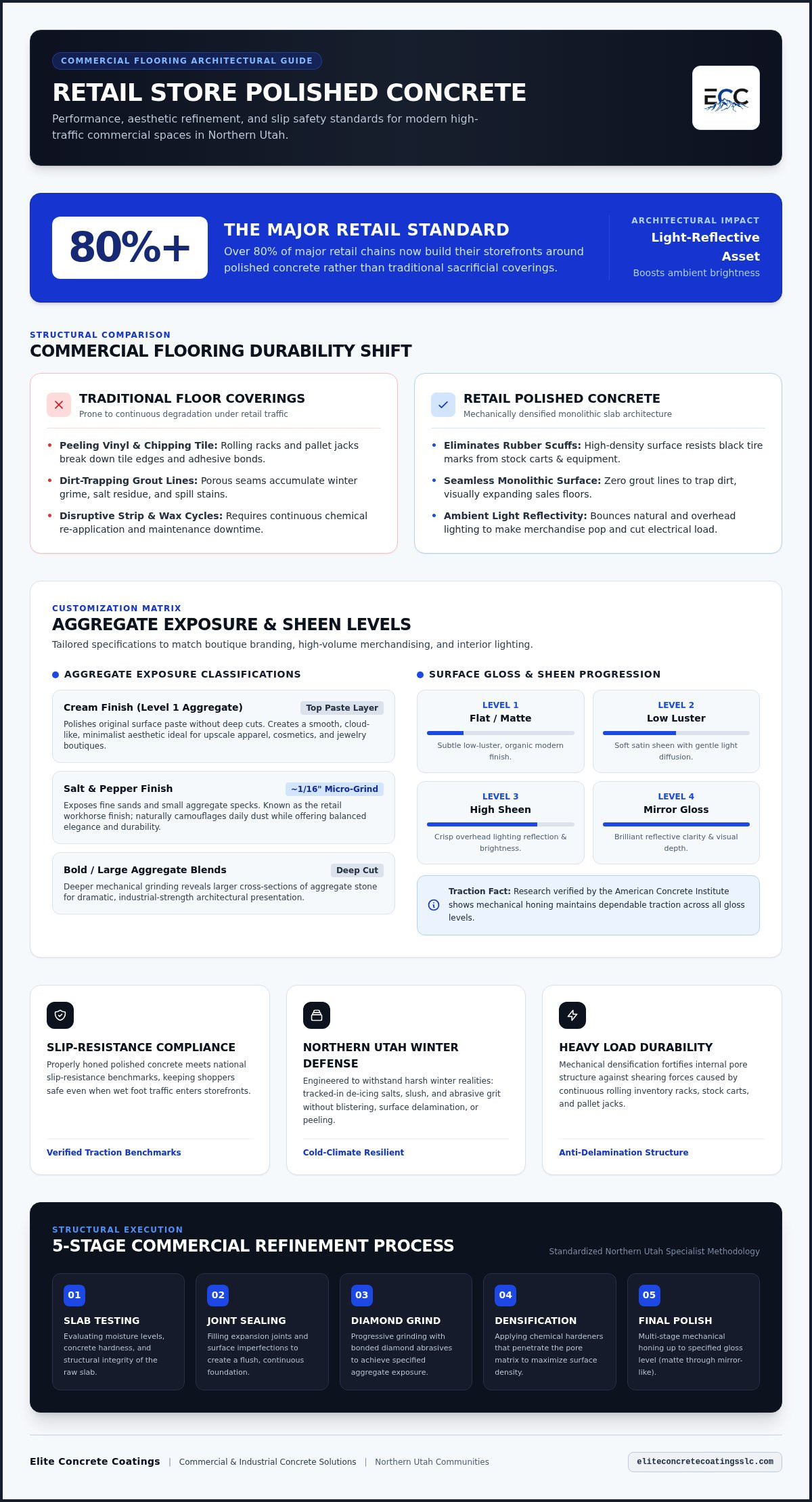
Tailoring retail store polished concrete comes down to two primary specifications: aggregate exposure and surface gloss. Aggregate exposure dictates how much natural stone shows through the cement matrix, while sheen ranges from a subtle, low-luster matte (Level 1) to a brilliant, mirror-like gloss (Level 4). Selecting the right pairing depends directly on your brand image, store lighting design, and daily customer volume.
Many business owners worry that higher gloss levels create slippery walking conditions. However, research documented by the American Concrete Institute on the slip resistance of polished concrete shows that proper mechanical honing preserves dependable traction across various finishes. This allows retail managers to balance striking visual clarity with dependable floor safety.
Cream Finish (Level 1 Aggregate) for Modern Minimalist Boutiques
A cream finish gently polishes the slab’s top paste layer without cutting deep enough to reveal underlying aggregates. It delivers a smooth, consistent, cloud-like aesthetic that complements upscale apparel boutiques, cosmetic studios, and modern jewelry displays. Because this delicate cut relies entirely on the original surface paste, it requires an exceptionally sound, well-poured concrete slab free from prior patch repairs or deep gouges.
Salt and Pepper Aggregate Finish for Busy Mainstream Retailers
By micro-grinding roughly 1/16 inch into the concrete, contractors expose fine sands and tiny aggregate specks. Often considered the retail workhorse finish, this salt-and-pepper look strikes an ideal harmony between architectural elegance and everyday utility. The speckled surface naturally camouflages light dust, shoe scuffs, and dried water spots between cleaning cycles, making it a reliable standard for hardware outlets, bookstores, and specialty grocers.
Medium to Large Aggregate Exposure for High-End Showrooms
Cutting deeper into the slab reveals substantial structural gravel, granite stones, and decorative river rock. This heavy exposure emulates classic Venetian terrazzo flooring at a fraction of the structural installation complexity. It pairs exceptionally well with satin or semi-gloss sheens in furniture showrooms, outdoor recreation stores, and luxury auto galleries across Northern Utah. If you are renovating a commercial building, consulting on tailored commercial polished concrete options helps identify the ideal aggregate depth and sheen for your space.
Slip Resistance and Customer Safety in High-Traffic Stores
One of the most persistent myths surrounding polished concrete is that a glossy finish inevitably creates an indoor ice skating rink. Retail operators often look at a highly reflective sheen and assume it presents an immediate liability for slip-and-fall claims. In reality, shine does not equal slickness. The glass-like appearance of retail store polished concrete comes from mechanical smoothing rather than slippery surface waxes or oily topical sealers.
Mechanical diamond grinding actually refines the microscopic peaks and valleys of the slab. When concrete is polished, it creates flat contact planes that maximize the surface area meeting customer shoe soles. This mechanical bond delivers dependable dry traction, easily satisfying commercial walkway expectations under normal operating conditions.
Understanding Commercial Traction and Safety Standards
Workplace and customer safety guidelines prioritize keeping walking paths clean, dry, and free of known hazards. While the Occupational Safety and Health Administration (OSHA) enforces hazard-free walking surfaces under 29 CFR 1910.22, the flooring industry measures dynamic traction using the national standard ANSI A326.3.
Under ANSI A326.3, hard interior surfaces subject to foot traffic when wet are generally benchmarked to maintain a wet Dynamic Coefficient of Friction (DCOF) of 0.42 or higher. Mechanically honed and densified concrete reliably meets dry commercial traction demands because it relies on penetrating lithium silicate hardeners. These chemical densifiers fuse into the concrete’s open capillary channels, hardening the matrix from within instead of sitting on top as a delicate, wear-prone plastic film.
Mitigating Wet-Weather Slip Hazards at Retail Entryways
Water, winter slush, and de-icing chemicals tracked past the front door represent genuine slip concerns across Northern Utah during winter months. While refined concrete provides strong grip when dry, sudden puddles at exterior doorways need proactive defense.
- Extended Walk-Off Mats: Placing at least 10 to 15 feet of commercial carpet mats at main entrances captures rain, melted snow, and shoe grit before it reaches bare polished floors.
- Specialized Transitional Coatings: For exterior ramps or wet vestibules exposed to driving weather, installing textured commercial non-slip coatings creates a secure transition zone for shoppers entering the building.
- Prompt Spill-Response Systems: Equipping staff with dedicated microfiber mops and placing safety signage near customer beverage stations ensures liquid accidents are addressed immediately.
Retail Maintenance Realities: Protecting Floors from Salt, Dirt, and Traffic
Polished slabs eliminate the endless cycle of stripping and waxing traditional vinyl, but expecting zero maintenance is a costly mistake. Everyday foot traffic carries abrasive grit indoors. Tiny particles of quartz sand, crushed rock, and outdoor sediment act like coarse sandpaper under customer shoes and rolling carts. Without proactive care, constant friction gradually scuffs the surface paste. Preserving the brilliance of retail store polished concrete comes down to a few simple, consistent housekeeping habits that safeguard your investment without disrupting daily trade.
Daily and Weekly Cleaning Best Practices for Store Staff
Your sales floor staff plays the most vital role in extending floor life. Simple, disciplined routines yield remarkable results:
- Daily Microfiber Dust Mopping: Dust-mop primary aisles multiple times each day. Removing dry particulate before foot traffic grinds it into the concrete prevents premature hazing and wear lanes.
- Strict Use of pH-Neutral Cleaners: Nightly damp mopping or auto-scrubbing must rely exclusively on specialized pH-neutral commercial detergents. Never use acidic formulas, citrus degreasers, ammonia, bleach, or pine-based cleaners. Harsh chemicals chemically attack calcium compounds in the slab, dulling the sheen.
- Clean Water Auto-Scrubbing: For larger retail footprints, utilize automatic floor scrubbers equipped with non-abrasive white pads to lift dissolved grime before dirty mop water dries into the surface pores.
Managing Northern Utah Winter Moisture and Deicing Salts
Retail operations in Salt Lake City, Lehi, and Ogden face intense moisture challenges between November and April. Customers drag in a destructive slurry of snow, slush, rock salt, and magnesium chloride from surrounding parking lots. When salty slush evaporates on bare concrete, the left-behind chemical brine can etch the surface, creating stubborn white residue lines along checkout aisles.
Combat winter salt intrusion by deploying dense scraper mats outside every exterior entrance and absorbent runner mats along interior vestibules. When winter wear begins taking the edge off your showroom floor, periodic high-speed mechanical burnishing with diamond-impregnated pads rapidly restores crisp light reflectivity. If your facility needs an evaluation or professional restorative treatment, discover how our expert commercial polished concrete services protect and revive high-traffic retail spaces.
Planning Your Retail Store Concrete Polishing Project with Utah Specialists
Executing a seamless retail store transformation demands strict scheduling and industrial-grade machinery. Commercial floor polishing isn’t a quick cosmetic touch-up. It requires disciplined project staging to ensure work finishes on schedule without interrupting store reopenings or fixture installations. Experienced teams evaluate the slab’s baseline condition thoroughly before heavy grinding machinery ever touches the floor, preventing costly delays during tenant improvements or facility remodels.
Step 1: Substrate Inspection, Hardness Testing, and Joint Assessment
Every commercial concrete slab possesses unique structural characteristics. Professional crews perform scratch testing using Mohs hardness picks to determine whether the concrete is soft, medium, or hard. This reading dictates the exact metal-bond matrix required for the initial diamond tooling passes. At this stage, technicians also examine floor flatness, test for excess moisture vapor emissions, and repair open joints. Filling control joints with semi-rigid polyurea joint fillers shields joint edges from spalling when heavy merchandise carts roll across them later. Review our complete commercial flooring overview to explore how foundational surface prep supports various facility layouts.
Step 2: Progressive Diamond Grinding, Densifying, and Polishing
Once surface prep is complete, the physical transformation moves through three distinct phases:
- Coarse Grinding: Heavy-duty planetary grinders equipped with coarse metal-bond diamonds strip away old tile mastic, carpet adhesives, or stubborn surface contaminants while establishing the targeted aggregate depth. Retail spaces with legacy adhesive residues or uneven slabs benefit significantly from professional concrete grinding services Salt Lake City specialists provide to create a clean, properly prepared foundation before polishing begins.
- Chemical Densification: Crews apply penetrating liquid hardeners across the exposed matrix. The chemical reacts with free lime in the cement, growing dense crystalline structures inside microscopic pores to permanently harden the slab.
- Progressive Resin Polishing: Successive passes with increasingly fine resin-bonded diamond abrasives hone the tightened concrete, steadily building up the specific sheen profile requested for your retail floor plan.
Partner with Elite Concrete Coatings for Your Retail Transformation
Elite Concrete Coatings brings family-owned dedication and specialized mechanical diamond polishing capabilities to commercial spaces throughout Northern Utah. Our seasoned crews understand local construction schedules, providing attentive communication across Salt Lake City, Sandy, Lehi, Draper, Provo, Layton, and Ogden storefronts. Whether you’re refreshing an established boutique or planning an extensive retail showroom buildout, our team delivers durable, beautiful craftsmanship tailored to high-traffic retail demands. Ready to elevate your customer experience? Explore our dedicated commercial polished concrete solutions to plan your upcoming retail renovation.
Elevate Your Retail Space with Lasting Surface Craftsmanship
Selecting the right commercial flooring sets the stage for customer experience and inventory presentation. By upgrading to retail store polished concrete, you replace fragile topical floor coverings with an enduring architectural feature that amplifies interior lighting, withstands punishing equipment traffic, and meets strict slip-resistance standards. With straightforward daily dust mopping and smart wet-weather entry protection, your showroom maintains its refined luster year after year.
As a family-owned and operated Utah business, Elite Concrete Coatings utilizes commercial-grade diamond grinding and densification systems engineered for demanding commercial environments. We take pride in serving retail and commercial spaces across Salt Lake City, Lehi, and surrounding Northern Utah communities with meticulous, dependable workmanship. Ready to create a durable, light-reflective foundation that showcases your merchandise at its best? Transform your retail store floor with Elite Concrete Coatings today.
Frequently Asked Questions
Is polished concrete too slippery for a customer retail store?
No, mechanically polished concrete isn’t dangerously slippery under normal dry showroom conditions. Diamond polishing creates smooth, flat microscopic planes that actually maximize surface contact with shoe soles, providing dependable traction. While tracked-in puddles should always be managed with quality entrance mats, the dry floor easily satisfies national commercial safety standards without requiring tacky or waxy topical films.
How long do retail store polished concrete floors typically last?
A professionally finished retail store polished concrete floor can easily last decades with basic daily care. Because diamond honing densifies and refines the concrete slab rather than applying a delicate topical film, it won’t peel, bubble, or chip like vinyl or tile. High-traffic checkout aisles may benefit from high-speed diamond pad burnishing every few years to revive shine, but the structural slab remains intact.
Can an old concrete slab with carpet glue or tile mastic be polished for a retail shop?
Yes, older slabs covered in leftover adhesives, thinset, or carpet glue can be polished successfully. Industrial planetary grinders equipped with aggressive diamond tooling strip away stubborn adhesive residues, leveling the substrate and opening the concrete pores. Ghost lines, old fastener holes, or minor cracks can be filled with color-matched joint sealants and patching compounds before final honing, creating an attractive rustic finish.
What is the difference between a grind and seal floor and mechanical polished concrete in retail?
Grind and seal relies on a protective topical film, whereas mechanical polishing tightens and refines the concrete slab itself. In a grind and seal concrete floors project, the floor is ground smooth and covered with a clear protective coating. Mechanical polished concrete uses progressive diamond abrasives and chemical densifiers to harden and polish the concrete directly, eliminating top layers that could eventually wear through under heavy foot traffic.
How do you keep polished concrete shiny in high-traffic retail corridors?
Daily microfiber dust mopping combined with routine auto-scrubbing using pH-neutral cleaners maintains peak reflectivity. Removing dry sand and abrasive dust daily prevents customer foot traffic from grinding grit into the refined surface paste. For primary walkways experiencing heavy volume in busy Northern Utah storefronts, periodic high-speed burnishing with diamond-impregnated pads rapidly restores crisp luster without requiring chemical strippers or waxes.
Will deicing salts carried in during Utah winters ruin retail polished concrete?
Tracked-in deicing salts can dull the surface finish if allowed to sit, but proper preventative care prevents lasting damage. Magnesium chloride and rock salt tracked into Salt Lake City and Lehi shops leave behind a brine that can chemically haze untreated concrete over time. Installing heavy-duty walk-off mats at entryways and auto-scrubbing regularly with fresh water neutralizes salt residue before it compromises your retail store polished concrete floor.
Can polished concrete be custom dyed or stained to match retail store branding?
Yes, penetrating concrete dyes allow you to incorporate specific brand colors directly into the polished surface. Unlike paint that sits on top of a slab, semi-translucent dyes soak deeply into the concrete pores prior to chemical densification. This creates rich, resilient tones ranging from warm earth hues and charcoal accents to distinct borders and display pads that won’t flake off under steady shopping cart traffic.