
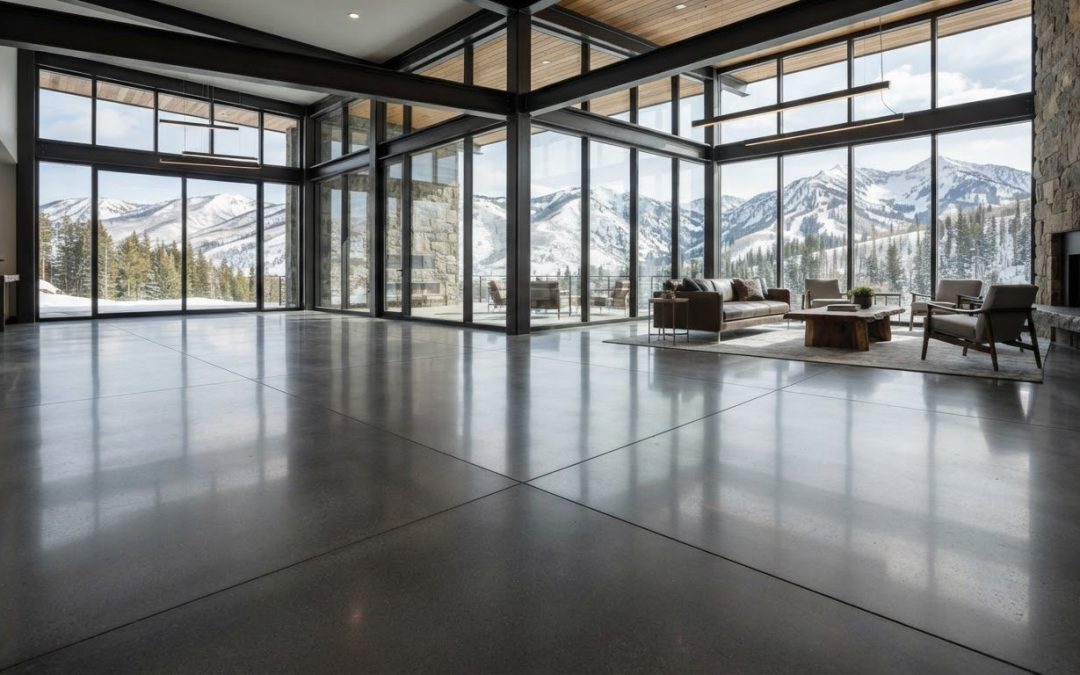
What if the most resilient floor for a high-altitude home or commercial showroom is also its most striking architectural feature? At 7,000 feet above sea level, Summit County structures endure over 100 annual freeze-thaw cycles, alongside relentless snowmelt and corrosive magnesium chloride tracked indoors. Standard topical coatings peel under this strain, which is why specifying true polished concrete Park City properties demand transforms ordinary structural slabs into hardened, enduring showpieces.
You already know that mountain-modern architecture requires a delicate balance of organic beauty and bulletproof durability. In this guide, you’ll discover how mechanical diamond polishing elevates luxury residences, upscale retail spaces, and hospitality venues across the Wasatch Back. We’ll break down the ideal aggregate exposures and sheen levels for alpine conditions, examine the chemistry behind deep lithium densification, and show you how to achieve stunning, slip-resistant floors built to last.
Key Takeaways
- Understand the critical engineering differences between true mechanical diamond polishing and standard topical grind-and-seal treatments.
- Explore how premium polished concrete Park City installations align with mountain-modern architecture while optimizing in-slab radiant heating performance.
- Compare the four standardized Concrete Polishing Council aggregate exposure levels to select the perfect balance of visual texture and surface refinement.
- Learn how deep chemical lithium densification protects high-traffic alpine slabs from harsh freeze-thaw cycles, moisture intrusion, and road brine pitting.
- Identify the precision machinery, advanced dust-containment systems, and regional expertise required to execute custom architectural finishes flawlessly.
What Sets Polished Concrete Apart in Park City Mountain Architecture?
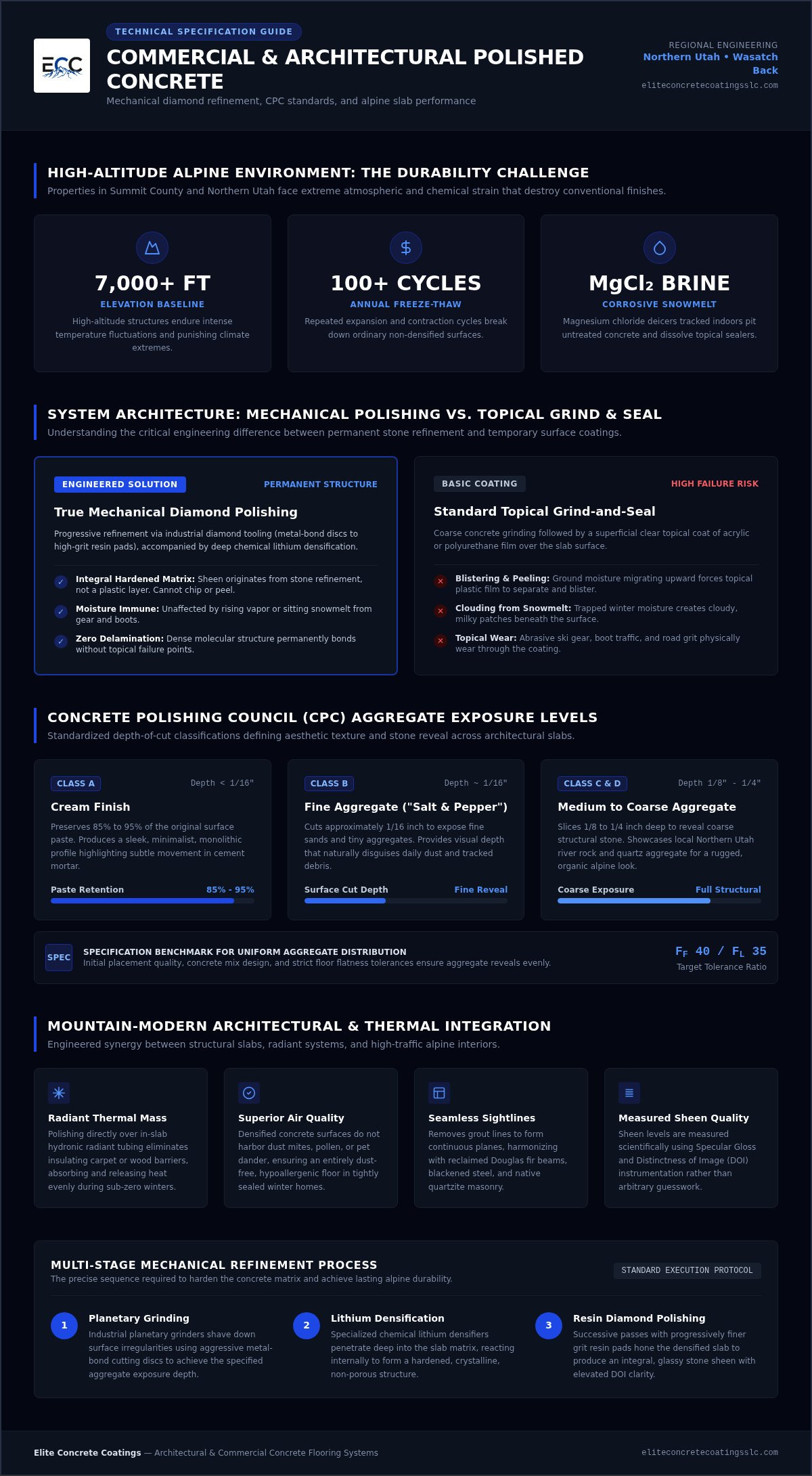
High-end mountain construction demands flooring that withstands punishing environmental realities without sacrificing design elegance. In Summit County, architects and property owners consistently turn to commercial polished concrete to unite rugged endurance with refined style. Achieving authentic mechanically polished concrete requires a rigorous, multi-stage refinement process. Planetary grinders shave down the surface using progressively finer industrial diamond abrasives, followed by specialized chemical densifiers that harden the matrix from deep within.
This process delivers substantial lifestyle and structural benefits across Northern Utah properties:
- Optimized Thermal Mass: Polishing the structural slab directly above in-slab hydronic radiant tubing eliminates insulating layers like carpet or engineered wood. The slab absorbs heat smoothly and releases it evenly, enhancing indoor comfort during sub-zero Wasatch Back winters.
- Superior Indoor Air Quality: Tightly sealed mountain homes trap airborne particulates during prolonged winter closures. Densified concrete does not harbor dust mites, pollen, or pet dander, providing an entirely hypoallergenic, dust-free floor.
- Unmatched Longevity: Because the sheen comes from natural stone refinement rather than a temporary plastic film, the floor stands up to heavy foot traffic, ski boots, and mountain lifestyle gear.
Mechanical Diamond Polishing vs. Topical Concrete Sealers
Many competitors confuse property owners by marketing basic topical clear coats as polished floors. A standard grind and seal concrete floors system simply applies an acrylic or polyurethane film across the slab. When ground moisture migrates upward or melting snow sits on the surface, these plastic topical films can blister, turn cloudy, and peel away. Mechanical diamond polishing works differently. It refines the concrete itself through progressive diamond tooling passes, moving from aggressive metal-bond cutting discs to high-grit resin pads. The final sheen is an integral, glassy stone surface that cannot chip or delaminate.
The Aesthetic Fit for Mountain-Modern Interiors
Modern alpine residences celebrate clean lines and honest materials. Polished concrete creates immediate visual harmony when framed alongside reclaimed Douglas fir beams, blackened steel accents, and native quartzite masonry. By adjusting the polishing process, specialists produce floor surfaces that bounce natural light deep into great rooms bordered by floor-to-ceiling glass walls. The resulting seamless plane removes distracting grout joints, drawing unbroken sightlines across open-concept layouts toward the mountain peaks outside. Choosing premium polished concrete Park City structures require ensures your interior remains visually stunning and practically indestructible.
Polished Concrete Design Options: Aggregate Exposure and Sheen Levels
Every architectural slab tells a visual story dictated by its depth of cut and diamond refinement. In custom builds across Summit County, achieving your target aesthetic requires understanding the official Concrete Polishing Council (CPC) standards. Initial placement quality, mix design, and floor flatness tolerances, typically aiming for an $F_F 40 / F_L 35$ benchmark, dictate how evenly aggregate reveals itself across the floor. Specifying these variables early ensures your polished concrete Park City installation delivers the exact visual character you envision.
Choosing Your Aggregate Exposure Level
The CPC establishes four standardized aggregate exposure classifications based on cut depth:
- Class A (Cream Finish): Shaving less than 1/16 inch preserves 85% to 95% of the surface paste. This minimalist, monolithic profile highlights subtle movement in the cement mortar without exposing aggregate stone.
- Class B (Fine Aggregate / “Salt-and-Pepper”): Cutting roughly 1/16 inch reveals sand and tiny aggregates. It provides visual depth that easily disguises day-to-day dust and tracked-in debris.
- Class C & Class D (Medium to Large Aggregate): Slicing 1/8 to 1/4 inch deep exposes coarse structural stone. This bold look showcases local Northern Utah river rock and quartz aggregate, providing a rugged, organic foundation for grand mountain spaces.
Selecting the Right Sheen Level for Your Space
Sheen levels are measured instrumentally via Specular Gloss and Distinctness of Image (DOI) rather than guesswork:
- Level 1 (Flat / Ground): Processed below 100-grit abrasives, this matte profile delivers a muted, industrial appearance with virtually zero reflection.
- Level 2 (Honed / Satin): Refined using 400-grit resin tooling. This soft luster diffuses natural light softly across great rooms without harsh glare, making it the most requested finish for mountain-modern residences.
- Level 3 & Level 4 (Semi-Polished to High-Gloss): Honed through 800 to 3,000 grit, these high-clarity floors bounce light across commercial showrooms and retail galleries, dramatically increasing interior illumination.
Before placing concrete on your next build, collaborate with your finisher to ensure the mix matches your desired aggregate class. You can explore architectural possibilities and tailored sheens by reviewing our commercial polished concrete systems for custom alpine properties.
Real-World Examples: Where Polished Concrete Excels in Park City
Every commercial property and luxury residence in the Wasatch Back faces distinct operational challenges. From bustling Main Street storefronts to quiet mountainside retreats, specifying polished concrete Park City properties rely on creates surfaces capable of handling real-world wear. Investing in custom architectural finishes transforms raw slabs into durable visual statements, connecting seamlessly with comprehensive commercial concrete solutions tailored for alpine environments.
High-End Retail Boutiques and Art Galleries
Historic Main Street and modern Kimball Junction retail centers see thousands of visitors walking in directly from snow-covered sidewalks. Pedestrians track in abrasive granite sand, road salts, and slush. Traditional hardwood gouges and topical coatings scuff quickly under this relentless friction. Mechanically refined retail store polished concrete stays pristine. Its glassy, densified surface resists micro-scratching from grit, while high light reflectivity brightens artwork and merchandise displays without discoloring under high-output gallery track lighting. Staff can easily dust mop the seamless floor at closing, keeping the boutique ready for tomorrow’s clientele.
Custom Residential Great Rooms and Private Showrooms
Modern luxury homes in Promontory and Deer Valley showcase polished concrete as a central design element rather than just a subfloor. Polished slabs conduct warmth directly from in-slab hydronic tubes, creating an even, radiant heat that warms cold mornings. Homeowners with active mountain lifestyles appreciate that large dogs, ski poles, and muddy hiking gear leave no marks on densified concrete, outperforming delicate hardwood planks or luxury vinyl tile. In private multi-car vehicle galleries, polished slabs handle hot performance tires and heavy jacks without staining or peeling, giving car collections a sleek, gallery-grade foundation.
Hospitality Spaces, Ski Resorts, and Clubhouses
Resort entryways and ski clubhouses face extreme punishment every winter. Heavy hard-shell ski boots, luggage wheels, and equipment carts strike the floor repeatedly throughout the day. Polished concrete delivers incredible impact resistance, preventing surface chipping and structural fracturing. When combined with penetrating fluoropolymer sealers and non-slip treatments, these floors help maintain safe footing in wet transition zones while meeting dynamic coefficient of friction standards. Discover specialized options for your upcoming hospitality or retail build on our commercial polished concrete service page.
Defending Park City Slabs Against Mountain Weather and Freeze-Thaw Wear
Park City sits at a base elevation of 7,000 feet, where the local climate subjects building foundations to intense physical pressures. With over 100 freeze-thaw cycles every year, local concrete constantly expands and contracts. Left unfortified, standard concrete absorbs moisture that freezes, expands, and breaks apart the microscopic bonds within the matrix. Specifying high-performance polished concrete Park City facilities require pairs mechanical diamond grinding with advanced chemical engineering, turning vulnerable porous slabs into impenetrable wear surfaces.
Combating Winter Road Brine and Snowmelt Infiltration
Vehicles and mountain footwear carry aggressive de-icing chemicals indoors daily, particularly liquid magnesium chloride utilized across Northern Utah roadways. In an untreated slab, these salts migrate into open capillaries. As water evaporates, salt crystals expand within the pores, causing severe sub-surface osmotic pressure and micro-spalling.
Mechanical polishing neutralizes this vulnerability. Specialists apply deep-penetrating lithium silicate or colloidal silica densifiers during the diamond-honing stages. These reactive silicates soak deep into the concrete’s open pores, reacting with free calcium hydroxide to produce insoluble calcium silicate hydrate (C-S-H). This reaction permanently closes the slab’s internal capillary network. Applying a penetrating, breathable stain-resistant guard shields the surface against standing snowmelt, oils, and chemical brines without forming a peel-prone surface film.
Joint Protection and Thermal Stability in Alpine Climates
Drastic temperature swings across the Wasatch Back force interior slabs through continuous movement between summer warmth and sub-zero winter temperatures. Saw-cut control joints absorb these shifts, but unsealed joint shoulders remain vulnerable to chipping and spalling under foot traffic and equipment carts. Installing semi-rigid polyurea joint fillers protects these critical edges. The polyurea cures flush with the polished slab, reinforcing joint shoulders while flexing smoothly with seasonal movement.
Read our in-depth guide on polished concrete contractors for site prep standards. If your alpine commercial property or custom garage requires complete protection against severe winter tracking, explore our specialized commercial polished concrete solutions to ensure decades of low-maintenance beauty.
Choosing the Right Polishing Specialist for Your Park City Project
Executing high-end architectural concrete requires far more than basic surface prep. Slabs poured across Summit and Wasatch counties feature unique aggregate sources, varying cement mixes, and distinct cure rates influenced by alpine air. When selecting a contractor for your project, look for proven technical mastery, commercial-grade equipment, and a deep understanding of local conditions. Choosing the right specialist ensures your polished concrete Park City installation meets rigorous aesthetic and structural standards.
Equipment Capabilities and Dust Containment Protocols
Achieving a uniform, undulating-free floor demands industrial planetary grinding machinery. Lightweight, single-head rotary buffers simply ride over high spots and dips, producing an inconsistent aggregate reveal. Heavy three-phase planetary grinders deliver the downward head pressure required to level the slab and achieve true mechanical refinement. Professional contractors pair these heavy grinders with OSHA-compliant pulse HEPA dust extraction systems. These high-volume vacuums capture airborne respirable crystalline silica right at the grinding head, keeping indoor air pristine during remodels of occupied structures. Before starting diamond passes, specialists also perform relative humidity and moisture vapor emission tests to verify internal slab conditions.
The Value of On-Site Mockups and Local Expertise
Every batch plant in Northern Utah utilizes slightly different local sand, gravel, and fly ash proportions. Because of this natural variation, requiring an in-situ test mockup on your actual slab is an essential step before grinding the entire space. A dedicated test patch allows you and your design team to inspect critical variables firsthand:
- Confirm the exact aggregate reveal, whether you prefer subtle Class B salt-and-pepper or bold Class C coarse stone.
- Evaluate concrete hardness across different areas using Mohs scratch tests to select the proper diamond matrix bond.
- Assess final gloss and light diffusion under your specific interior lighting conditions.
Partnering with an established, family-owned Utah contractor guarantees accountability and localized expertise. As a dedicated Northern Utah team, Elite Concrete Coatings brings precision tooling and extensive commercial experience to luxury homes, mountain retail spaces, and ski amenities. Reach out to our team today to schedule an architectural walkthrough for your custom concrete project.
Transform Your Mountain Property With Lasting Architectural Concrete
Creating an alpine interior that balances high-altitude resilience with organic beauty starts from the ground up. Specifying professional polished concrete Park City properties need ensures your floors won’t just endure extreme freeze-thaw cycles and tracked-in winter salts, they will actively enhance your living or retail environment for decades. From optimizing in-slab radiant heating to revealing the rich character of native aggregates, mechanical diamond polishing delivers timeless sophistication without peeling surface films.
As a locally owned and operated Utah concrete finishing specialist, Elite Concrete Coatings brings the heavy-duty planetary grinders, HEPA dust containment systems, and proven craftsmanship required for flawless execution. Our extensive portfolio across Northern Utah commercial facilities, upscale retail spaces, and custom luxury residences reflects our deep commitment to precision on every slab. Take the first step toward transforming your space today. Contact Elite Concrete Coatings to schedule your Park City architectural consultation and bring your design vision to life.
Frequently Asked Questions
Is polished concrete cold in Park City winter homes and retail spaces?
Polished concrete assumes the ambient room temperature of the building, meaning it feels no colder than ceramic tile or natural slate. In mountain spaces without radiant heat, passive solar gain from expansive south-facing alpine windows helps warm the concrete naturally during sunny winter days. When paired with proper perimeter foundation insulation, a polished slab holds room temperature effectively, eliminating the chill associated with uninsulated slabs.
Can polished concrete become slippery when wet from snowmelt?
Properly mechanically polished concrete Park City installations are surprisingly slip resistant when dry and meet industry safety benchmarks for wet traction. However, heavy snowmelt in entryways can temporarily reduce grip. To protect guests and customers, specialists apply penetrating non-slip treatments or specify lower-sheen honed finishes, such as a satin CPC Level 2, in ski locker zones and retail vestibules to provide reliable footing year-round.
How does polished concrete perform over radiant hydronic in-floor heating?
It performs exceptionally well and acts as one of the most efficient thermal conductors available. Polishing the structural topping slab directly over hydronic PEX tubing removes insulating thermal breaks like wood underlayments or carpets. The dense concrete acts as an expansive thermal battery, absorbing warmth evenly from the circulating hot water and gently radiating it upward into living areas throughout cold Wasatch Back winters.
Can damaged or pitted concrete in older Park City buildings be polished?
Yes, experienced Northern Utah specialists can restore and polish worn, aged, or lightly pitted concrete slabs. The process begins with heavy planetary grinding to remove surface contaminants and open the pores. Technicians then patch spalls and fill pinholes using specialized structural polymer grouts before applying penetrating lithium densifiers. The resulting surface retains distinct historic character while delivering the structural density of a modern architectural floor.
What is the routine maintenance required for an interior polished concrete floor?
Routine maintenance is remarkably simple and requires no waxing, buffing, or chemical stripping. Daily care involves microfiber dust mopping to remove tracked-in granite sand and abrasive dirt. For weekly washing, damp mop using clean water and a pH-neutral concrete cleaner designed not to etch the silicate matrix. Promptly cleaning standing puddles of road salt or snowmelt keeps the refined finish looking pristine for years.
How does mechanical polished concrete differ from a grind-and-seal application?
Mechanical polishing uses progressively finer diamond abrasives to hone the actual concrete stone up to high grits, followed by chemical densification. There is no topical film to scratch or peel. In contrast, a grind and seal concrete floors system grinds concrete to a lower grit and applies a topical acrylic or polyurethane topcoat. While grind-and-seal is effective for certain spaces, true polished concrete Park City builders specify offers superior longevity against ski boots and heavy abrasion.
Will road salt and magnesium chloride ruin my polished concrete floor?
Untreated concrete will pit and spall under road de-icers, but mechanically polished and densified slabs resist this chemical attack. During installation, lithium densifiers permanently lock up free lime within the concrete pores, preventing liquid brine from penetrating the matrix. Pairing this with a breathable, penetrating stain-resist guard prevents salt crystallization near the surface, allowing you to easily wipe away tracked-in winter slush without etching the slab.