
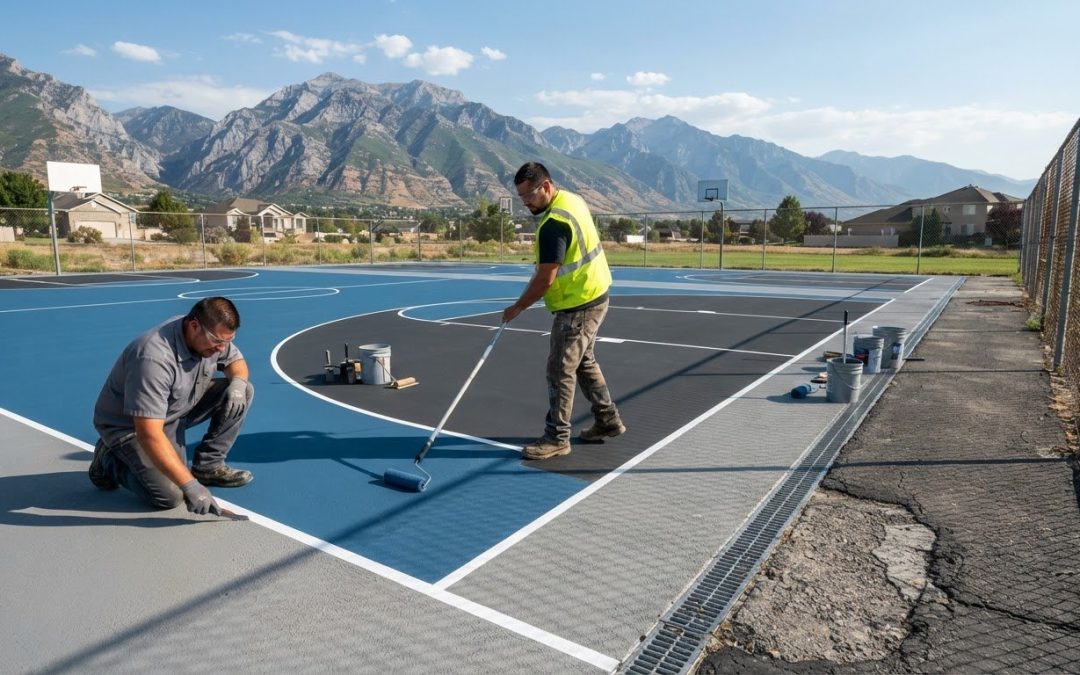
The right outdoor basketball court coating depends on more than the finish itself. Cracks, worn areas, and drainage all affect how a finished court performs, so the condition of the concrete is an important place to start. In Northern Utah, seasonal freeze-thaw cycles and strong sun make the existing surface and its exposure especially relevant to planning.
Choosing a coating means balancing traction, play needs, durability, and appearance. The best fit depends on the court’s condition and how people will use it, not just on a product label. This guide explains what to look for in the concrete, how to compare coating priorities, and what local weather means for an outdoor project. You’ll also learn what to expect from professional sport-court coating, so you can make informed decisions about the surface and the work involved.
Key Takeaways
- Choose an outdoor basketball court coating based on the existing concrete and how the court will be used.
- Cracks, worn areas, and uneven spots can help identify what professional surface preparation needs to address.
- Compare options by traction, play needs, outdoor exposure, and maintenance expectations instead of relying on product labels alone.
- A professional project typically includes a court assessment, preparation, coating application, and a final review, with the details guided by the concrete’s condition.
- For Northern Utah courts, include local weather and sport-court experience in your planning.
What Does Outdoor Basketball Court Coating Do for Your Court?
An outdoor basketball court coating is a surface system applied over a suitable playing area. It creates a finished surface for play, helps define the court’s appearance, and can provide a protective layer over the concrete. The coating works with the existing slab, so it does not remove the need to assess the concrete first.
Think of the coating as one part of a complete surface, rather than a quick cosmetic cover. The right approach depends on the condition of the concrete, how people will use the court, and the site’s outdoor exposure. A court for occasional neighborhood games may have different priorities from one used frequently or shared for multiple activities.
How a coated surface supports basketball use
Players move across the whole court as they run, stop, change direction, and handle the ball. Cracks, worn patches, and abrupt changes in level can interrupt that experience, so the concrete beneath the finish matters as much as the coating choice. When comparing options, consider how the planned surface relates to the court’s use without assuming a particular traction level or ball response.
Color and line markings help make the court easier to read, but they serve a different purpose from the coating itself. Markings define boundaries and play zones, while the coating forms the finished surface beneath them. General information about basketball court surfaces provides helpful context on materials used for courts.
Why the existing concrete matters
Begin with what the concrete shows. Cracks, worn areas, and uneven spots can call for different preparation, and the coating system needs to suit the substrate it will cover. Simply covering imperfections without addressing their condition can leave the finished surface poorly matched to its base. A professional assessment helps determine what preparation is appropriate before coating begins.
The assessment also connects the surface choice to the court’s setting. Sun, moisture, and seasonal temperature changes expose an outdoor court to conditions that an indoor surface does not face. In Northern Utah, weather belongs in the planning conversation alongside play needs and concrete condition. It does not replace a close look at the slab, but it helps shape a choice that fits the site.
Before selecting a finish, consider these factors together:
- Concrete condition: Identify cracks, wear, and changes in level that may affect preparation.
- Intended use: Consider how often the court will be used and whether it needs to support activities beyond basketball.
- Appearance and markings: Plan how the finished color and court lines should organize the playing area.
- Outdoor exposure: Account for the site’s weather and sun exposure when comparing coating options.
Elite Concrete Coatings provides sport court surfaces tailored to the existing surface and intended use. Matching the coating plan to the concrete and the way people will play gives the project a practical starting point.
How to Assess Your Outdoor Basketball Court Before Choosing a Coating
Choose a coating only after understanding the court you have. Substrate condition is a key input when selecting a court coating system. A professional assessment brings the concrete’s current state together with the court’s intended use and outdoor exposure. That information helps shape a recommendation for the specific project.
Work through four considerations:
- Inspect the concrete: Note visible cracking, peeling, staining, worn patches, and uneven areas.
- Define court use: Consider whether play is recreational, frequent, shared, or intended to support multiple activities.
- Assess exposure: Account for sun, moisture, and seasonal conditions at the site, including Northern Utah freeze-thaw exposure.
- Prioritize the finish: Decide how important traction, visual clarity, and playability are for the people using the court.
Inspect concrete condition and existing surface issues
Look across the whole playing area, not just the most visible section. Cracks may appear near the edges or across open areas. Peeling, stains, worn spots, and changes in level can also indicate conditions that need professional review. Note where issues occur and whether they appear isolated or widespread. These observations give the assessment a useful starting point.
Applying a finish over unresolved surface problems can compromise the completed result. Preparation should respond to the concrete’s actual condition instead of following an identical checklist for every court. A professional assessment helps determine which conditions need attention and how they affect the coating system suited to the existing substrate.
Match coating priorities to how the court will be used
A court used occasionally for recreation may have different priorities from a shared community court with frequent play. Consider how people use the space day to day. Do they need clear visual organization, a surface planned around confident movement, or a layout that accommodates varied activities? These details help guide selection without assuming that a particular coating will deliver an exact traction level or ball response.
Include Northern Utah exposure in the assessment
Conditions in Ogden and Layton are part of the project context. Outdoor courts face changing weather, and Northern Utah’s seasonal freeze-thaw cycles make the relationship between concrete condition and surface preparation especially relevant. Sun exposure and moisture also belong in the review. A site-specific recommendation considers these factors alongside the slab and intended use, rather than treating weather as a separate concern.
Bring those observations together before settling on a coating. A suitable system should respond to the concrete, the demands of play, and the site’s exposure as a whole. Elite Concrete Coatings tailors its sport court coating projects to the existing surface and intended use, providing a clear starting point for professional preparation.
How to Compare Basketball Court Coatings for Traction, Play, and Exposure
No single coating is right for every basketball court. Compare options by how the court will be used, the condition of its base, practical maintenance expectations, and the outdoor conditions it faces. For an outdoor basketball court coating, these factors work together. A finish that suits one site may not be the best match for another.
Use this comparison to organize the project discussion rather than relying on broad product labels or unsupported rankings.
| Decision factor | What to consider |
|---|---|
| Play pattern | Is the court for occasional recreation, frequent games, or shared use? |
| Traction and movement | How should the surface support stops and changes in direction while remaining suitable for basketball play? |
| Existing substrate | Does the concrete condition call for particular preparation before a coating system is applied? |
| Maintenance expectations | What level of routine care is practical for the people responsible for the court? |
| Outdoor exposure | How do sun, precipitation, and seasonal conditions affect the site? |
| Visual clarity | Will the chosen colors and markings make court boundaries and play areas easy to distinguish? |
Evaluate traction and basketball playability together
Traction matters because players accelerate, stop, and change direction, but it should not be considered in isolation. The surface also needs to suit the way basketball is played. Recreational use and frequent shared play may lead to different priorities, so discuss how players use the court and what kind of movement the finished surface should accommodate. There is no single ideal texture for every court.
Traction is also a broader surface-safety consideration beyond sport courts. Elite Concrete Coatings’ commercial non-slip coatings show how grip can be a design priority in other settings. A basketball court still needs choices tailored to its specific play needs.
Consider outdoor exposure and appearance
Sun, precipitation, and seasonal weather all shape the demands on an outdoor surface in Northern Utah. Consider how exposed the court is and how it will be used through changing conditions. Discuss coating options in relation to the actual site and concrete rather than assuming any material will respond to every kind of exposure in the same way.
Appearance affects how people use the space, too. Contrast between the playing surface, boundaries, and court lines can help players read the area and orient themselves during a game. Decide which markings matter, whether the court will support more than one activity, and how colors can keep those areas visually clear. These choices should work with the coating system and the court’s intended use.
Bring the factors together before comparing final approaches. A useful coating discussion considers traction, play patterns, substrate condition, maintenance, exposure, and line visibility as parts of one project. This keeps the selection grounded in the specific court instead of broad product claims.

What to Expect During Professional Outdoor Basketball Court Coating
A professional outdoor basketball court coating project follows a clear sequence, with details shaped by the court itself. The work typically moves from an initial discussion and surface assessment to preparation, coating application, and a final review. Each stage helps align the finished court with the concrete’s condition, intended use, and site conditions.
Planning matters outdoors. Access to the court, activity nearby, and weather can affect how the work is organized. The project team considers those factors alongside the surface so the work can proceed in a suitable order. Application timing and return to play depend on project conditions, so a fixed schedule or access date should not be assumed before the site is assessed.
From court assessment to coating plan
The planning conversation establishes how the court is used, what the surface looks like, and what the finished area should look like. A professional reviews the concrete and any existing surface issues, then considers the court’s play needs and layout. This creates a practical foundation before preparation or coating begins.
Those findings shape the project scope. A court with visible wear may need a different preparation approach from one in better condition. The coating plan should respond to observed conditions rather than follow a one-size-fits-all checklist. Elite Concrete Coatings plans its sport court surfaces around the specific surface and intended use.
Preparation, application, and project timing
Preparation and coating are distinct phases. Preparation addresses the existing surface as needed before the coating is applied. Application creates the planned finish. Keeping these steps connected to the assessment helps ensure the work responds to the court’s actual condition.
Outdoor conditions are part of the schedule. Weather can affect whether work proceeds as planned, so the team accounts for site conditions when organizing the application. The time before the court can be used also depends on the project and coating process. A professional explains the relevant timing as the work is planned instead of relying on a generic duration.
Site access deserves attention, too. A clear work area helps the crew move through the project, while nearby activity or access limitations may affect sequencing. If the court serves a shared space, the plan should account for managing access while work is underway and before the surface is ready for play.
At completion, a final review gives everyone an opportunity to look over the finished surface and court markings, address project questions, and clarify care and use guidance. This step helps confirm that the result aligns with the agreed scope and that expectations for returning to play are understood.
Explore professional sport court coating with Elite Concrete Coatings for a plan shaped around your court’s concrete, use, and site conditions.
Choose a Northern Utah Court Coating Partner for a Complete Project
A well-planned court coating project connects surface assessment, preparation, and finish in one clear scope of work. Sport-court experience helps keep those decisions focused on how the court will actually be used. Rather than treating coating as a color upgrade alone, choose a plan that accounts for the concrete, play priorities, outdoor exposure, and desired appearance.
Elite Concrete Coatings is a family-owned Utah company offering professional sport-court surfaces. The company serves communities across Northern Utah, including Salt Lake City, Ogden, Provo, Lehi, West Jordan, South Jordan, Spanish Fork, Layton, and Syracuse. Each project is guided by a review of the individual surface, with local weather and court use included in planning.
What a project-specific court coating plan should address
A useful plan explains how observations about the concrete connect to the proposed preparation and coating approach. It should also reflect court use, site exposure, and finish goals, including how players will read the lines and move through the space. A clear scope helps everyone understand what the project is intended to address before work begins.
Preparation and coating decisions belong together. Cracking, wear, or uneven areas inform the preparation approach and the suitability of a finish. The coating choice, in turn, needs to be considered in relation to the surface it will cover. Treating both as parts of one plan creates a more coherent project than choosing a finish without accounting for the substrate.
As you review the scope, make sure the key considerations are visible:
- Surface assessment: The plan reflects the concrete’s observed condition.
- Intended use: The approach accounts for recreational, frequent, shared, or multipurpose play.
- Outdoor exposure: Northern Utah site conditions factor into planning.
- Finish goals: Appearance and court markings are considered alongside play needs.
- Project sequence: Preparation, coating, and final review are treated as connected stages.
Plan your next step with a local sport-court specialist
For an outdoor basketball court coating project, start with a focused discussion about the court’s condition and purpose. Sharing whether the space is used for casual games, regular community play, or more than one sport gives the project team useful context. A review of multi-purpose sport court flooring can also clarify how surface choices relate to the broader project.
Elite Concrete Coatings brings local sport-court experience to projects across Northern Utah, with recommendations tailored to the existing surface and intended use. If you’re ready to plan a court that fits your site and play needs, discuss your outdoor basketball court project.
Move Your Court Project Forward
A court project is an opportunity to shape a space around the people who will use it, whether for casual games with family or regular community play. Before settling on an outdoor basketball court coating, consider what you want the finished court to support over time. That perspective helps keep decisions focused on the court’s purpose, not just its appearance.
Elite Concrete Coatings can help turn those priorities into a project plan grounded in the existing court. Share what you envision for the space and start a conversation about your court.
Discuss your court with Elite Concrete Coatings to plan a surface around your site and the way you play.
Frequently Asked Questions
Is outdoor basketball court coating different from regular concrete coating?
Yes. A basketball court needs a finish planned around athletic use, not just a general concrete surface. Court layout, markings, player movement, and the existing slab all matter. A coating intended for another setting may not address those priorities. For example, a court used for basketball and occasional community events needs its appearance and play areas considered together.
Can an outdoor basketball court be coated if the concrete has cracks?
Possibly, but the cracks need professional assessment before coating begins. Their location, appearance, and surrounding concrete help determine the appropriate preparation. A fine crack and a wider, uneven area may call for different considerations, so a surface review is more useful than assuming every crack can be treated the same way. The coating plan should account for observed conditions rather than simply cover them.
How does outdoor basketball court coating affect traction and ball bounce?
A coating contributes to the court’s finished feel, so it can influence how players perceive footing and how the ball responds across the surface. The outcome also depends on the concrete and the overall system, so a particular texture or bounce should not be assumed in advance. Discuss the expected type of movement and play, such as quick stops or casual shooting, when selecting an outdoor basketball court coating.
What coating is best for an outdoor basketball court in Utah?
There is no single best option for every Northern Utah court. The right choice depends on the concrete’s condition, how the court is used, and its exposure to sun, precipitation, and seasonal weather. A court in Salt Lake City may have different site conditions from one in Ogden, so recommendations should be based on the actual project. A professional assessment connects those factors to a suitable sport-court system.
How long does an outdoor basketball court coating project take?
Project duration varies with the court’s condition, the preparation required, the coating work, and outdoor conditions. A surface needing more attention may involve a different sequence from one that is ready for the planned work. Weather can also affect scheduling and when the court is ready to use. A project-specific plan is the best way to understand the expected stages and timing without relying on a generic estimate.
Can a coated basketball court be used in different seasons?
A coated court can serve outdoor play across seasons, but actual use depends on the weather and the surface’s condition at the time. Rain, snow, ice, or seasonal temperature changes may affect whether the court is suitable for play on a particular day. In Northern Utah, plan around changing conditions and follow the project-specific guidance for returning to play after coating work is complete.
How should a coated outdoor basketball court be maintained?
Follow the care guidance provided for the specific court coating, since suitable cleaning practices can vary by system. Check the surface and markings during routine use, noting new cracks, peeling, worn areas, or changes that could affect play. For example, debris collecting around the court’s edges may be worth addressing as part of regular upkeep. Have changes assessed so maintenance decisions suit the surface’s condition.