
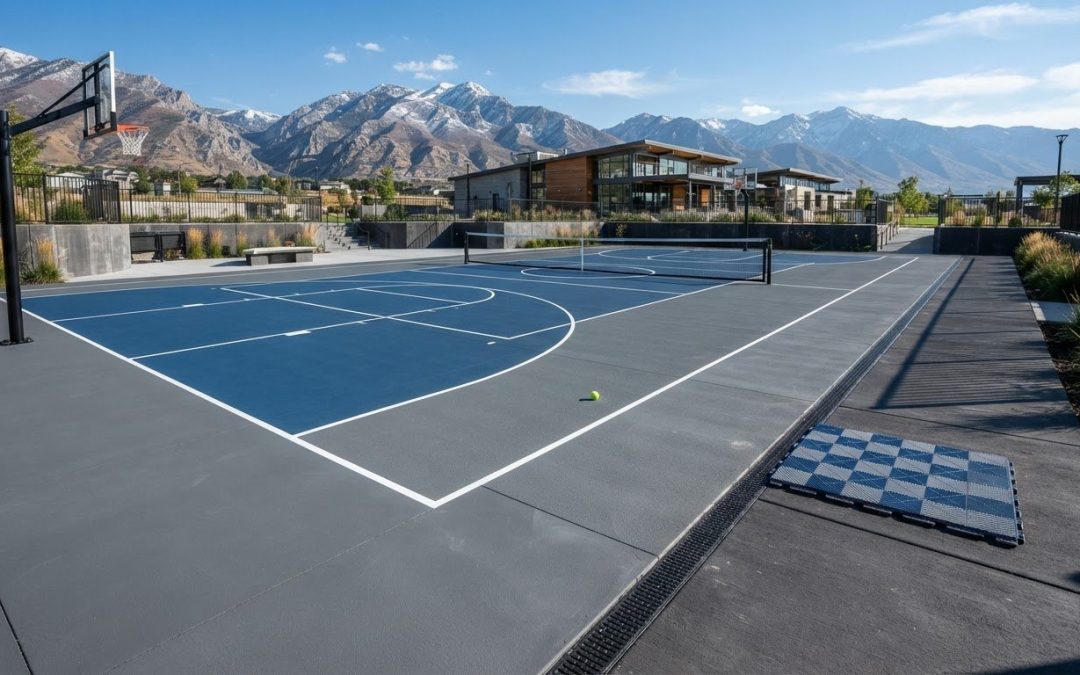
A solid concrete slab doesn’t automatically make a great sport court. The right sport court concrete surfacing depends on how the court will be used, the condition of its base, and the site’s drainage and outdoor exposure. Traction, ball response, layout, and the experience players expect all matter when choosing a surface.
Start by identifying the activities the court needs to support and who will use it. Then consider the existing slab and compare the practical differences between a surface applied over concrete and modular sport flooring. Neither option suits every site, and selecting by color or appearance alone can overlook important questions about the base, water flow, and play.
This guide explains what to review before selecting a surface for a residential or recreational court. Elite Concrete Coatings is a family-owned Utah company that provides sport court surfaces for communities including Salt Lake City, Ogden, Provo, Lehi, West Jordan, South Jordan, Spanish Fork, Layton, and Syracuse. A site-specific plan connects the court’s intended use with the concrete and outdoor conditions.
Key Takeaways
- Choose sport court concrete surfacing based on the activities, users, and playing experience you want, not appearance alone.
- Compare coated concrete with modular flooring by considering how each option relates to the base and the court’s intended use.
- Review the slab, court layout, drainage, and outdoor exposure before selecting a surface system.
- Use a practical checklist of sports, users, concrete condition, and water flow to guide the project plan.
- Elite Concrete Coatings provides tailored sport court surfaces for Northern Utah communities.
Sport Court Concrete Surfacing: What the Surface Needs to Do
A concrete court has two parts: the slab that forms the base and the surfacing system installed over it to create the playing area. Sport court concrete surfacing can involve different materials and construction approaches, so courts with concrete bases may not feel or play alike. Texture, surface feel, appearance, and ball response all contribute to the experience.
For context, hard court surfaces commonly use asphalt or concrete as a base with a playing layer above. The base alone does not determine how a court will play. Surface selection should also reflect the intended sports, the people using the court, and the outdoor conditions at the site.
How does a sport court surface affect play?
Texture affects how shoes grip the court and can influence players’ footing as they start, stop, and change direction. The playing layer also contributes to ball response, which is important when consistent play is a priority. A single-sport court and a shared court may call for different design priorities. Consider the intended activities, users, and frequency of play together, rather than treating traction, color, or appearance as the only deciding factor.
What makes a concrete court base suitable for surfacing?
Before surfacing, assess the overall condition of the slab. Cracks, joints, surface cleanliness, wear, and drainage can all affect how the project is planned. These observations do not automatically point to one preparation method: the work depends on the concrete and the surfacing system selected.
Surface selection and preparation go hand in hand. Reviewing the existing concrete helps identify conditions that may need attention before the finish is applied. It also avoids assuming that one process fits every court. For a related look at a different concrete finish, explore our commercial polished concrete work.
In Northern Utah, account for drainage and outdoor exposure early. Standing water can affect how usable the court is, while moisture and seasonal freeze-thaw conditions make the relationship between the site, slab, and surface an important planning consideration. Review where water flows across and away from the court before settling on a surface approach.
How Sport Court Concrete Surfacing Systems Are Planned and Applied
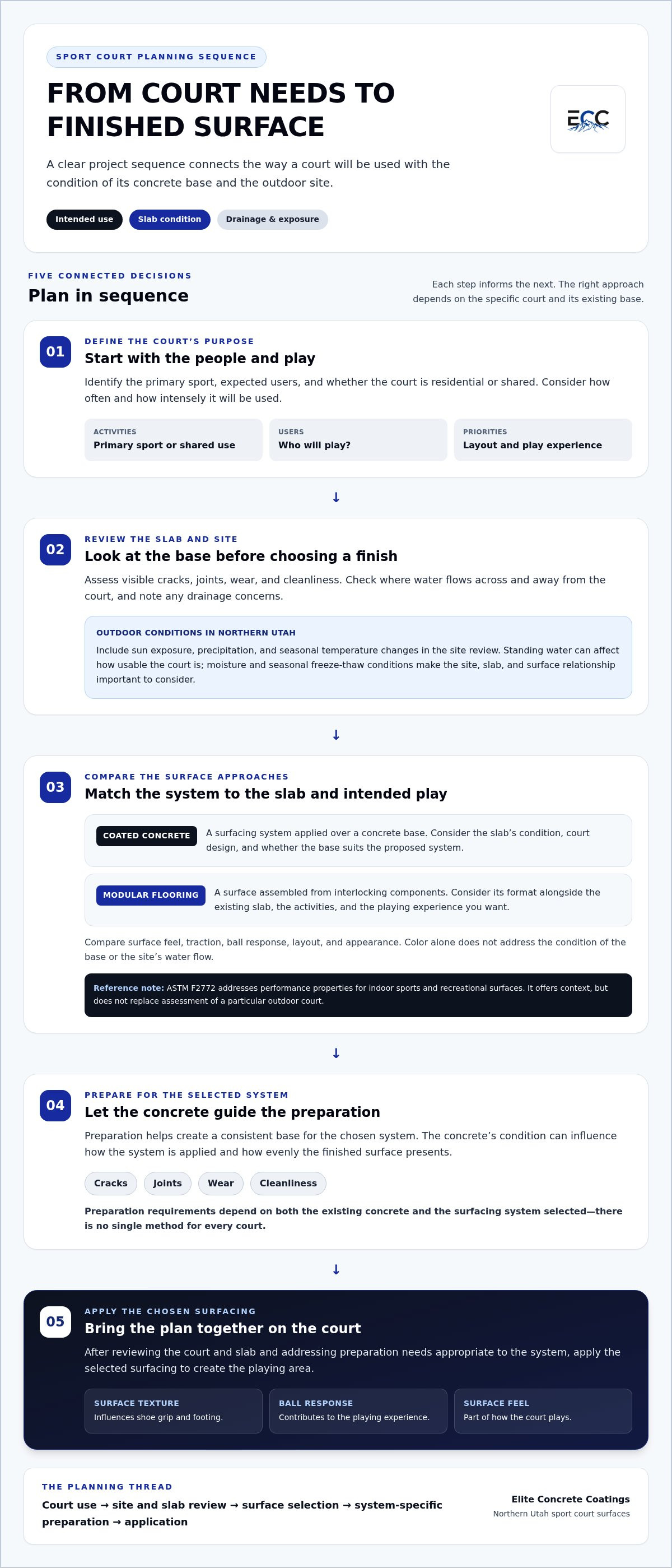
A clear project sequence begins with how the court will be used, followed by a review of the site and slab, selection of a surface approach, and preparation and application of the chosen system. Each decision informs the next. A residential court for occasional family recreation may have different priorities from a shared recreational space or a court intended for frequent, higher-intensity play.
Assess the concrete before selecting the surface: the slab’s condition and the site’s needs help determine which surfacing approach is appropriate. This keeps the plan focused on the actual court rather than assuming one finish suits every concrete base.
Which project details should be reviewed first?
Begin with the primary sport, expected users, and whether the court is residential or shared. These details help define the layout and playing priorities. Next, review the concrete for visible cracks, joints, and wear, and note any water-flow or drainage concerns. For an outdoor court in Northern Utah, include sun exposure, precipitation, and seasonal temperature changes in the site review.
With those factors in view, compare surface options against the court’s intended use and conditions. The relationship between a surface and sport-specific performance is also reflected in references such as ASTM F2772 standards for sports flooring. The cited standard addresses performance properties for indoor sports and recreational surfaces. It offers context, but does not replace an assessment of a particular outdoor court.
Why does concrete preparation matter before surfacing?
Preparation helps create a consistent base for the selected system. The slab’s condition can influence how the system is applied and how evenly the finished surface presents across the court. Cracks, joints, wear, and cleanliness all matter during assessment, but they do not dictate one universal preparation method. Requirements depend on both the existing concrete and the selected surfacing system.
At a high level, the work involves reviewing the court and slab, addressing preparation needs appropriate to the system, and applying the selected surfacing. A tailored plan connects the court’s intended use with the condition of its base. Explore our sport court surfaces to learn about Elite Concrete Coatings’ court projects for Northern Utah communities.
Coated Concrete or Modular Sport Flooring: Which Fits Your Court?
Choosing a court surface involves more than colors or court lines. Coated concrete and modular sport flooring are different approaches: one is a surfacing system applied over a concrete base, while the other is assembled from interlocking components. Their formats and relationship to the base differ, so they should not be treated as identical options.
Compare them in the context of the existing slab, the court’s intended use, and the site. Consider the surface feel you want, the planned activities, and whether the concrete is suitable for the proposed system. These questions put appearance in its proper place: an important design consideration, but not the only one.
When might a surfaced concrete court be a practical fit?
A surfaced concrete court may be worth considering when the project has an existing concrete base and a permanent outdoor layout. Whether it fits depends on the slab’s condition, court design, intended sport, and site exposure. User expectations matter as well. A court for occasional family recreation may have different priorities from a shared space that sees more frequent use.
Sport court concrete surfacing does not guarantee one specific feel or performance level. Those qualities depend on the selected system and project details. Avoid assuming every coated court provides the same traction, cushioning, or service life. Assess the concrete base and surfacing layer together.
How does modular sport flooring differ?
Modular sport flooring is made from interlocking components assembled into a playing surface. This differs from a surface system applied over concrete, even when both are being considered for the same court. Their construction and relationship to the base are not interchangeable, so the court’s condition and layout remain relevant to the choice.
Compare the options against the priorities that matter for your site: the intended sport, user group, desired surface feel, and condition of the base. Include outdoor exposure and court layout in the decision. A color scheme cannot tell you whether a surface approach suits the way the court will be used or the conditions at the site.
For general context on concrete finishes beyond athletic courts, see our commercial polished concrete work. Polished concrete is a separate surface category, not a substitute for sport court surfacing. Elite Concrete Coatings tailors sport court projects to their intended use, concrete condition, and site requirements across Northern Utah.
Plan a Sport Court Surface for Northern Utah Conditions
Plan around the court’s location and intended use from the outset. In Northern Utah, outdoor sites may be exposed to sun, precipitation, and seasonal temperature changes. These conditions do not point to one universal material choice. They make it important to review the actual court and surroundings before selecting a surface system.
What should a court plan account for outdoors?
Start with water movement. Review the slope, drainage paths, and areas where water may stand, because they can affect court usability. A surface finish alone cannot resolve every drainage concern. The concrete base and the way the site sheds water are both part of the plan.
Include these points in the project review:
- Use: Which sports will the court support? Is it for one activity or several?
- Users: Who will play, and how often will the court be used?
- Concrete: What is the slab’s condition, including visible cracks, joints, or wear?
- Water: Where does rain or melting precipitation flow? Are there signs of standing water?
- Exposure: How do sun, precipitation, and seasonal conditions affect the site?
These factors help guide sport court concrete surfacing decisions. Base the choice on the specific site rather than broad assumptions about local weather.
How should sport and community use shape the design?
Decide whether the court is intended for one sport or several before finalizing the layout. A single-sport court can focus on that game’s needs. A shared court may need a deliberate plan for markings and overlapping uses. The expected players and frequency of activity help clarify priorities before choosing a surface and finalizing the design. For neighborhood associations coordinating shared recreational amenities, learn more about professional HOA management in Utah.
That planning applies to courts in Salt Lake City, Ogden, Layton, and Syracuse, where every site has its own conditions and use patterns. For general traction context, explore our non-slip concrete coatings. These coatings are a separate category, not a sport court specification.
Bring the intended sport, users, slab condition, drainage, and exposure into one coordinated plan. Plan your sport court project with a tailored professional approach for your Northern Utah site.
Choose Professional Sport Court Concrete Surfacing in Northern Utah
A successful court plan connects the game with the site. The intended sport guides the layout and playing priorities, while the concrete base, drainage, and outdoor exposure help shape the surfacing approach. Considering these factors together gives the surface decision a practical foundation and avoids choosing a finish by appearance alone.
What should you expect from a professional project discussion?
Start with the court’s purpose: which activities it will support, who will use it, and how the space should function. A site review then considers the existing concrete and surrounding conditions, including visible slab issues, water movement, and exposure. This information helps guide decisions about the surface and project plan.
Recommendations should reflect the particular court. A project’s sport, base condition, and layout all matter, so the plan should be shaped around those details rather than assumptions that every slab and outdoor setting is alike.
How can Elite Concrete Coatings help with a sport court?
Elite Concrete Coatings is a family-owned Utah company providing professional sport court surfaces for residential and recreational projects across Northern Utah. We connect the intended use of the court with the concrete and site conditions to create a tailored surfacing plan. This project-focused approach helps organize the decisions that shape the court before work begins.
If you’re planning a court, bring your goals and site considerations into the project conversation. Elite Concrete Coatings can help you plan sport court concrete surfacing for your Northern Utah community.
Explore our professional sport court surfaces and discuss your project with our team.
Build a Court That Fits Your Game
The right sport court concrete surfacing starts with how you’ll use the court, then accounts for the existing slab, drainage, and outdoor exposure. Coated concrete and modular flooring are different approaches, so compare them by how each fits your site and playing priorities, not by appearance alone.
A considered plan connects the surface choice to the sports and users the court is intended to serve. Reviewing the base and site conditions before selecting a system also helps set clear expectations for the project. These considerations matter for residential and recreational courts throughout Northern Utah.
Elite Concrete Coatings is a family-owned Utah company providing professional concrete coating services, including sport court surfaces. We tailor projects to the court’s intended use and site conditions in communities such as Salt Lake City, Ogden, Provo, Lehi, West Jordan, South Jordan, Spanish Fork, Layton, and Syracuse.
Discuss your sport court project with Elite Concrete Coatings and plan a surface that fits your game and site.
Frequently Asked Questions
Is concrete a good base for a sport court?
Concrete can provide a base for a sport court surfacing system when its condition, drainage, and intended use suit the project. Visible cracks, joints, and surface wear matter because they can affect the plan. Assess the slab before choosing a finish. That review helps determine whether sport court concrete surfacing is a practical approach for the specific site, rather than assuming every concrete slab is ready for the same system.
What is the difference between sport court concrete surfacing and modular flooring?
Sport court concrete surfacing is applied over a concrete base, while modular sport flooring is assembled from interlocking components. The categories differ in format and how they relate to the base, so they are not interchangeable finishes. Compare them based on the sport, user expectations, court setting, and site conditions. A project-specific review of those priorities helps guide the choice without assuming one category is right for every court.
Can an existing concrete court be resurfaced?
An existing concrete court may be suitable for resurfacing, depending on the slab and site. Visible cracks, joints, surface wear, and drainage all need consideration before selecting a finish. An assessment helps show how those conditions affect the project and which surfacing approach fits. Because the same solution does not suit every slab, a professional evaluation is the practical starting point for planning work on an existing court.
Which sports can use a concrete sport court surface?
Basketball, tennis, and pickleball are examples of sports played on courts with surfaced concrete bases. The appropriate surface and court markings depend on the activity and the people who will use the space. A single-sport court can be planned around one game, while a multi-sport layout needs coordination for each intended activity. Consider play priorities and users together instead of assuming one surface specification fits every sport.
Does Northern Utah weather affect outdoor sport court surfacing?
Yes. Outdoor exposure, precipitation, drainage, sun, and seasonal temperature changes are relevant planning factors for courts in Northern Utah. Consider these conditions alongside the concrete’s state before selecting a surfacing system. They do not, on their own, establish how a particular material will perform or how long it will last. Site-specific evaluation is useful for projects in Salt Lake City, Ogden, Provo, Lehi, West Jordan, South Jordan, Spanish Fork, Layton, and Syracuse.
How should I maintain a concrete sport court surface?
Follow care guidance for the installed surface system and keep the court clear of debris. Pay attention to standing water, accumulated dirt, or visible changes in the surface, as these may call for professional guidance. Cleaning products, procedures, and care needs vary by system, so one routine may not suit every court. Use project-specific instructions as the reference for maintaining your surface.