

Did you know that up to 20% of your routine forklift maintenance costs, from shredded tires to damaged steer axles, stem directly from degraded concrete joints? If you’re managing a facility in Salt Lake City, West Jordan, or Ogden, you’ve likely seen the telltale signs of trouble. You probably agree that watching your floor edges crumble into dust isn’t just an eyesore; it’s a constant drain on your budget and a safety risk for your team.
We’re here to help you turn those problematic gaps into a seamless, durable asset. In this guide, you’ll learn how a high-performance warehouse floor joint sealant protects your industrial slab from structural damage and costly spalling. We’ll walk through the technical standards required for heavy-duty traffic, including the importance of Shore A 80 hardness and why rapid-curing polyurea is becoming the gold standard for Northern Utah warehouses. From meeting OSHA safety benchmarks to reducing long-term repair costs, we’ll cover everything you need to know to achieve a flush, professional finish that stands up to the toughest Wasatch Front winters.
Key Takeaways
- Discover why industrial floors require semi-rigid fillers instead of flexible caulking to support heavy forklift traffic and prevent edge spalling.
- Compare the benefits of polyurea and epoxy systems to find the best balance of fast cure times and extreme durability for your facility’s specific needs.
- Learn how to combat Northern Utah’s aggressive thermal expansion and soil settlement with a professional-grade warehouse floor joint sealant strategy.
- Understand the technical application steps, including mechanical routing and precise depth-to-width ratios, that ensure a long-lasting, flush surface.
- See how proper joint maintenance reduces equipment repair costs and integrates seamlessly with polished concrete to keep your warehouse safe and OSHA-compliant.
Understanding the Role of Warehouse Floor Joint Sealants
Industrial concrete floors aren’t solid, continuous sheets. To manage the natural behavior of concrete, engineers design gaps into the slab. While these gaps are necessary, they create vulnerable edges that can quickly deteriorate under the pressure of daily operations. A professional warehouse floor joint sealant isn’t just a cosmetic filler or a bit of flexible caulk; it’s a semi-rigid structural component designed to bridge these gaps and protect the integrity of your floor.
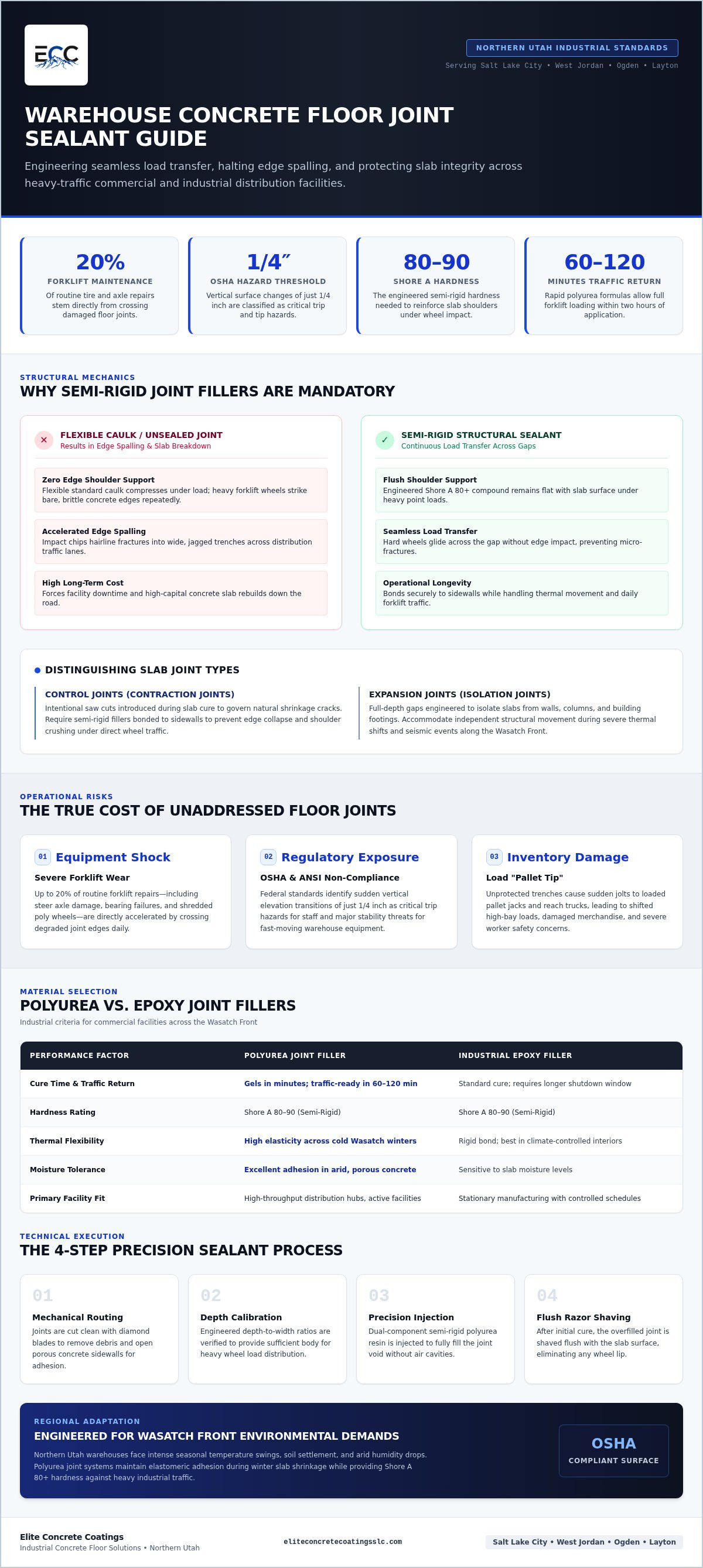
In a high-traffic environment, your floor needs “shoulder” support. Standard aesthetic caulking is too soft; it compresses under the weight of a loaded pallet jack, leaving the sharp edges of the concrete exposed. In contrast, industrial-grade sealants are engineered with a specific Shore A hardness (typically 80 or higher) to remain flush with the surface. This allows heavy wheels to glide over the joint without catching the edge, effectively transferring the load across the slab without causing structural distress.
Control Joints vs. Expansion Joints
It’s vital to understand that not all floor gaps are created equal. Control joints are the intentional saw cuts made shortly after the concrete is poured to “control” where the slab cracks as it shrinks. These require a semi-rigid filler that bonds to the sidewalls to prevent edge collapse. On the other hand, concrete expansion joints are full-depth gaps designed to allow the entire building to move independently during thermal shifts or seismic events. Because these joints see more significant movement, they require specialized materials that can expand and contract without losing their bond or failing to support traffic. Proper identification of these joint types is the first step in any successful warehouse concrete coatings strategy.
The Cost of Neglect: Spalling and Slab Damage
Leaving joints open or using the wrong material leads to a destructive process called spalling. Think of your forklift tires as heavy hammers. Every time a hard-wheeled lift crosses an unprotected joint, it strikes the concrete edge. This repeated impact causes the concrete to chip, crack, and eventually break away. What starts as a hairline fracture quickly grows into a wide, jagged trench.
The consequences of this neglect are expensive and hazardous:
- Equipment Wear: Research indicates up to 20% of routine forklift maintenance, including tire and axle repairs, is caused by driving over degraded joints.
- Safety Hazards: OSHA and ANSI standards identify vertical changes of just 1/4 inch as significant trip hazards and equipment stability risks.
- Product Damage: Uneven floors lead to “pallet tip,” where unstable loads can shift or fall during transport.
By proactively installing a high-quality warehouse floor joint sealant, you eliminate these impacts at the source. It’s a simple investment that keeps your Northern Utah facility running smoothly while avoiding the massive capital expenditure of deep structural slab reconstruction later on.
Polyurea vs. Epoxy: Choosing the Right Industrial Joint Filler
Selecting the right warehouse floor joint sealant requires balancing installation speed with long-term structural support. Industry-leading warehouse concrete floor design standards emphasize that joints must resist heavy wheel abrasion while supporting significant point loads from racking and equipment. This is where the choice between polyurea and epoxy becomes critical. Both materials offer professional-grade protection, yet they behave differently under the unique environmental stresses found in Salt Lake City and Layton facilities.
The most important metric in this decision is Shore Hardness. For industrial floors, we look for a “semi-rigid” rating between Shore A 80 and 90. This hardness level is firm enough to support the concrete shoulders under heavy forklift traffic, yet flexible enough to accommodate the minor slab movement common along the Wasatch Front. Modern resins also feature high moisture tolerance, ensuring a tenacious bond even in the arid Utah climate where concrete can be notoriously dry and porous.
When to Prioritize Polyurea Fillers
Polyurea is the go-to solution for high-throughput distribution centers in West Jordan or Ogden that can’t afford operational downtime. These systems are incredibly fast. They gel in minutes and can typically support heavy forklift traffic within 60 to 120 minutes of installation. One major advantage for Utah businesses is polyurea’s temperature versatility. It can cure effectively in sub-zero conditions, making it the only viable choice for cold storage and freezer warehouses. It also offers excellent UV stability, which prevents yellowing or degradation in loading dock areas exposed to intense, high-altitude sunlight.
The Case for Heavy-Duty Epoxy Joint Fillers
While polyurea wins on speed, epoxy joint fillers remain a powerhouse for maximum edge protection. Epoxy typically offers a higher Shore hardness, providing a rock-solid surface for the highest-capacity fork trucks and heavy racking systems. It is an exceptionally durable choice for stationary environments where slab movement has already stabilized over several years. If you are already planning to upgrade your facility with professional warehouse floor coatings, epoxy fillers integrate seamlessly to create a unified, high-performance surface. While epoxy requires a longer curing window, often 24 to 48 hours for full-load traffic, the structural reinforcement it provides is unmatched for heavy industrial use. If you are unsure which material fits your traffic patterns, our team can help you select the ideal system for your specific operation.
Why Utah Warehouses Face Unique Joint Challenges
Utah facility managers face a set of environmental hurdles that most national contractors simply don’t see. Our climate is notoriously aggressive toward industrial concrete. Between the triple-digit summer heat in Salt Lake City and the sub-zero winter nights in Provo, concrete slabs undergo massive thermal shifts. These shifts cause the slab to expand and contract significantly, putting immense pressure on your joints. If your warehouse floor joint sealant isn’t designed to handle these specific cycles, it will eventually pull away from the concrete sidewalls, leaving the edges vulnerable to damage.
Beyond temperature, the arid Great Basin climate plays a major role. Low relative humidity accelerates moisture evaporation during the curing process. This often leads to “slab curling,” where the edges of the concrete sections lift slightly. In unconditioned logistics hubs in Layton and Ogden, these gaps become even more pronounced. Without a professional-grade filler to bridge these voids, your forklift traffic will turn those curled edges into a series of speed bumps that slow down production and damage equipment.
Freeze-Thaw Cycles and Joint Integrity
Winter brings more than just cold; it brings chemical stress. Truck tires track road salts and de-icing chemicals directly into your loading docks. When moisture from melting snow seeps into unsealed joints and then freezes, it expands with incredible force. This cycle can lead to sub-base erosion during the spring thaw, which creates hollow spots beneath your floor. To stay in compliance with OSHA walking-working surface regulations, you must ensure these surfaces are kept in good repair. We use sealants that maintain their bond even when temperatures plummet, keeping chemicals and water out of your slab’s foundation. Facilities throughout Utah County dealing with these same freeze-thaw pressures can benefit from understanding how professional concrete floor sealing in Orem addresses moisture infiltration and surface dusting as part of a complete slab protection strategy.
Regional Soil Movement in Northern Utah
Geology also dictates floor performance. Facilities in West Jordan and South Jordan often deal with specific soil settlement issues common along the Wasatch Fault corridor. If the sub-grade shifts, a filler that is too rigid will simply crack under the stress. Choosing the right warehouse floor joint sealant for these shifting conditions prevents the filler from becoming brittle and failing prematurely. This is why partnering with a local expert who understands Salt Lake County geology is so important. We don’t just pour material; we evaluate the stability of your floor to ensure the joint solution we provide can handle the micro-seismic vibrations and soil settling unique to our region.
Professional Concrete Joint Sealant Application Process
Installing a high-performance warehouse floor joint sealant is a technical operation that requires more than just filling a gap. It is a precision engineering task designed to turn a vulnerable crack into a structural asset. For facilities in Salt Lake City or Sandy, achieving industrial-strength adhesion depends entirely on the preparation and the specific techniques used during the install. We don’t just pour material; we follow a methodical process that ensures the sealant becomes a permanent part of your floor’s architecture.
One of the most critical steps involves calculating the correct depth-to-width ratio. Unlike residential projects, industrial saw-cut joints must be filled to the full depth of the cut. We follow ACI 302.1R standards, ensuring the filler bears the load directly against the sidewalls without the use of compressible backer rods. This full-depth installation is what prevents the joint from deflecting under the weight of a 10,000-pound forklift.
The Importance of Mechanical Preparation
Simply vacuuming out a joint isn’t enough for a warehouse environment. To get a true chemical bond, we use diamond-bladed saws to mechanically route every inch of the joint. This process removes old debris, weak “laitance” (concrete dust), and any residual curing compounds that might prevent the resin from biting into the slab. By routing the joint, we create a fresh, porous surface on the concrete “walls.” This ensures the warehouse floor joint sealant anchors itself deeply into the concrete, preventing it from peeling or popping out when the slab moves during a cold Utah winter.
Achieving a Flush, Trip-Free Surface
The hallmark of a professional installation is the “overfill and shave” technique. We intentionally overfill the joint so the material crowns slightly above the floor level. Timing is everything here. We wait for the material to reach a specific “gel state” before using a specialized floor razor to shave the excess material completely flush with the concrete. This creates a seamless transition that you can’t even feel when walking or driving over it.
A perfectly flush joint does more than just look good. It significantly reduces impact vibrations for your forklift operators, which helps prevent long-term fatigue and repetitive strain injuries. When combined with our slip resistant concrete coatings, this process creates a total floor system that is safe, durable, and fully compliant with modern safety standards. If you’re ready to fix your crumbling joints and protect your equipment, contact our team today for a professional floor assessment.
Maximizing ROI with Elite Concrete Coatings Joint Solutions
Investing in a high-quality warehouse floor joint sealant is one of the most effective ways to protect your facility’s long-term value. While the physical application is about durability, the business case is about return on investment. By creating a smooth, uninterrupted travel path, you’re directly reducing the wear and tear on your material handling equipment. Every saved tire and every avoided suspension repair adds up to significant operational savings over the life of your floor. It’s a proactive strategy that keeps your budget focused on growth rather than constant maintenance.
A professional joint strategy works best when it’s part of a complete floor system. For example, our joint solutions integrate perfectly with commercial polished concrete. Polishing provides a beautiful, light-reflective finish, but the joints remain the weakest point where dust can collect and edges can chip. Sealing those gaps ensures your polished surface stays pristine and structural. Similarly, if you’ve invested in resinous commercial flooring, proper joint treatment prevents the coating from cracking or delaminating at the slab breaks. This level of precision extends the lifespan of your entire floor investment, ensuring your facility remains a high-performance asset for years to come. For Utah County businesses looking to build on this foundation, our guide to concrete floor sealing in Orem covers how industrial-grade densifiers and moisture mitigation work together to maximize slab longevity.
A Holistic Approach to Warehouse Protection
We believe in protecting every square inch of your workspace. Often, we bundle joint sealing with commercial non-slip coatings to ensure your team is safe from both trip hazards and slip hazards. This creates a seamless, easy-to-clean environment that’s essential for sensitive areas like electronics manufacturing or food storage hubs. Because we understand that every facility is unique, we offer custom color-matching sealants. If your facility includes a public-facing showroom or a high-end commercial space, we ensure the joints blend perfectly with your floor’s aesthetic for a clean, professional, and uniform look.
The Expert Neighbor Advantage
Choosing a local partner means working with people who live and work in the same communities you do. From Syracuse and Layton down to Spanish Fork and Springville, we understand the specific building codes and environmental pressures that Utah businesses face. As a family-owned company, we take personal pride in every project. We ensure the technical precision we’ve described throughout this guide is delivered on your site with the care of a dedicated service provider. We’re not just a contractor; we’re your neighbors who want to see your business succeed. Don’t wait for your joints to crumble and damage your bottom line. Request a professional floor evaluation from Elite Concrete Coatings today and let’s build a floor that lasts.
Secure Your Facility’s Future with Professional Joint Protection
Maintaining a high-performance industrial floor requires more than just occasional cleaning; it demands a proactive strategy for your slab’s most vulnerable points. By selecting the right warehouse floor joint sealant, you are investing in the longevity of your forklifts and the safety of your entire crew. We’ve seen how Utah’s extreme climate can punish unsealed joints, but with the correct semi-rigid filler and professional application, those gaps become a seamless part of your success story.
Elite Concrete Coatings is a family-owned and operated business right here in Utah. We are specialists in heavy-duty industrial coatings, serving Salt Lake City, Provo, Ogden, and the entire Wasatch Front with precision and pride. We understand the unique geology and building codes of our region, and we’re eager to help you transform your facility into a more efficient, durable workspace.
Don’t let crumbling joints slow down your operations or lead to expensive equipment repairs. Protect Your Warehouse Floor—Get a Professional Joint Sealing Quote Today. We look forward to being your reliable partner in building a floor that stands the test of time.
Frequently Asked Questions
How long does warehouse floor joint sealant take to cure before we can drive on it?
Polyurea systems allow for a rapid return to service, often supporting heavy forklift traffic in just 60 to 120 minutes. If your facility in Salt Lake City or Ogden uses an epoxy-based filler, the window is much longer, typically requiring 24 to 48 hours for a full cure. We prioritize polyurea for high-throughput hubs to minimize downtime, ensuring your operations can resume safely without the risk of tracking uncured resin across your facility.
Will sealing the joints stop my concrete floor from cracking elsewhere?
Sealing joints won’t prevent new cracks from forming in other areas of your slab, as those are usually caused by sub-grade settling or structural stress. However, a properly installed warehouse floor joint sealant prevents existing control joints from widening and crumbling. While the sealant manages the movement within the designed gaps, separate repairs like crack injection are necessary if your floor is developing uncontrolled fractures outside of the joint lines.
What is the difference between a joint filler and a joint sealant?
In an industrial setting, the term “filler” is more accurate because these materials are semi-rigid and designed to support heavy wheel loads. Standard flexible sealants, like those used in expansion joints on building exteriors, will compress under a forklift’s weight, leaving the concrete edges unsupported. For Utah warehouses, we use semi-rigid fillers with a Shore A hardness of 80 or higher to ensure the joint edges don’t collapse or spall under pressure.
How often do warehouse floor joints need to be resealed?
The lifespan of your joint protection depends on traffic volume and the type of equipment used in your Provo or Layton facility. High-traffic aisles traversed by hard-wheeled reach trucks may require inspection and minor maintenance every three to five years. Fortunately, professional-grade polyurea systems are incredibly durable. If you notice the material pulling away from the sidewalls or sinking below the floor level, it’s time to call a specialist for a professional evaluation.
Can joint sealants be applied to old or damaged warehouse floors?
We frequently perform joint rehabilitation on older slabs throughout the Wasatch Front. The process involves using diamond-bladed saws to route out old, failing material and clean the joint “shoulders.” Even if your joints have significant spalling, we can rebuild the edges using structural polymers before applying the final sealant. This restoration process is a cost-effective way to extend the life of an aging warehouse floor without requiring a full slab replacement.
Do I need to seal joints if I am already getting an epoxy coating?
Yes, joints must be treated even when you are installing a high-performance coating system. If you apply a rigid epoxy coating over an open joint, the coating will inevitably crack as the slab expands and contracts during Utah’s seasonal temperature swings. We coordinate the joint treatment with our warehouse coatings to ensure the floor remains seamless and easy to clean while still allowing the necessary movement at the slab breaks.
Why are the edges of my concrete joints breaking off (spalling)?
Spalling occurs when the edges of your concrete joints are left unsupported. When heavy, hard-wheeled forklifts cross an open gap, the impact acts like a hammer strike against the brittle concrete edge. Over time, this repeated stress causes pieces of the concrete to chip away, creating wide, jagged trenches. Using a semi-rigid warehouse floor joint sealant provides the necessary shoulder support to transfer these loads smoothly and stop the cycle of destruction.
Is joint sealing required for OSHA compliance in Utah warehouses?
OSHA 1910.22 regulations require that all walking and working surfaces be maintained in a clean, safe, and repaired condition. In Utah warehouses, open joints or spalled edges that exceed 1/4 inch in depth or width are often cited as trip hazards and equipment stability risks. Keeping your joints flush and filled is a critical part of maintaining safety compliance and protecting your team from avoidable workplace accidents and repetitive strain injuries.