
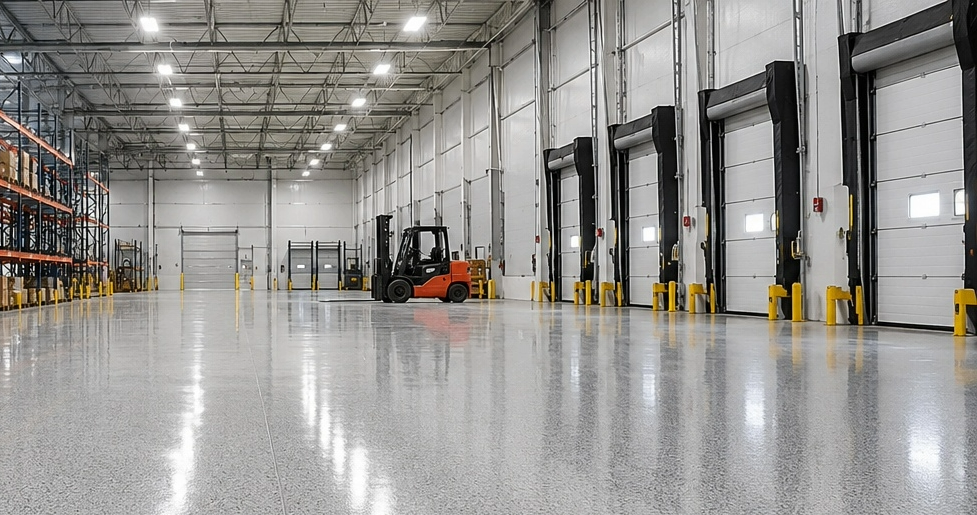
Warehouse floors should be able to withstand more abuse than almost any other commercial floor.
For lifting equipment, pallet jacks, heavy equipment drive throughs, dropped tools, chemical exposure, rolling loads and heavy foot traffic can beat untreated concrete up pretty quickly. That’s why selecting the right epoxy flooring for your warehouse goes beyond just how it looks.
Your coating system should be compatible with how your facility operates day in and day out.
Here at Elite Concrete Coatings, we believe warehouse flooring applications should be assessed according to traffic, equipment, chemicals, existing surface conditions, safety requirements and downtime needs. Selecting the correct system from the start can aid in longevity, maintenance and performance down the road.
1. Start With the Amount of Traffic Your Warehouse Handles

Heavy-Duty Warehouse Floor Coating
You should consider how much traffic traverses your floor daily.
Light-duty storage warehouses may only see the occasional cart or foot traffic. On the other hand, distribution facilities may have forklifts running constantly.
Questions to ask yourself:
- How many forklifts use the floor each day?
- Are pallet jacks used frequently?
- Does heavy machinery travel across the same areas repeatedly?
- Are there high-traffic loading and unloading zones?
- Do certain aisles receive much more wear than others?
The more traffic your warehouse sees, the more important coat abrasion resistance and thickness are.
A coating that’s ideal for a small warehouse may not be suitable for a busy distribution center.
2. Consider Forklift and Equipment Weight
Forklifts place significant stress on warehouse floors.
Not only the weight of the equipment itself. Tight corners, breaking and accelerating, and point loads from wheels will break down coatings over time.
Any warehouse that sees daily forklift traffic should consider a coating system that is formulated to withstand:
- Tire wear
- Abrasion
- Scraping
- Impact
- Heavy rolling loads
- Repeated traffic patterns
Heavy equipment can also highlight problem areas in under-prepared concrete.
Which is why a commercial grade epoxy system with the correct topcoat can offer far better durability than a thin homebrew style coating.
3. Think About Chemical Exposure
Warehouses may be exposed to more than simple dirt and dust.
Depending on your business, the floor could be exposed to:
- Oil
- Grease
- Hydraulic fluid
- Cleaning chemicals
- Solvents
- Automotive fluids
- Manufacturing chemicals
Not every coating has the same chemical resistance.
If your warehouse or facility works with harsh chemicals on a regular basis, you want to make sure you choose a flooring system that can hold up.
Discuss chemical exposure prior to installation and choose the right epoxy, topcoat, or specialty system.
4. Evaluate the Existing Concrete
The condition of the concrete below the coating is crucial.
Prior to epoxy application, you should look for:
- Cracks
- Spalling
- Oil contamination
- Existing coatings
- Moisture problems
- Uneven areas
- Surface damage
A coating is only as strong as the surface it bonds to.
If there are existing problems with the concrete, they must be taken care of before applying a coating. Using a coating to “hide” these problems can cause headaches down the road.
Surface preparation could include grinding, crack repair, cleaning, removing old sealers or coatings. Taking the time to prepare the surface will help ensure a successful installation. Skipping this step will lead to failure.
5. Choose the Right Epoxy Thickness
Epoxy flooring systems can vary significantly in thickness.
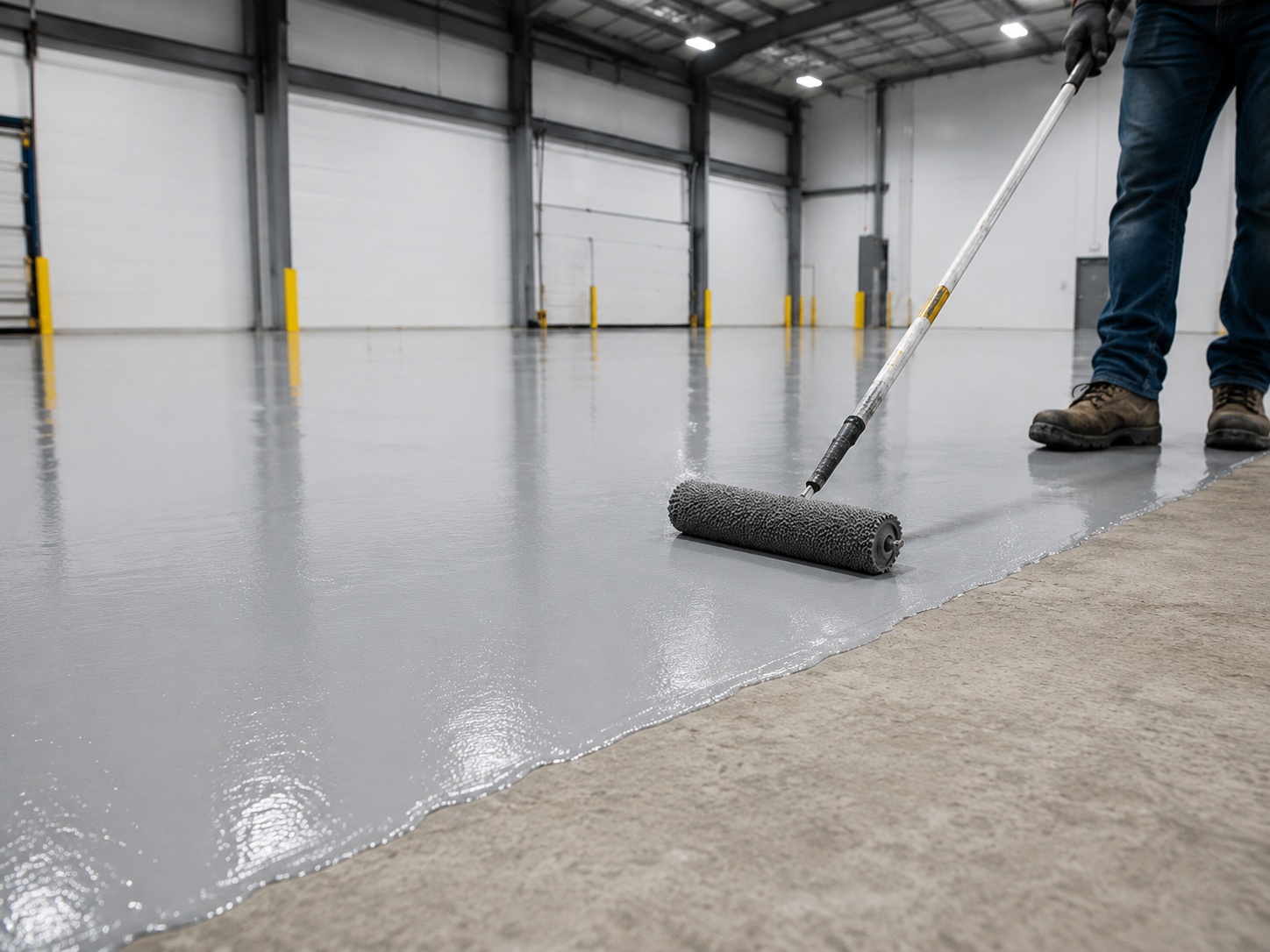
Epoxy Floor Installation Salt Lake City
Thin coatings might be sufficient for your low traffic area, but if you have a high traffic warehouse you may need a thicker, industrial-grade system.
Thickness will determine:
- Durability
- Impact resistance
- Appearance
- Ability to hide surface imperfections
- Long-term wear
here is no magic thickness that will work for every warehouse.
Build should be determined by traffic, weight of equipment, condition of floor, and expected usage.
6. Decide Whether you Need a Polyaspartic Topcoat
While epoxy itself is tough, most commercial grade epoxy systems can be used with a topcoat added for protection.
Polyaspartic topcoats can add:
- Abrasion resistance
- Chemical resistance
- Scratch resistance
- UV stability
- Ease of maintenance
If your warehouse has forklifts, carts, or equipment that frequently drive/roll across your floor, the added protection can be very beneficial.
Layered System: A durable epoxy base with a protective finish on top
7. Consider Slip Resistance
Flooring should be safe for warehouse personnel.
Just because a coating is very smooth doesn’t mean it’s ideal for every space. Some settings require extra traction.
Slip resistant coatings/additives or textured flooring systems can help with safety in high-risk areas for slipping like:
- Water
- Oil
- Cleaning solutions
- Snow or moisture tracked indoors
- Frequent foot traffic
You want a floor that’s cleanable but doesn’t pose a slipping hazard.
Too slick can be hard to keep clean. Too much texture can cause more slipping.
Consult your flooring installer about what’s best for the space.
8. Think About Floor Markings and Work Zones
Warehouse efficiency can also benefit from epoxy flooring.
Floor coatings are commonly used to mark off defined spaces such as:
- Walkways
- Forklift lanes
- Loading zones
- Equipment areas
- Safety boundaries
- Storage spaces
Color-coded flooring can help make traffic patterns easier to understand. This can increase appearance and efficiency in busy warehouse environments.
Your facility will also appear more professional while being easier to clean.
9. Consider Cleaning and Maintenance
- With coated warehouse floors, cleaning can be much easier. Concrete left bare will absorb liquids since it’s porous. It will soak up:
Oil - Dirt
- Moisture
- Grease
- Chemicals
When installed properly, an epoxy system provides a less porous surface.
Routine maintenance may include sweeping, scrubbing and using the right cleaning products.
Think about how often your floors are cleaned and what methods are used before making a choice.
A business that scrubbers floors daily may benefit from a different finish than a low traffic warehouse.
10. Plan Around Downtime
Warehouse downtime costs money.
Factor into your decision how long you can afford to have the area out of commission. Some epoxy systems have longer curing times than their faster curing counterparts. If you can’t afford to have your operation down for an extended period of time, then a system that offers faster cure times might be right for you.
There are times where installations can be done in stages so that areas of the warehouse are still operational.
Epoxy vs. Polyaspartic for Warehouse Floors
Epoxy flooring and polyaspartic systems both have their place in commercial applications, but have different strengths.
Pros of epoxy flooring include:
- Strong adhesion
- Good thickness
- Excellent durability
- Attractive appearance
- Good value for commercial spaces
Polyaspartic coatings may provide:
- Faster curing
- Strong abrasion resistance
- UV resistance
- Durable topcoat performance
Keep in mind that many of the top warehouse floor systems use more than one product. For instance, you can have epoxy base coats topped with durable polyaspartic topcoats.
What Color is Best for Warehouse Epoxy Flooring?
Gray tends to be one of the top picks as it provides a sleek industrial look while helping to mask dirt and wear.
Colors can also be used to:
- Define work areas
- Mark safety zones
- Improve visibility
- Match company colors
- Separate pedestrian and equipment traffic
Lighter colors can help reflect light from overhead lights and brighten up the huge interior space.
You want to choose a color that fits your aesthetic needs, is easy to maintain, and helps with day-to-day functions.
How Long Does Warehouse Epoxy Flooring Last?
Warehouse epoxy flooring will last depending on:
- Traffic volume
- Forklift use
- Installation quality
- Concrete preparation
- Chemical exposure
- Maintenance
- Coating thickness
Facilities with heavy industrial traffic will cause more wear and tear than those that are light duty.
Maintaining a regular cleaning schedule and taking care of damaged areas will prolong the systems life.
Signs Your Warehouse Needs a new Floor Coating
Need to recoat or replace your warehouse floor? If you see some or all of the following…
- Peeling
- Flaking
- Bare concrete
- Deep scratches
- Worn forklift lanes
- Heavy staining
- Cracks
- Surface damage
- Loss of traction
…it’s time to recoat! Letting these issues go will only allow the underlying concrete to continue degrading.
The Best Warehouse Epoxy Flooring Starts With Proper Preparation
One of the biggest mistakes we see with commercial flooring is when people focus solely on the coating they will be applying. Yes, there are different grades of epoxy that will perform differently on warehouse floors, but even the best epoxy can fail if applied directly to poorly prepared concrete.
Professional preparation ensures the substrate has the bond it needs to provide long-term durability. This may include:
- Mechanical grinding
- Crack repair
- Cleaning
- Removing old coatings
- Correcting contaminated areas
- Addressing moisture concerns
Any experienced warehouse flooring contractor will tell you that proper preparation is absolutely necessary for high traffic warehouse floors. In fact, preparation is one of the most critical steps of the whole installation process.
Warehouse Epoxy Flooring in Utah
When it comes to choosing warehouse flooring, it’s not as simple as picking a color and slapping on some coating.
The ideal system will take into consideration traffic flow throughout your facility, forklift traffic, equipment, chemical exposure, cleaning processes, and your concrete’s current condition.
At Elite Concrete Coatings, we work with Utah businesses to select long-lasting warehouse epoxy flooring and commercial concrete coating systems that are built to withstand heavy use.
From distribution centers to manufacturing facilities to storage warehouses and commercial workspaces, the right flooring system can help protect your concrete and establish a clean, professional environment.
Get a free quote by filling out our online form or call Concrete Coatings today at (801) 946-0929. Learn more about epoxy flooring for warehouses and discover a coating system that meets the needs of your business.