
Could the right sealer protect a Utah driveway without a strong application odor? It depends on the product, so look beyond the word “sealer” and consider its type, performance, and application requirements. For salt-resistant concrete sealers in Utah, the key is choosing protection suited to moisture, de-icing salts, and repeated freezing and thawing.
It’s reasonable to want a driveway that stands up to winter without sacrificing the finish you prefer. A penetrating sealer can help limit water and brine entering concrete pores, while the finish affects appearance and upkeep. No sealer can undo existing cracks or spalling, so the concrete’s condition matters too.
This guide explains how sealer types and finishes compare in Utah’s freeze-thaw conditions, including options for Salt Lake City. You’ll learn what to consider if application odor is a concern, how to match protection to a driveway’s exposure and use, and when sealing alone may not address visible damage.
Key Takeaways
- Learn why penetrating sealers can help limit water and brine from entering concrete pores during Utah freeze-thaw cycles.
- Compare water-based and solvent-based options with application conditions and odor concerns in mind.
- See how finish, appearance, and upkeep factor into choosing a sealer for a Salt Lake City driveway.
- Recognize when cracks, spalling, or scaling may call for more than sealing alone.
- Understand where Grind And Seal may fit when you’re considering a professional concrete surface solution.
What is the best concrete sealer for driveways?
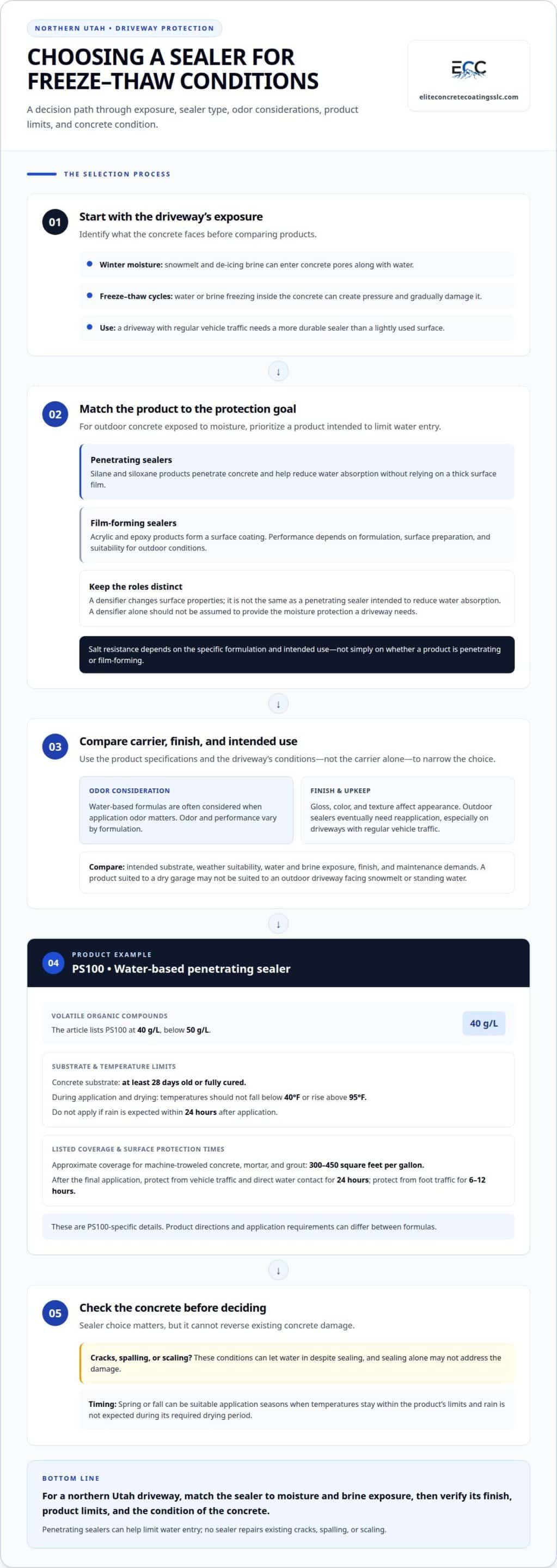
For a Utah driveway exposed to de-icing salts and freeze-thaw cycles, a penetrating sealer is a practical option because it helps reduce water and brine entering concrete pores. Spring or fall can be suitable application seasons when temperatures stay within the product’s limits and rain is not expected during its required drying period.
Penetrating Sealer Performance
Concrete contains pores and capillaries that let moisture enter below the surface. When water or brine freezes inside, the pressure can gradually damage the concrete. A penetrating sealer soaks into the surface rather than relying only on a visible film, helping limit moisture entry. When comparing salt-resistant concrete sealers in Utah, consider the driveway’s exposure, traffic, and the product’s application requirements.
Penetrating Sealers and Densifiers
A penetrating sealer is intended to reduce water absorption within concrete; a densifier changes the concrete’s surface properties. These products serve different purposes, so don’t assume a densifier alone provides the moisture protection a driveway needs. Match the treatment to your goal, whether that’s limiting water penetration, changing the surface, or addressing both with suitable products.
PS100 is a water-based penetrating sealer with 40 g/L of volatile organic compounds, below 50 g/L. Its application conditions matter: the concrete substrate should be at least 28 days old or fully cured. During application and drying, temperatures should not fall below 40°F or rise above 95°F. Don’t apply it if rain is expected within 24 hours after application.
For machine-troweled concrete, mortar, and grout, PS100 coverage is approximately 300-450 square feet per gallon. Stir or gently agitate the sealer for 3-5 minutes before application. After the final application, protect the surface from vehicle traffic and direct water contact for 24 hours; protect it from foot traffic for 6-12 hours.
Read the product directions and assess the driveway’s condition. Existing cracks, spalling, or scaling can let water in despite sealing, so the sealer may not address that damage. Concrete exposed to regular vehicle traffic also needs a more durable sealer than a lightly used surface. Gloss, color, and texture affect appearance, but protection and application conditions should guide the decision.
In Salt Lake City, commercial polished concrete is a distinct surface option, while driveway sealing focuses on limiting moisture entry into outdoor concrete.
Water-based and solvent-based sealers
Water-based and solvent-based formulas differ in their carriers, application characteristics, and the appearance they leave. For salt resistance, compare their protection against water and brine, then weigh odor, finish, and driveway conditions.
Silane and siloxane penetrating sealers reduce water entry into concrete, while acrylic and epoxy products form surface films. Salt resistance depends on the specific formulation and its intended use. Compare product specifications to find an option suited to the concrete and its exposure.
Water, Oil, and Salt Repellency
Repellency describes how a treated surface responds to particular liquids, not an all-purpose shield. A water-repellent sealer can help limit water and brine from entering concrete pores, which matters on driveways exposed to winter de-icers. Oil repellency varies by product, so an oil stain on a garage floor calls for a formula suited to that exposure.
Salt doesn’t behave like oil on the surface: dissolved de-icing salts travel with water and can enter porous concrete. Look for a sealer designed for exterior concrete exposed to moisture. A product suited to a dry garage may not provide the waterproofing needed for an outdoor driveway facing snowmelt and standing water.
Waterproofing and Salt Resistance
Silane and siloxane sealers penetrate concrete and help reduce water absorption without relying on a thick surface film. Acrylic and epoxy sealers form a coating on top, so their performance depends on formulation, surface preparation, and suitability for outdoor conditions. Neither category is automatically superior for every driveway.
For northern Utah’s freeze-thaw exposure, prioritize a product intended to limit water entry. A penetrating treatment may suit porous exterior concrete; a film-forming sealer may better suit a different finish or use. In extremely wet conditions, choose a product that offers greater waterproofing.
Water-based formulas are often considered when application odor matters, while solvent-based products have different application characteristics. Odor and performance vary by formulation, so compare the product’s instructions and intended substrate rather than relying on the carrier alone. A desired low-gloss finish, for example, may narrow the options differently from a glossy look.
Product specifications can help clarify which sealers are suited to different concrete surfaces and exposure conditions. Compare features such as the intended substrate, weather suitability, and finish to understand how an option may perform. PS100, for example, has specific application limits.
Plan for maintenance, too. Outdoor sealers eventually need reapplication, especially on driveways with regular vehicle traffic. Compare the expected finish, salt and water exposure, and maintenance demands before choosing. If the project is actually a garage floor rather than an outdoor driveway, garage floor coatings address a different surface need.
Utah freeze-thaw conditions and concrete vulnerability
Utah’s changing temperatures, winter snow, and spring melt expose concrete to repeated moisture and freezing. Understanding how that cycle affects driveways, patios, and walkways helps guide protection decisions.
Concrete Vulnerability in Freeze-Thaw Conditions
Concrete contains pores and capillaries that absorb water. When moisture inside the material freezes, it expands and creates internal pressure; repeated cycles can gradually weaken the concrete. Utah’s daily temperature swings and spring snowmelt give moisture opportunities to enter and refreeze. Salt-resistant concrete sealers in Utah help limit water and brine penetration, but the slab’s condition and traffic exposure matter too.
Scaling and Spalling Protection
Scaling appears as flaking or peeling at the surface, while spalling creates deeper broken or crumbling areas. Salt-related damage can also appear as cracks, rough patches, or exposed aggregate. Sealing can reduce future water entry, but existing cracks and spalling may let moisture pass beneath the treated surface. Assess the concrete to distinguish preventive sealing from damage that needs separate repair.
Winter de-icers add another stressor. Traditional rock salt, or sodium chloride, lowers water’s freezing point and creates salty liquid brine. Calcium chloride, magnesium chloride, and potassium chloride are also chemical ice melts used in Utah. Some ice melts attract moisture, keeping concrete damp and increasing the chance that water enters pores before another freeze.
Damage often becomes visible after repeated exposure, not after one cold night. A driveway, for example, may develop rough, scaling edges where meltwater collects, while a high-traffic approach can show cracks or crumbling in frequently driven areas. Compare exposed sections with sheltered concrete; differences can reveal where snowmelt, salt, or vehicle use creates greater stress.
Protection starts with reducing prolonged moisture and choosing a sealer suited to exterior exposure. A penetrating sealer can help limit water and salt solution entering the concrete, reducing one source of stress during freeze-thaw cycles.
Apply the same observations to patios and walkways, even without vehicle traffic. A patio may collect snow against a wall or hold meltwater in low spots. Note where water remains, where surface scaling appears, and whether cracks cross the slab. These details help determine whether preventive sealing is suitable or visible deterioration needs attention first.
An effective protection plan matches the treatment to the slab’s condition and exposure. Salt, freeze cycles, standing moisture, and traffic each affect the decision. Sealing helps reduce one route of damage, water penetration, but it cannot restore concrete that has already lost surface material.
Concrete sealer options for Salt Lake City
Salt Lake City driveways need a sealer matched to winter moisture, de-icing salts, traffic, and the desired appearance. Start by deciding whether water protection or a particular finish matters most.
Local Concrete Sealer Choices
For exterior concrete in Salt Lake City, a penetrating sealer can help reduce water and brine entry without creating a prominent surface film. Film-forming products may suit different appearance goals, but the product must also be intended for outdoor exposure. Compare the concrete’s condition, vehicle use, and maintenance needs before choosing.
Finish is another deciding factor. Matte treatments keep the surface’s appearance more natural, while glossy, wet-look sealers can require more upkeep. Certain products add slight color, and tinting can change how the driveway looks. Consider a small area of existing color variation or decorative aggregate when weighing the desired result.
Penetrating Sealers for Freeze-Thaw Conditions
Look for a penetrating concrete sealer designed to limit water absorption in exterior concrete. Silane and siloxane options penetrate the surface, while PS100 is a water-based penetrating sealer. The right choice depends on the product’s stated use and the driveway’s condition, not simply its label or finish.
PS100 contains 40 g/L of volatile organic compounds. Product specifications also address surface age, temperature, and weather conditions. Those factors matter in Salt Lake City, where exposure varies with local conditions. Choose a product suited to the driveway and its surroundings.
If a driveway has visible cracks, scaling, or spalling, sealing may not address the underlying damage. Those openings can allow additional moisture into the concrete, so assess the surface before selecting a sealer. A smooth, intact driveway and a crumbling slab have different needs, even when both face the same winter conditions.
Traffic also affects the decision. A regularly driven driveway needs a more durable sealer than a lightly used path. Consider where tires turn or stop, since those areas receive repeated contact. Choose a product suited to that use to protect the finished surface.
For Salt Lake City flatwork, treat protection as ongoing maintenance rather than a permanent finish. Outdoor sealers eventually need reapplication, particularly in high-traffic areas. Concentration, finish, exposure, and upkeep all affect the product choice. The practical takeaway: prioritize freeze-thaw protection, then select an appearance and maintenance level that fit the property.
Which penetrating concrete sealers are suitable for Utah freeze-thaw conditions?
For Utah exterior concrete, choose a penetrating sealer intended to reduce water entry and follow its application limits. PS100 is one water-based example; its specifications help show what to assess before selecting a product for freeze-thaw exposure.
Compare the product’s purpose with the surface and exposure. Driveways face vehicle traffic, snowmelt, and de-icing brine, so a suitable sealer should address moisture penetration and provide durability for regularly driven concrete. A product’s name alone doesn’t establish its suitability. Check its stated uses, application temperatures, curing requirements, and the surfaces listed in its coverage information.
PS100 contains 40 g/L of volatile organic compounds, below 50 g/L. Its coverage is approximately 300-450 square feet per gallon on machine-troweled concrete, mortar, and grout. Those coverage surfaces are specific; don’t assume the same rate applies to every driveway finish. The treated area, concrete texture, and product instructions guide application planning.
Concrete substrates should be at least 28 days old or fully cured before PS100 application. During application or drying, temperatures should not fall below 40°F or exceed 95°F. These limits make weather and surface readiness central to scheduling in northern Utah. Apply only when the temperature conditions fit, rather than relying on a broad seasonal label.
Rain timing matters as well. PS100 should not be applied if rain is expected within 24 hours after application. Before applying, check the forecast against that interval and account for the full drying period. After the final application, protect the surface from vehicle traffic and direct water contact for 24 hours. Keep foot traffic off for 6-12 hours.
Follow the product’s preparation instructions, including stirring or gently agitating PS100 for 3-5 minutes before application. Existing cracks, spalling, or scaling deserve attention because sealing alone may not prevent water intrusion through damaged areas. A penetrating sealer helps limit moisture entry; it doesn’t repair broken concrete or replace needed surface restoration.
Use these criteria to narrow the choice: exterior suitability, water-reduction purpose, traffic demands, substrate condition, coverage information, and application limits. PS100’s listed coverage applies to specified materials, while its temperature and rain requirements determine whether conditions suit application. For flatwork such as driveways, the stated sealing interval is 10 years, though outdoor sealers eventually need reapplication, especially in high-traffic areas.
If your project also includes an interior concrete surface, explore polished concrete options for a different finish and use.
Elite Concrete Coatings: Grind And Seal
Elite Concrete Coatings offers Grind And Seal for concrete projects where the goal is a finished, sealed surface rather than a penetrating driveway treatment. It’s a separate option, not a substitute for choosing an exterior sealer to limit salt and moisture entering a Utah driveway.
Consider Grind And Seal for an existing concrete floor when you want a refined surface finish. The right solution depends on the concrete’s condition and how the space will be used. For a driveway facing winter brine, focus on the exterior protection criteria covered above; for a concrete flooring project, Grind And Seal may be the more relevant option.
Contact Elite Concrete Coatings to discuss whether Grind And Seal suits your concrete project.
Plan your next concrete project with confidence
Choose a solution based on how the concrete will be used, not appearance alone. Salt-resistant concrete sealers in Utah address driveway exposure, while other concrete spaces may call for a different surface treatment.
For facility projects, Elite Concrete Coatings also offers Warehouse Coatings, Non-Slip Coatings, and Parking Decks & Garages. These options help match the treatment to the demands of the space, whether the priority is a warehouse floor, traction, or a parking structure.
Move forward with a clear picture of the surface, its use, and the result you want. Contact Elite Concrete Coatings to discuss your concrete project and identify a suitable next step.
Frequently Asked Questions
Are there sealers that don’t emit a strong odor during application?
Water-based sealers are a useful category to compare if application odor concerns you, but water-based doesn’t automatically mean odor-free. PS100, for example, is water-based and contains 40 g/L of volatile organic compounds. Check the specific product’s label for odor and application guidance, since formulas differ. For a Salt Lake City project, also consider the application conditions and nearby occupied spaces.
What concrete sealers resist road salt and deicing chemicals best?
Choose a penetrating sealer intended to reduce water absorption in exterior concrete exposed to salt and brine. A product’s suitability depends on its stated use, the concrete surface, and vehicle traffic. For example, a regularly driven driveway needs a durable product intended for that exposure. Review the application directions and surface coverage rather than relying on a “salt resistant” label alone.
Which Utah contractors or retailers offer salt-resistant concrete sealers?
For concrete surface projects around Salt Lake City, Ogden, Provo, Lehi, West Jordan, South Jordan, Spanish Fork, Layton, and Syracuse, Elite Concrete Coatings offers related services including Grind And Seal, Polished Concrete, and Parking Decks & Garages. These are concrete finishing and coating options, not a claim that every service is a driveway sealer. Match the project to the surface and its winter exposure.
How often should concrete be resealed in Utah’s climate?
The stated sealing interval for flatwork such as driveways or sidewalks is 10 years. That interval is a useful reference, not a substitute for assessing wear. A driveway with frequent vehicle traffic or visible deterioration may need attention sooner than lightly used flatwork. Look for changes in the surface, such as areas where water remains or where the sealer appears worn, when planning maintenance.
Can concrete sealer prevent scaling and spalling from deicing salts?
Sealer can help reduce water and brine penetration, but it can’t repair existing scaling or spalling. Cracks and crumbling areas may still let moisture beneath the treated surface. For example, exposed aggregate on a driveway signals damage to assess alongside any sealing plan. Preventive sealing is most useful when the concrete is in suitable condition for treatment.
What are the drawbacks and safety risks of concrete sealers, including slip hazards and VOCs?
Sealers can require reapplication, and some finishes may change the concrete’s color or gloss. A sealed surface is slip-resistant when kept clean and dry, but wet conditions can change traction; traction additives can improve grip when wet. VOC content also varies by product. PS100 contains 40 g/L, so compare the specific product information and follow its application and safety directions.