

The word “epoxy” alone won’t tell you whether a floor is right for your property. Even the search phrase “professional epoxy flooring vs DIY kits” points to a bigger question: how well will a coating suit your concrete and the work the floor needs to handle?
It’s reasonable to want clear information before choosing between a contractor-installed coating and a DIY kit, especially if you’re unsure about your slab or the demands of the space. The decision involves more than comparing product labels. Consider who will assess and prepare the concrete, what work is included, and whether the proposed system suits how you use the floor.
This guide explains what Northern Utah property owners can compare, from slab condition and coating options to preparation and intended use. You’ll find practical questions to ask a flooring contractor, common points to clarify before work begins, and ways to decide whether epoxy garage flooring, a commercial coating, or another suitable flooring service deserves a closer look.
Key Takeaways
- Look beyond the word “epoxy”: the concrete, coating system, and space’s use all influence whether a proposal is a good fit.
- When comparing professional epoxy flooring vs DIY kits, consider the full scope, including concrete assessment, preparation, application, and care guidance.
- Ask how the proposed preparation and coating approach address visible slab concerns and your project’s needs.
- Compare written scopes, intended use, and care guidance rather than relying on product claims alone.
- Before discussing a project, note how the space is used, any known concrete concerns, and your flooring priorities.
Myth: The Word “Epoxy” Alone Tells You How a Floor Will Perform
It’s easy to compare coating claims and still be unsure what they mean for your floor. Similar product descriptions don’t tell you whether a proposed coating suits your concrete, how the work will be scoped, or whether the installation fits the space. Focus on the project details that explain why a particular approach is being recommended.
Professional epoxy flooring is a coating system installed on concrete. The term describes a broad category, not one identical product or guaranteed result. As the seamless polymer flooring overview explains, these coatings are applied in liquid form. Materials and project scope can vary according to the site and the floor’s intended use. Compare the proposed system and installation details rather than relying on labels alone.
What does “professional epoxy flooring” actually mean?
Ask for the system details in the contractor’s written scope. It should explain what work is included, what coating approach is proposed, and how that approach relates to the space’s use. For commercial properties, you can also review resinous commercial flooring as you decide which questions to raise about your facility.
Why does the concrete matter as much as the coating?
The coating is applied to an existing slab, so the slab’s condition is part of the decision. Visible cracks, damaged areas, old coatings, joints, or other site conditions may affect which preparation or coating approach is appropriate. A surface that looks sound doesn’t, by itself, establish that every system will suit the concrete.
Ask how the contractor will assess the slab and whether moisture or damage needs closer evaluation. These considerations are site-specific, so don’t assume one preparation plan or coating is suitable for every floor. Compare the concrete, proposed work, and intended use together to judge whether the recommendation fits your Northern Utah property.
What Shapes Professional Epoxy Flooring Performance From Slab to Finish?
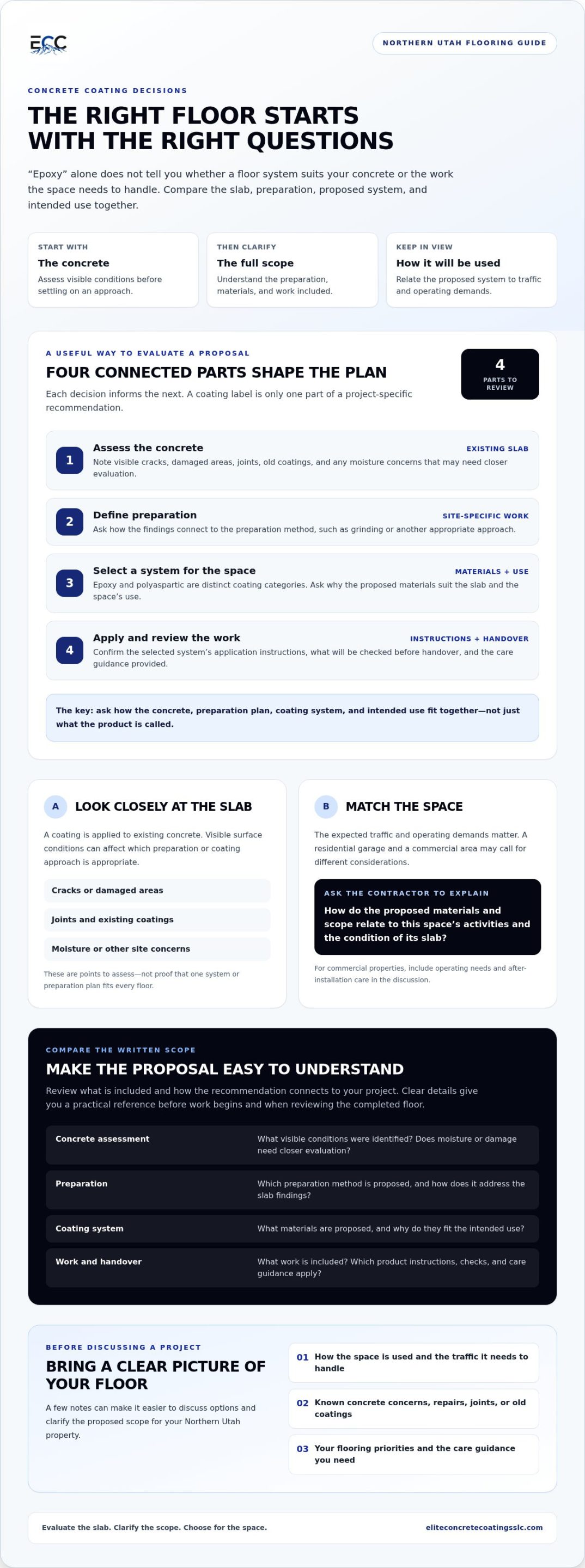
A well-planned floor project follows a clear sequence: assess the concrete, define the preparation, select a system for the space, apply it according to the product instructions, and review the finished work. Each step informs the next. If a recommendation is made before the contractor understands the slab and how the area is used, important questions may remain unanswered.
How should a contractor assess and prepare the concrete?
Start with an evaluation of the existing surface. The contractor should identify visible damage, existing coatings, joints, and other conditions that could affect the proposed scope. Moisture concerns may also warrant site-specific assessment. These findings help determine whether grinding or another preparation method is appropriate. There isn’t one process that suits every slab.
Ask how the assessment connects to the work being proposed. The industry resource Concrete surface preparation discusses the relationship between preparing a surface and selecting a coating. Before work begins, document known repairs, joints, and areas of concern, then confirm in writing how the scope addresses them. That record gives you a practical reference when reviewing the completed floor.
How does system selection relate to the space?
The coating should be considered in relation to the floor’s expected traffic and operating demands. A residential garage and a commercial area may call for different considerations. Epoxy and polyaspartic are distinct coating categories, but the name alone doesn’t establish whether a particular system fits a project. Ask the contractor to explain why the proposed materials and scope match your site’s use.
For a commercial property, professional resinous flooring options can be part of the discussion. Ask how the proposed system relates to the activities in the space, relevant slab conditions, and the care guidance you’ll need after installation. You can also find out more about how professional resinous and epoxy systems are selected and installed to handle demanding environments.
Application conditions and product instructions can also affect the work plan, including when the floor can return to use. Rather than relying on a general timeline, ask which instructions apply to the selected system and what the contractor will verify before handover. A useful project review confirms that the agreed scope was completed and clarifies any care or access guidance.
Compare the assessment, preparation plan, system rationale, and completion guidance as one connected process. Those details help you judge a proposal by how it responds to your concrete and needs, not by broad performance promises.
How to Compare Professional Epoxy Flooring Claims With Your Project Needs
Broad claims are easier to evaluate when they connect to your floor. Compare what the contractor assessed, what the written proposal includes, and which statements need further explanation. A clear recommendation should relate to the concrete, the planned coating work, and how you’ll use the space, rather than relying on general benefits alone.
Which questions reveal whether a proposed system fits?
Ask what concrete conditions informed the recommendation, which system is proposed, and what the written scope includes. Then clarify what care and use guidance applies after installation. These questions help you understand the reasoning behind the proposal and whether its details match your property’s needs.
| Project need | Question to ask | Evidence to request |
|---|---|---|
| Concrete condition | What slab conditions did you assess, and how did they shape the plan? | Written notes on observed damage, joints, repairs, or other concerns, along with how the scope addresses them. |
| Preparation and coating work | What preparation and coating work are included? | A written scope describing planned work and identifying exclusions or assumptions. |
| Intended use | Why is this system being recommended for my space? | An explanation connecting the proposed system to the area’s use and operating demands. |
| After installation | What maintenance and return-to-use guidance applies? | Care instructions and relevant project-specific product guidance. |
What should a clear project scope explain?
A useful scope describes the proposed preparation and coating work, along with assumptions about the existing slab. It should identify exclusions and unresolved concerns so you know what is and isn’t included. If damage or another condition needs further evaluation, ask how that uncertainty affects the proposal before agreeing to the work.
Separate documented project details from claims that need support. Visible damage, for example, can be noted during an assessment. Statements about finished-floor performance should be explained in relation to the proposed system and your space. Ask what information supports the claim and where it appears in the written scope or product guidance.
Compare proposals line by line, not just by their headline benefits. Details about preparation, coating work, intended use, exclusions, and care guidance give you a practical basis for evaluating each proposal and resolving questions before the project begins.
Choose a Professional Epoxy Floor for Your Northern Utah Space
A floor that suits a garage may not fit a warehouse or industrial work area. Start with the space’s daily demands, then use what you learn about the concrete and proposed system to compare contractor scopes. Property owners in Salt Lake City, Ogden, Layton, Provo, Lehi, West Jordan, South Jordan, Spanish Fork, and Syracuse can use the same approach: focus on how the recommendation fits the actual site, not on broad claims.
Use this sequence to prepare for an assessment:
- Define the use. Note the activities, traffic, and practical priorities the floor must accommodate.
- Document slab concerns. Record visible cracks, worn areas, joints, existing coatings, or other conditions you want reviewed.
- Request an assessment. Ask how the concrete’s condition will inform the proposed work.
- Compare written scopes. Review the preparation, coating work, assumptions, exclusions, and care guidance each proposal describes.
What should homeowners clarify before selecting a garage floor?
Describe how you use the garage, whether it mainly serves for parking, storage, or other household activities, and what matters most in everyday care. Share any slab concerns and ask how they’ll be evaluated. A site assessment can help determine whether the proposed epoxy garage flooring approach suits the existing concrete. Don’t assume every garage slab calls for the same system. For residential project context, review epoxy garage floor coatings. If you’re in Utah County, this guide to garage floor epoxy in Provo covers what to know before you hire.
What changes for a commercial or industrial floor?
For a facility, describe the traffic and operating demands the floor must accommodate. Consider how the area is used, what activities take place there, and any safety priorities that should inform the assessment. A warehouse may have different requirements from another commercial space, so the proposed coating scope should reflect the facility’s actual use. Ask the contractor to explain how the recommendation addresses those conditions and what assumptions or exclusions apply.
Residential and commercial projects share the need to evaluate the slab, but they shouldn’t be treated as interchangeable. A useful recommendation connects the condition of your concrete, the space’s purpose, and the work described in the written scope.
Ready to explore a residential garage option? Review garage floor coating details, then bring your priorities and known concrete concerns to a project discussion.
Plan Your Professional Epoxy Flooring Project With Clear Next Steps
A clear project discussion starts with useful information about the space, the concrete, and what you want the finished floor to support. Preparing those details helps a contractor assess the site and explain how the proposed work fits your priorities. Use this checklist to get ready:
- Identify the space. Note whether it’s a residential garage or a commercial or industrial area.
- Describe how the floor is used. Share the activities, traffic, and day-to-day needs the coating should accommodate.
- Record concrete concerns. Point out visible damage, joints, existing coatings, or areas you’d like assessed.
- List your priorities and questions. Ask about preparation, proposed materials, included work, care guidance, and project assumptions.
What information should you prepare for a project discussion?
Bring observations, not guesses about what the slab needs. Photos or notes can help you describe visible concerns, but some details may require an on-site assessment or further verification. Ask the contractor which conditions can be evaluated during the visit and what information is still needed to shape a recommendation. This keeps the conversation focused on your property rather than a one-size-fits-all plan.
How can you judge whether the recommendation is clear?
Check that the proposed approach connects the assessed concrete to the space’s intended use. If unfamiliar materials or technical terms come up, ask for a plain-language explanation. Before proceeding, confirm that the scope, assumptions, exclusions, and next steps are documented. A clear proposal should help you understand what work is planned and what remains uncertain, without treating an unverified performance statement as a guaranteed outcome.
Elite Concrete Coatings is a family-owned Utah provider offering concrete coating services for residential, commercial, and industrial spaces. Its services include epoxy garage flooring and commercial coating options such as warehouse coatings. Sharing your property use, known slab concerns, and project priorities can help frame a site-specific discussion.
Ready to take the next step? Discuss your concrete coating project with Elite Concrete Coatings.
Make Your Next Flooring Decision With Confidence
A coating’s name alone can’t tell you whether it’s right for your property. The question behind “professional epoxy flooring vs DIY kits” is better answered by comparing the existing slab, the proposed preparation and coating scope, and how the space will be used. A clear written plan helps you understand what’s included, what needs further assessment, and what care guidance applies after installation.
Elite Concrete Coatings is a family-owned Utah company serving residential, commercial, and industrial spaces in Salt Lake City, Ogden, Provo, Lehi, West Jordan, South Jordan, Spanish Fork, Layton, Syracuse, and surrounding communities. Its offerings include epoxy garage flooring and warehouse coatings, with recommendations shaped by the project and the concrete on site.
Bring your priorities and known slab concerns to a project discussion. Discuss your concrete coating project with Elite Concrete Coatings and take a practical next step toward a floor that fits your space. With clear questions and a site-specific evaluation, you can compare options with greater confidence.
Frequently Asked Questions
Is professional epoxy flooring suitable for every concrete floor?
No. A coating shouldn’t be recommended without considering the concrete and how the space is used. Existing damage, moisture concerns, traffic, and operating conditions can all affect the project plan. Ask the contractor to assess the slab, explain why the proposed system may suit the space, and document any limitations. A broad product description alone can’t establish whether a coating is appropriate for your floor.
How does a contractor decide which epoxy flooring system to use?
A contractor should consider the concrete’s condition, the space’s use, and your project requirements before recommending a system. Ask what the assessment revealed and how those observations shaped the recommendation. Review which materials and work are included in the written scope. Product details and application requirements vary, so ask the contractor to explain the relevant specifications for the proposed system rather than assuming all epoxy installations follow the same process.
Can professional epoxy flooring be installed over damaged concrete?
It depends on the type and extent of damage and the project scope. The contractor should inspect the slab and explain whether repairs or additional preparation need to be considered before coating. Ask how observed conditions affect the recommendation and which items are outside the proposed scope. Don’t assume a coating will correct structural or underlying concrete problems. A site-specific assessment helps clarify what needs attention before a system is selected.
How long does professional epoxy flooring take to install?
Project duration varies with the site, preparation needs, selected materials, and product instructions. The work schedule and the time before the floor can return to use may differ from one project to another. Ask the contractor for a schedule specific to your property, including preparation and return-to-use guidance. Confirm that timing against the selected system’s instructions, and treat general estimates as guidance rather than a promise for every floor.
What should a professional epoxy flooring quote include?
A written proposal should describe the work area, concrete assessment, planned preparation, proposed coating system, and project assumptions. Ask how identified damage, joints, or other slab conditions will be handled, and what the proposal excludes. Clear documentation makes it easier to compare the work being offered rather than broad claims. Review unresolved conditions with the contractor so you understand what may need further assessment before work proceeds.
Is epoxy flooring appropriate for a commercial or warehouse floor?
It may be suitable, depending on the facility’s use and concrete conditions. Traffic, operating demands, and relevant safety needs should inform the assessment and written scope. Ask how the proposed approach addresses your facility’s requirements. Elite Concrete Coatings offers commercial and industrial coating services, including warehouse coatings, for properties in Salt Lake City, Ogden, Provo, Lehi, West Jordan, South Jordan, Spanish Fork, Layton, and Syracuse.