
Parking garages are one of the hardest environments to keep up. It’s open 24/7 and has to deal with everything from heavy vehicles, oil spills and road salts, and the tread of tires on concrete. If you get the wrong flooring, you’re looking at continuous repairs and even danger.
Commercial facility managers and owners or those that have new construction know that concrete doesn’t always last. Unprotected concrete slabs spall, crack and stain. The flooring system you pick becomes the armor of the facility and can greatly add to the longevity while minimizing maintenance costs.
Let’s look at five of the most durable parking garage flooring systems and see how they measure up in terms of cost, longevity, and performance.
Parking Garage Flooring Guide
Parking garage flooring needs to be incredibly durable to face all the punishment it endures. For the purposes of this article, when we say “durable” we don’t just mean resistance to indentation. For example, something that’s hard but brittle isn’t going to last very long.
In the parking garage environment, a floor also needs to be able to stand up to a perfect storm of three types of hazards at the same time.
- Mechanical Load: Heavy vehicles rolling over the floor, brake on the pavement and maneuvering constantly take a toll on the floor. Abrasion and vibration can lead to micro-cracks.
- Chemical Attack: Vehicles leak oil, transmission fluid, coolant and a host of other chemicals that will eat away at concrete over time. In northern climates, snow melt and ice cause people to track in de-icing salts that are highly corrosive.
- Thermal Shock: Temperatures can fluctuate extremely quickly in garages, especially open-air ones. Your flooring needs to be able to expand and contract without delaminating.
The flooring system you choose helps prevent water intrusion which is the primary cause of failure of multi-level parking decks.
1. Epoxy Mortar Systems
Epoxy mortar is the heavy-duty workhorse of garage floors. It is 100% solids epoxy mixed with graded sand or quartz aggregate and troweled on to form a thick, seamless layer.
The Breakdown
This is not a paint product; it’s a structural resurfacer. Regular epoxy coatings are thin films. Epoxy mortar forms a thick layer (3/16 to 1/4 inch is typical) that actually fills in and repairs damaged concrete while protecting it.
Pros
- Extreme Impact Resistance: Trucks and heavy equipment run over it all day. Dropped tools won’t chip it.
- Structural Repair: Due to its thickness, it can fill existing cracks and pitted areas as it is installed.
- Chemical Resistance: Offers a 100% impermeable barrier from oils, fuels, and salts.
Cons
Cons
- Cost: One of the more expensive options due to material volume and labor intensive installation.
- Flexibility: Epoxy is not flexible. If the concrete expands or contracts due to heat and humidity, epoxy will crack instead of stretching.
Ideal Use Case: High-traffic ramps, turning circles, and where the existing concrete is already pitted or damaged.
2. Polyurethane Traffic Coatings
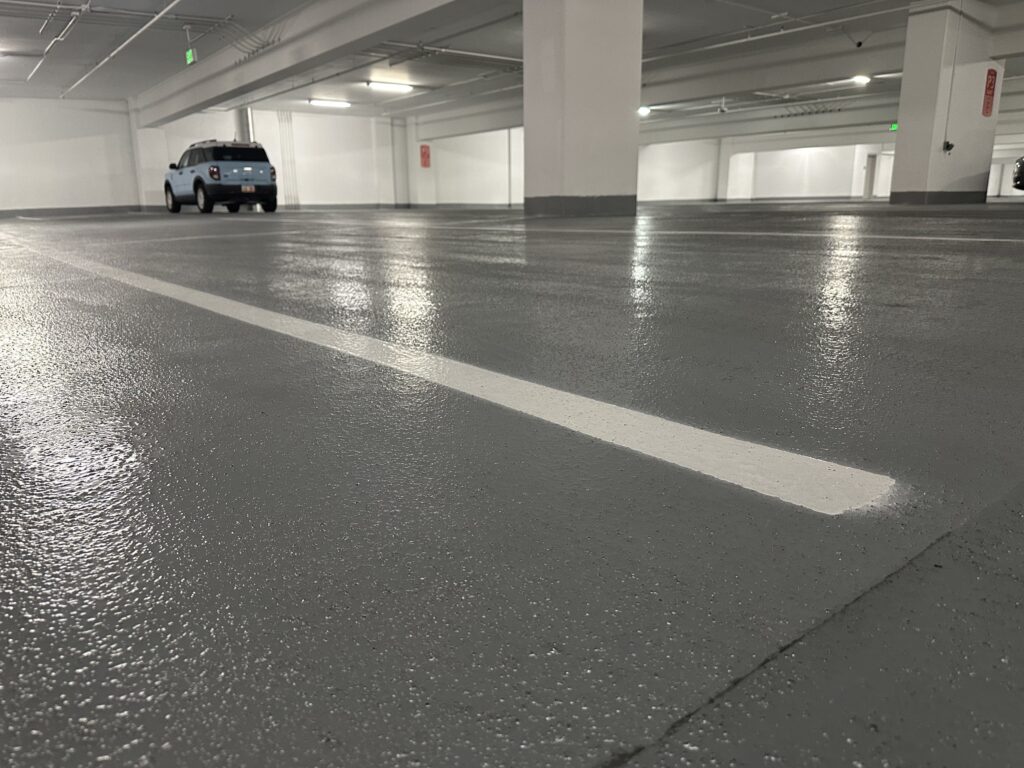
Commercial parking garage floor coatings, Utah
Industry standard for multi-level decks are often polyurethane traffic coatings. Polyurethane is the opposite of epoxy, it’s elastomeric, or stretchy.
The Breakdown
This is usually a primer, a base coat, and one or more wear coats with aggregate broadcast into them for slip resistance. Flexibility is the key ingredient in these systems.
Pros
- Crack Bridging: It can span small cracks in the concrete that open and close with temperature changes, waterproofing the steel rebar below.
- UV Stability: Aliphatic polyurethane topcoats do not yellow and chalk in the sun, so these are ideal for top decks.
- Waterproofing: This is the first line of defense against water from reaching lower levels.
Cons
- Sensitivity to Moisture During Install: If substrate is not 100% dry during application, coating will blister and fail.
- Wear Life: Although durable, topcoat will wear over time in high traffic lanes and will require recoating every 5-10 years.
Best Use Case: Upper Decks exposed to weather, Mid Decks needing Waterproofing and structures that are in climates with large temperature fluctuations.
3. Methyl Methacrylate (MMA)
Time is money, right? If so, MMA is your new best friend. This acrylic-based resin is known for extremely rapid cure times.
The Breakdown
MMA systems are chemically cured, as opposed to air drying. You can install a multi-layer system in one day and be ready for traffic in as little as one hour after the final coat is applied.
Pros
- Fast: Apply a patch, and by morning it is ready to open to traffic
- Cold weather application: Cures down to -20°F (-30°C). Epoxy or polyurethane systems cannot
- Bond: Layers of MMA chemically bond to other layers. Need to patch a patch? Cut it out and new MMA melts into old, creating a solid bond.
Cons
- Smell: Installation has a strong, unpleasant odor. Odorless MMA is available, but more expensive. Non-hazardous with good ventilation, but a nuisance if buildings are occupied
- Cost: Material costs are typically higher than a standard epoxy.
Best Application: 24/7 parking facilities such as hospital or airport decks, where downtime is not an option or when building during the winter. 24/7 parking facilities such as hospital or airport decks, where downtime is not an option or when building during the winter.
4. Polished Concrete with Densifier
Sometimes the best floor is the one you already have…just made better. Polished concrete is ground smooth and then treated with a chemical densifier.
Details
Mechanical grinding abrasively removes the weak top layer of cement paste. Liquid densifier (usually lithium or sodium silicate) is then applied, penetrating the pores and reacting with free lime in the concrete, resulting in a harder and denser surface.
Pros
- Low Maintenance: No coating to peel or flake. Cleaned mostly with water and a neutral cleaner.
- Cost-Effective: Cheaper than high performance resinous coatings.
- Brightens Garage: Reflects overhead lighting and can help reduce energy costs.
Cons
- Susceptible to Stains: Even with sealer, it is more porous than resinous coatings. Oil will soak in if not cleaned up quickly.
- No Waterproofing: It does not seal cracks or prevent water from migrating through the slab to levels below.
Best Applied Where: On-grade parking levels (ground floor) where there is no deck below to waterproof and budget is a key driver.
5. Polyaspartic
Polyaspartic is sort of a cousin to polyurethane, but with some differences (mainly faster application and much higher durability). You could view it as a sort of hybrid of several different technologies, taking the best features of each.
The Breakdown
First created as a corrosion-resistant coating for steel bridges, polyaspartic coatings are quickly becoming a popular choice for concrete. They are thin-film coatings that cure in hours, and have amazing UV stability.
Pros
- UV Stability: Polyaspartics never yellow or fade, making them ideal for any exterior or interior spaces that get a lot of sun exposure.
- Abrasion Resistance: In laboratory abrasion tests, polyaspartic coatings have been shown to be up to many times more abrasion-resistant than standard epoxies.
- Quick Cure: They have a quick cure time, similar to MMA (typically, full service can be achieved in 24 hours), but without the extremely harsh odor associated with MMA.
Cons
- Quick Pot Life: The material has a very fast pot life, making it extremely difficult for novice installers to apply without roller marks. Hiring professional installers is a must.
- Cost: It is priced at a premium over standard epoxy.
Best Applications: Exterior entryways, top decks, any high-traffic area or interior/exterior area that will get a lot of sun exposure and requires a high-gloss, decorative finish that won’t fade over time.
Determining the Right System for Your Garage Floor
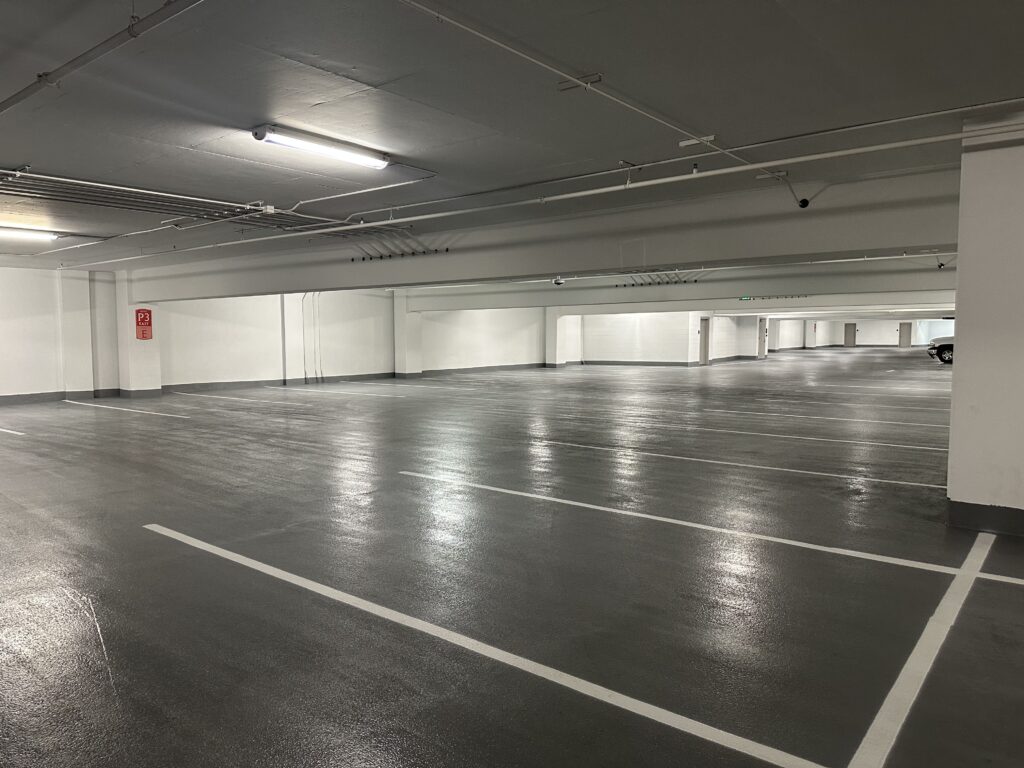
Parking deck flooring installation Utah
Ideally, we’d all like to believe there is a “best” floor for every garage. The truth is, the ideal flooring system for a given zone of your garage is a function of the zone’s unique requirements and your operational constraints.
Assess Your Climate
If you are located in a freeze-thaw zone (Northeast and Midwest USA, Canada, etc.) waterproofing is an absolute must. Saltwater will quickly disintegrate your rebar if it seeps through the concrete. You will also need a flexible Polyurethane or MMA system to “bridge” any cracks that may develop. If your garage is located in a dry, warm climate, you can probably get away with just Polished Concrete or standard Epoxy on your on-grade levels.
Consider the Level
- Slab on Grade (Ground Floor): Moisture wicking up from the ground is the number one cause of delamination on this level. Polished concrete or breathable epoxy systems are your best option.
- Intermediate Decks: The level above will have to protect your system from vehicle traffic, but you also must protect the cars below from any drips or fluids. Flexible waterproofing membranes are crucial at this level.
- Top Deck: This level is subject to the direct effects of the sun and rain. UV stability is of the utmost importance. Aliphatic Polyurethanes or Polyaspartics are your best option here.
Upfront Costs v. Lifecycle
Upfront Costs vs. Lifecycle
Polished concrete has the lowest upfront material cost, but gives the least amount of chemical resistance. Epoxy Mortar has the highest initial cost, but it also forms the closest to indestructible surface possible. The best way to look at this from a monetary perspective is to calculate your downtime costs—if shutting your garage causes you to lose thousands of dollars a day in revenue, then the faster MMA or Polyaspartic coatings go a long way to paying for themselves.
Final Thoughts
Investing in the right parking garage floor coatings is an investment in the overall structural integrity of the building. Don’t let sticker shock stop you from exploring the right solution for your building. A cheap coating that lasts two years will almost always end up tripling in cost to have it removed and replaced. Look at your specific traffic loads and environmental exposure and choose the right system for the longevity your facility needs.
For a solution that’s custom-engineered for your facility and installed for maximum performance and longevity, always work with experienced, professional flooring contractors who can assess your needs and recommend the right system for your project. We can help you find the best flooring for parking decks, from material and color choices to texture and slip-resistance options. For a free estimate and consultation, contact Elite Concrete Coatings today for your next parking deck and garage coatings project. You can reach us at (801) 946-0929 or fill out our online estimate form.
Elite Concrete Coatings
7879 S 1530 W, West Jordan, UT 84088
(801) 946-0929
https://eliteconcretecoatingsslc.com/
Check out our reviews!